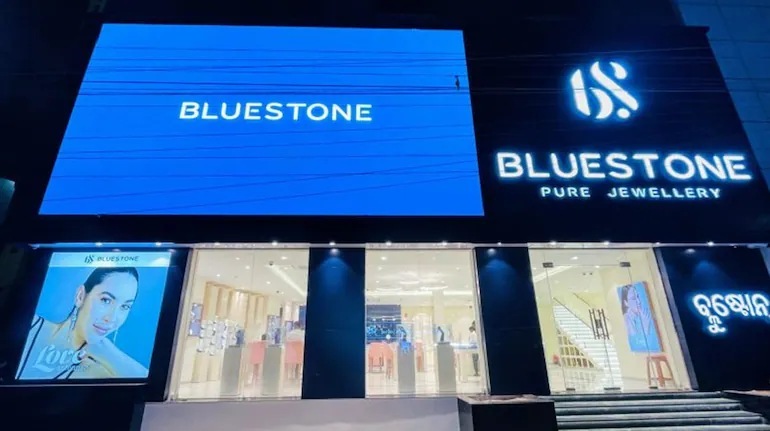
01 — At a Glance
The Startup That Decided Profitability Was Cool
- 52-Week High / Low₹793 / ₹400
- Q3 FY26 Revenue₹748 Cr
- Q3 FY26 PAT₹71.5 Cr
- Q3 FY26 EPS₹4.72
- Annualised EPS (Q3×4)₹18.88
- Book Value₹111
- Price to Book4.70x
- Dividend Yield0.00%
- Debt / Equity1.12x
- Pre-IndAS EBITDA Margin12.1%
IPO Baby Hits Paydirt: Listed August 19, 2025. Six months later, posts first-ever quarterly profit of ₹71.5 crore on ₹748 crore revenue. Raised ₹1,541 crore through IPO, spent it on stores (323 by end of Q3), manufacturing footprint, and working capital. Gold prices went mad. Cheaper bangles outpaced premium studded jewelry. Bluestone still grew 27.4% YoY. The stock, meanwhile, is down -18.3% in 6 months. Markets are a joke. But the business? That’s the punchline nobody laughed at yet.
02 — Introduction
The IPO That Hatched an Actual Business Model
Bluestone Jewellery is India’s second-largest digital-first omni-channel jewellery retailer. Translation: they started online, built stores, then realized they should have started with both. They sell diamonds, gold, platinum, and studded jewelry. Not weddings exclusively—the company specifically avoids the wedding jewelry vortex because margins there get destroyed faster than a diamond under pressure.
What makes them interesting is the vertically integrated model. They design 7,400+ designs internally. They manufacture 75%+ of their stuff in-house across facilities in Mumbai, Jaipur, and Surat. They operate 323 stores across 26 states and UTs. They’ve built a distribution network that reaches 12,600 PIN codes. And after five years of losses, they finally posted a profit in Q3 FY26.
The IPO happened August 2025. Raised ₹1,541 crore. Pumped it into inventory, stores, manufacturing capacity, and working capital. Q1 and Q2 were loss-making—the usual startup math. Q3? First profit. Concall management called it “an important milestone” and “a clear inflection point in the evolution of our business model.” Translation: we finally stopped losing money on every sale.
The stock has given -18.3% returns in 6 months. But the quarterly profit has arrived. Now the question is whether this is a one-time trick or the start of something real. The concall transcript suggests it’s not a trick—it’s leverage. Operating leverage. The kind that gets visible when you’ve invested enough in fixed costs and then suddenly revenue scales.
Concall Insight (Jan 2026): “Not about cost excellence… it is about absolute operating leverage.” — CFO. They have stores. They have manufacturing. They have people. Now that revenue is accelerating, that fixed cost base is finally pulling its weight. Welcome to the profitability club, kids.
03 — Business Model: WTF Do They Even Do?
Design-Led Jewelry for People Who Actually Know What They Want
The business is startlingly straightforward. Bluestone designs jewelry. Makes it in-house. Sells it online and in stores. Customers can discover products online, buy online, buy in-store after discovering online, or do whatever hybrid nonsense Gen-Z wants. The average ticket size is ₹25,000–₹50,000 per transaction—premium, but not wedding-exclusive. Daily wear. Occasion wear. Lightweight studs. Fashion-forward stuff that doesn’t scream “I borrowed this for the wedding.”
The market they target: urban, digitally native consumers aged 25–45. Women, men, couples. People who care about design, transparency, and not getting ripped off by a jeweler who claims “this stone cost more because the moon was aligned properly.” The company serves 903,000 customers, up 25% YoY. The repeat revenue ratio stands at 57.8% of Q3 revenue. Translation: one out of every two rupees comes from people who’ve already bought from them.
Manufacturing vertically in-house is the moat. 75%+ in-house production means better margins than jewelers who outsource. It also means faster design-to-retail cycles and quality control that doesn’t depend on third-party luck. Stores are expanding aggressively—323 stores across 26 states, 12 net adds in just Q3. The company is targeting ~65–70 net store additions in FY26.
Stores323Across 26 States
Active Designs7,400+In-House Catalog
In-House Mfg75%+Vertical Integration
Repeat Customers57.8%Of Q3 Revenue
Ethereal Play: Bluestone owns 74% of Ethereal—an early-stage lab-grown diamonds (LGD) business. Founders own the rest and run it themselves. Management says it’s seeing “some good traction” but it’s “very, very early days.” Translation: Hail Mary pass at avoiding the traditional diamond cartel’s stranglehold. Could be brilliant. Could be a cautious money pit. Watch this space.
💬 Do you think lab-grown diamonds become mainstream in India, or do Indians insist on “real” diamonds for the next 20 years? Drop your nuclear take in the comments.
04 — Financials Overview
Q3 FY26: The Numbers Nobody Expected