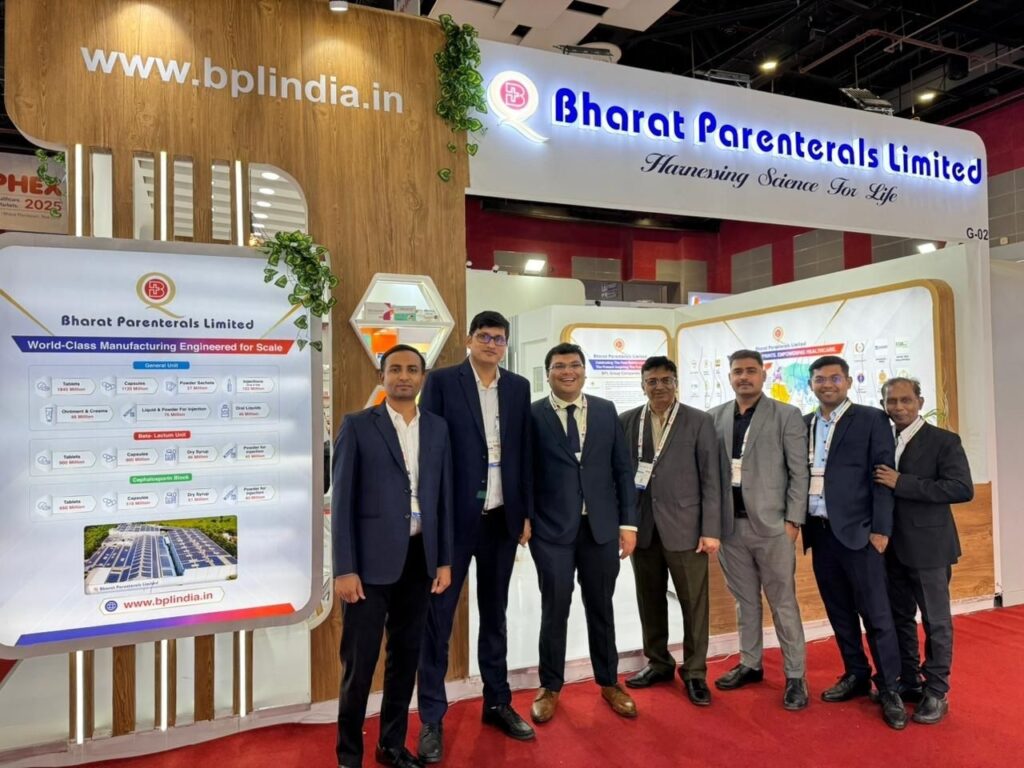
In a market full of pharma heavyweights flaunting billion-dollar valuations and clean balance sheets, Bharat Parenterals Ltd (BPL) is that chaotic middle child — losing money, doubling borrowings, yet somehow bagging U.S. FDA clearances and a $27 million order in the same year. The company’s stock currently trades at ₹1,061 (as of 11 Dec 2025), with a market cap of ₹731 crore — smallcap zone, but with ambitions that sound straight out of a large-cap fantasy novel.
In the last 3 months, the stock has tanked nearly -21.5%, and in one year it’s down a stinging -39%. Yet, management seems busy globe-trotting for certifications — Innoxel Lifesciences (its 51% arm) just cleared USFDA and EU GMP inspections with no major observations. Meanwhile, consolidated sales stand at ₹357 crore, but PAT is in red at ₹–5.40 crore, with a ROE of –4.71% and ROCE of –4.38%. Debt? Oh, that ballooned from ₹50 crore in FY23 to ₹158 crore in FY24. Because who doesn’t like a bit of financial adrenaline?
Still, the company is positioning itself as a global formulations player with 97% export revenue and ambitious specialty injectables through its subsidiaries — Innoxel and Varenyam Bio Lifesciences. So yes, Bharat Parenterals is basically that one relative who’s broke but keeps posting photos from Switzerland.
2. Introduction
Welcome to the world of Bharat Parenterals — a 1992-born Gujarati pharma firm that manufactures over 800 products across 20+ therapeutic categories. This isn’t your average generics company making paracetamol and calling it innovation; BPL deals in injectables, β-lactam antibiotics, cephalosporins, oral solids, ointments, and creams — basically everything that can be prescribed with a doctor’s bored handwriting.
The company’s claim to fame lies in its formulation expertise — making complex drugs, sustained-release injectables, and now, aiming for regulated markets like the U.S. and Western Europe. Its subsidiaries, Innoxel Lifesciences and Varenyam Bio Lifesciences, handle the high-end side of the business. Innoxel develops and manufactures specialty injectables for developed markets, while Varenyam targets emerging countries.
But life’s not been a Bollywood climax. FY25 saw consolidated losses of ₹43.7 crore, declining margins, and a debt pile that makes bankers nervous. Yet, the silver lining is shiny — the FDA cleared Innoxel’s facility, and the company secured a $27 million institutional order. In pharma, that’s like failing chemistry but getting into med school through a management quota.
So, is this the story of a potential turnaround or another “GMP-certified dream gone broke”? Let’s find out.
3. Business Model – WTF Do They Even Do?
Bharat Parenterals Ltd is a full-stack pharmaceutical formulations company based in Vadodara, Gujarat. It doesn’t make APIs (the raw chemical compounds) — it takes those APIs and converts them into finished drugs like tablets, capsules, syrups, creams, and most importantly, injectables.
Its three major manufacturing blocks cover General formulations, Beta-Lactam antibiotics, and Cephalosporin injectables, operating within a 4,300 sq. mt facility. With production capacity of 6 million vials per annum (expandable to 14 million), and oral liquid capacity of 3 million bottles (expandable to 6 million), the company runs a pretty muscular operation for its size.
The focus? Contract manufacturing and exports. BPL supplies to clients across Eastern Europe, APAC, Africa, and LATAM, while preparing to enter North America and Japan post regulatory approvals. It even counts reputed clients like Macleods, USV, Artemis, and Galaxy Pharma — proof that it’s not just hustling in isolation.
Its subsidiary Innoxel Lifesciences (51%) caters to complex injectables for developed markets, while Varenyam Bio Lifesciences (60%) does the same for emerging ones. And in FY25, BPL went all in — acquiring 100% of Varenyam Healthcare Pvt Ltd and Varenyam Biolifesciences Pvt Ltd via a ₹53.78 crore preferential issue.
So yeah, BPL isn’t just manufacturing drugs. It’s manufacturing drama, growth, and debt — all in WHO-GMP-certified proportions.
4. Financials Overview
Let’s open the numbers capsule — and unlike their formulations, these numbers aren’t coated for sweetness.
Quarterly Comparison (Consolidated Figures in ₹ crore):
Metric
Q2 FY26 (Sep 2025)
Q2 FY25 (Sep 2024)
Q1 FY26 (Jun 2025)
YoY %
QoQ %
Revenue
64.62
71.63
116.00
-9.8%
-44.3%
EBITDA
0.83
-7.66
13.78
+110.8%
-94.0%
PAT
-8.60
-17.51
-0.87
+50.8%
-888.5%
EPS (₹)
-10.50
-11.50
11.94
+8.7%
NA
Commentary: Revenue slipped both YoY and QoQ, showing export weakness or delayed orders. EBITDA barely survived, moving from negative to a feeble ₹0.83 crore, suggesting cost discipline is still aspirational. PAT continues in the red, but losses halved YoY — a “less bad” situation that only accountants celebrate. EPS of –₹10.5 screams capital erosion, not shareholder value.
In short — the company’s operating microscope is working fine, but the balance sheet is bleeding.
5. Valuation Discussion – Fair Value Range
Let’s approach valuation like a cautious chemist handling volatile acids.
a) P/E Method: EPS (TTM) = –₹7.84 → Negative → P/E not meaningful.
But for educational analysis, if we assume normalised EPS of ₹10 (considering past profitable years and turnaround hope), and apply industry average P/E of 31x, we get: Fair Value = ₹10 × 31 = ₹310.
With a premium for USFDA + EU GMP credentials, say 25%, the upper bound = ₹388.
Fair Value Range (P/E-based) → ₹310 – ₹390
b) EV/EBITDA Method: EV = ₹847 crore, EBITDA (TTM) = ₹30 crore approx. EV/EBITDA = 28.3x — expensive vs industry average 15–18x.
If we re-rate it down to 18x: Theoretical EV = 18 × 30 = ₹540 crore → Equity value ≈ ₹424 crore → Fair price ≈ ₹615/share.
Fair Value Range (EV/EBITDA-based) → ₹600 – ₹650
c) DCF (simplified) Assuming FY26 free cash flow of ₹20 crore, growth 10%, discount 12%, terminal growth 3%. Intrinsic Value ≈ ₹500 crore equity → ₹725/share.
Educational Fair Value Range: ₹600 – ₹725
Disclaimer: This fair value range is for educational purposes only and not investment advice.
6. What’s Cooking – News, Triggers, Drama
Bharat Parenterals has had more press releases than profits this year. Let’s recap:
Nov 2025: Innoxel Lifesciences completed EU GMP inspection (Belgium’s FAMHP) with zero critical observations — a rare, brag-worthy feat.