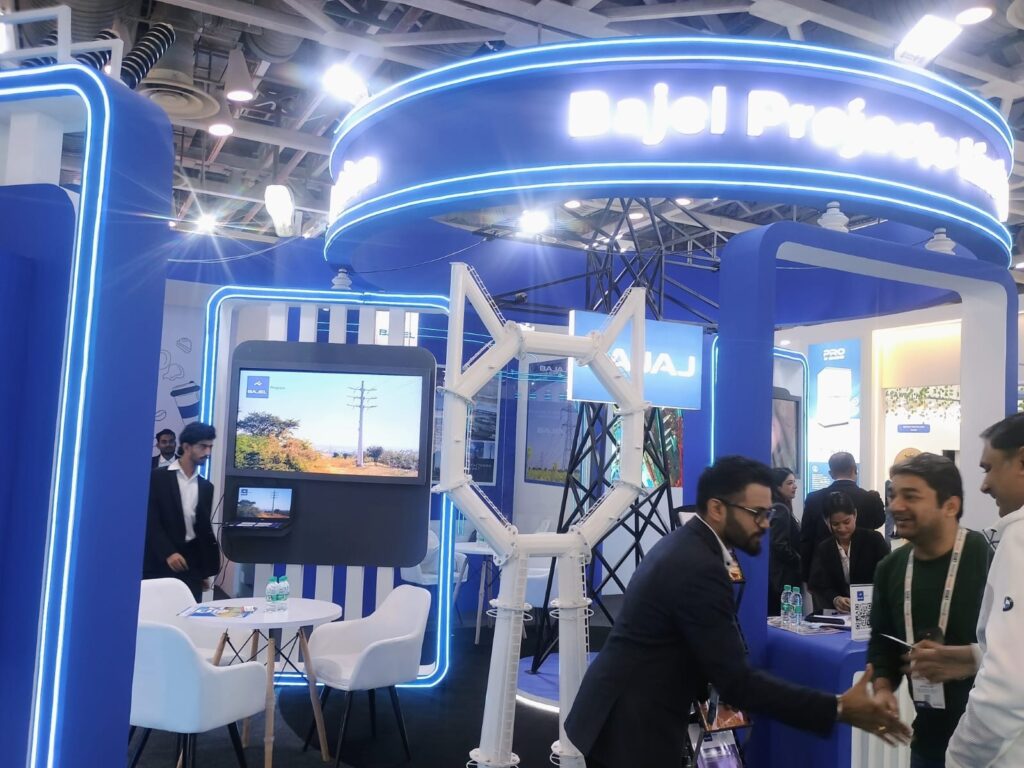
1. At a Glance – High Voltage, Low Margins, Even Lower Patience
Bajel Projects Ltd is what happens when a respected legacy EPC business is spun off, listed, hyped, and then immediately told by the stock market: “Beta, ab kaam dikhao.”
At a market cap of ₹1,909 Cr and a current price of ₹165, Bajel trades at a P/E of ~120, while delivering a TTM PAT of just ₹15.9 Cr. Yes, you read that right — triple-digit valuation for single-digit margins. Bold strategy.
The company clocked Q3 FY26 revenue of ₹562 Cr, down 9.65% QoQ, but reported a dramatic 209% QoQ jump in PAT — largely because the base quarter was miserable. Operating margins finally woke up to 4.4%, the highest in its listed life so far.
Return ratios remain sleepy:
- ROCE: 12.1%
- ROE: 2.5%
- Net margin: sub-1%
Meanwhile, the order book stands tall at ₹2,792 Cr, with 85% in power transmission, and Bajel keeps announcing new orders like it’s Diwali every quarter.
So the big question before we go deeper:
Is this a margin turnaround story… or just a very expensive order book showroom?
2. Introduction – From Bajaj Electricals’ Shadow to Market Spotlight
Bajel Projects Ltd was incorporated in 2022, carved out from Bajaj Electricals Ltd, and listed with the promise of becoming a focused, pure-play Power Transmission & Distribution EPC company.
On paper, this makes complete sense. EPC businesses need:
- Operational focus
- Balance sheet discipline
- Aggressive bidding without dragging parent company margins
So Bajel was given independence, its own balance sheet, its own management, and unfortunately… its own stock market judgment.
The company operates in a sector that investors love to romanticize:
- Power evacuation
- Renewable integration
- Grid strengthening
- Ultra-high voltage lines
But EPC is not a SaaS business. It doesn’t scale with PowerPoint decks. It scales with steel prices, labour discipline, execution timelines,
and brutal working capital cycles.
Bajel’s journey since listing has been a crash course in that reality:
- Revenues doubled YoY
- Margins crawled up slowly
- Debt spiked
- ROE stayed embarrassingly low
- Stock price corrected ~38% from highs
So while the Bajaj Group surname opens doors, the balance sheet still has to do the talking.
3. Business Model – WTF Do They Even Do?
Think of Bajel as the guy who builds the high-voltage highways electricity travels on.
What Bajel Actually Executes
Power Transmission (85% of order book):
- 132 kV to 765 kV transmission lines
- Single, double & multi-circuit configurations
- 7,900+ circuit km executed historically
- 40+ EHV AIS/GIS substations
Power Distribution (14%):
- 11 kV & 33 kV lines
- Underground cabling
- Ring Main Units
- Compact substations
- 26 lakh+ consumer connections
- 50,000+ villages electrified
International EPC (1%):
- Projects in Kenya, Togo, Zambia
- Monopole exports to 7+ countries
Manufacturing (In-house):
- Lattice towers
- Monopoles
- High masts
- Lighting poles
Installed Capacity (Pune Plant)
- Towers: 30,000 MTPA
- Steel tubular poles: 15,000 MTPA
- Lighting poles & masts: 15,000 MTPA
- Galvanized products: 5,000 MTPA
In short: Bajel is vertically integrated, execution-heavy, capex-hungry, and margin-constrained.
Now tell me — does this sound like a business that should trade at 120x earnings?
4. Financials Overview – The Numbers That Matter
EPS Annualisation
