01 — At a Glance
The Appliance Maker That Chose Self-Destruction for Redemption
- 52-Week High / Low₹711 / ₹337
- Q3 FY26 Revenue₹1,051 Cr
- Q3 FY26 PAT-₹21.4 Cr
- 9M FY26 Revenue₹3,223 Cr
- 9M FY26 PAT-₹10.8 Cr
- Book Value₹148
- Price to Book2.34x
- ROCE11.6%
- ROE (3-Year Avg)8.93%
- Debt / Equity0.13x
The Setup: Bajaj Electricals posted a ₹21.4 crore loss in Q3 FY26, turned its CFO into a memory, and decided the best time to acquire Morphy Richards was while running inventory liquidation sales. The stock is down 40% in one year. P/E is 107x (yes, 107). And the concall transcript reads like a B-grade Bollywood thriller where the hero admits the problem, executes the solution, burns the profits in the process, and hopes you’ll applaud the comeback arc. Spoiler: you might.
02 — Introduction
The Appliance Graveyard of Hope & Inventory Nightmares
Bajaj Electricals is a 88-year-old company part of the Bajaj Group. It makes fans that spin, coolers that cool, mixer grinders that grind, and water heaters that heat. Tremendously innovative stuff. You’d think a company this old, this embedded in Indian households, would just cruise along, print dividends, and retire. Wrong.
In FY24, they made ₹131 crore profit on ₹4,639 crore revenue. Healthy margins, steady cash. Then someone in management said: “You know what? Let’s inventory overbuild in the Consumer Products segment.” Two summers flopped. Channel partners got stuck with fans that wouldn’t sell. Summer product volumes — normally 20–25% of annual business — collapsed to roughly half. Coolers tanked 38–40% YoY. And because they can’t just write down the inventory and move on, they spent Q3 running promotions, slashing margins, and deliberately shipping less to “normalize channel health.” Translation: they intentionally tanked Q3 profits to save Q4 and beyond.
Meanwhile, the Lighting Solutions division is humming along at 9% growth with 7% EBIT margins. New categories (switchgear, solar, wires) are in pilot/launch mode. And they just closed a ₹141 crore acquisition of Morphy Richards IP for India. The CFO resigned. An interim CFO was appointed. The stock is priced like it’s a penny stock discovery, not a Bajaj Group subsidiary with ₹509 crore in cash.
This is a company executing a deliberate, transparent, and completely self-inflicted turnaround. For some investors, that’s a red flag. For others, it’s vindication that management isn’t hiding the mess.
Concall Insight (Feb 2026): “Please concentrate on secondary rather than primary. Top line is only a transfer from our stock to our distributor stock, which we don’t want.” — Chairman, Bajaj Electricals. Translation: We’re shipping less ON PURPOSE.
03 — Business Model: So What Exactly Do They Sell?
Two Totally Different Businesses Pretending to be One
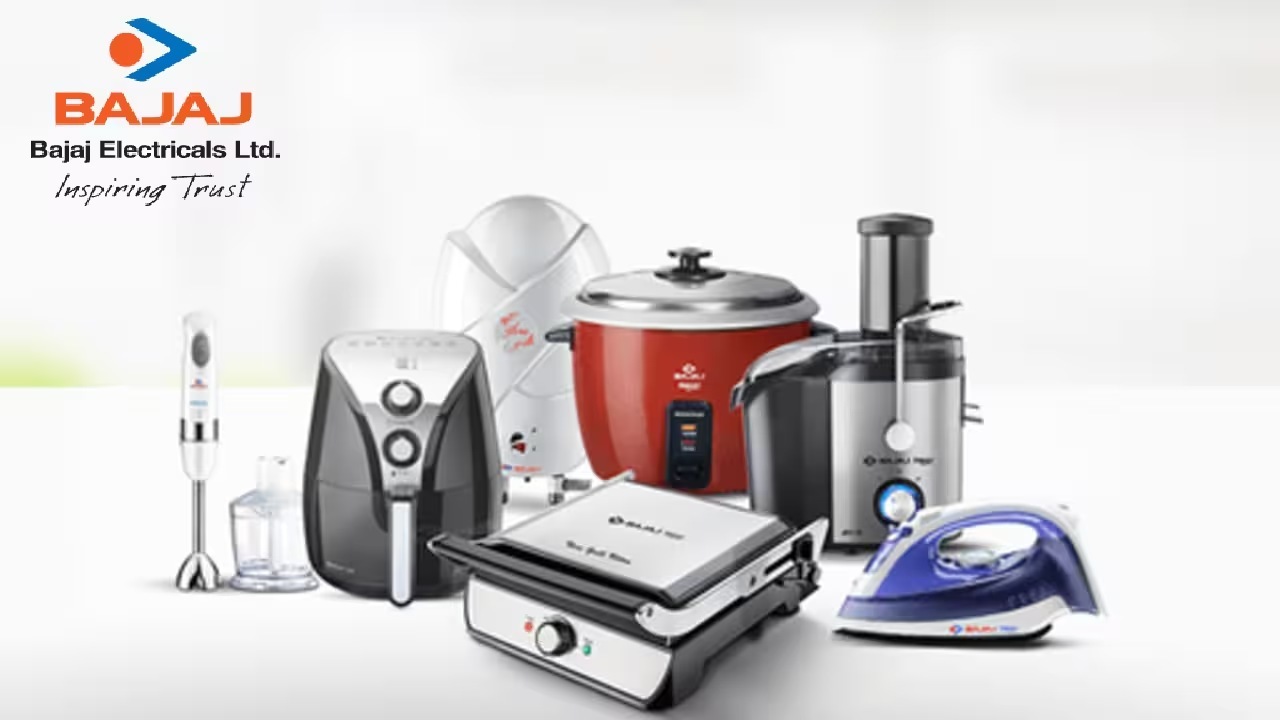
Consumer Products (CP): Fans, coolers, water heaters, mixer grinders, irons, pressure cookers under brands like Bajaj, Morphy Richards (newly acquired), Nirlep (cookware), and Nex (premium fans). ~80% of revenue. Sold through 700+ distributors reaching ~200,000 retail outlets. Intense competition from unbranded, imports, and other branded players. Thin margins. Commoditized. The segment that makes you want to scream into a pillow.
Lighting Solutions (LS): LED bulbs, tube lights, street lighting, professional/industrial lighting. ~20% of revenue. Growing faster. Better margins. Strategic expansion into adjacent categories: switchgear (entered Q2), solar (announced Q3), and wires (launched Feb’26). The segment everyone’s actually rooting for because it’s growing and profitable.
The company has capacity to produce 4.8M fan units annually at Chakan but is running at ~55% utilization. Nashik (water heaters, LEDs) at 53%. Aurangabad (pressure cookers, Nirlep) at 25%. Translation: there’s room to grow, but the supply chain is humbled right now.
The Acquisition: Morphy Richards IP (India + neighbouring markets) acquired March 16, 2026, for ₹141.4 crore. This is a BRAND—not a manufacturing business. Morphy Richards is premium positioning (hair straighteners, steam irons, microwaves) and was underperforming under licensing. Bajaj is betting it can accelerate this with its distribution muscle. High risk, high reward. Basically, they bought a brand that was already theirs to license, made it their property instead, and are wagering it won’t become their tombstone.
04 — Financials Overview: The Q3 Bloodbath
Nine Months Into Chaos: Where Are We?
Result type: Quarterly Results (Q3 FY26) | Q3 EPS: -₹2.96 (negative, due to loss) | Annualised EPS (Q3×4): -₹11.84 | Last Year Q3 FY25 EPS: ₹2.89
| Metric (₹ Cr) |
Q3 FY26
Dec 2025 |
Q3 FY25
Dec 2024 |
Q2 FY26
Sep 2025 |
YoY % |
QoQ % |
| Revenue | 1,051 | 1,290 | 1,107 | -18.5% | -5.1% |
| Operating Profit | 8 | 87 | 57 | -90.8% | -85.9% |
| OPM % | 1% | 7% | 5% | -600 bps | -400 bps |
| PAT | -21.4 | 33 | 10 | -164% | -314% |
| EPS (₹) | -2.96 | 2.89 | 0.85 | -202% | -448% |
The Narrative: This is intentional destruction. Consumer Products revenue down 25% (a 9% decline in Q3 base was compounded by deliberate “deleverage” selling). Lighting up 9%. When CP runs promotions to liquidate channel inventory, gross margins compress AND you still have fixed costs eating you alive. Hence, a ₹21.4 crore loss. Management is saying: “This is temporary. We’re flushing the system.” And the data supports it: operating cash flow of ₹211 crore in Q3. They literally freed ₹30% in inventory days. That cash had to come from somewhere — it came from NOT padding the channel anymore.
05 — Valuation: What’s This Chaos Actually Worth?
Fair Value in an Asymmetric Turnaround
Method 1: P/E Based (Normalized)
Q3 EPS is -₹2.96 (garbage). FY25 full-year EPS was ₹11.38. FY24 was ₹11.57. Assume turnaround normalizes to ₹11–12 EPS by FY27. Peer P/E (LG, Voltas, Blue Star) averages ~50–70x for consumer durables in a recovery phase. Fair normalized P/E: 40x–50x.
Range: ₹440 – ₹600 (FY27 normalized earnings)
Method 2: EV/EBITDA (Adjusted)
FY25 EBITDA: ~₹241 Cr (net profit ₹133 + depreciation ₹144 – working capital gains ~36). Current EV: ~₹3,798 Cr (₹4,013 – ₹215 debt). Distressed EV/EBITDA: 15.8x. Normalized (post-turnaround): 12x–14x suitable for established FMEG. Back-calculated fair EV:
Normal EBITDA run-rate (FY27): ~₹300–350 Cr → EV at 12x–14x = ₹3,600–₹4,900 Cr
Range: ₹350 – ₹475
Method 3: Discounted Cash Flow (DCF)
FY25 operating CF: ₹347 Cr. Assume Q3 OP CF (₹211 Cr) is depressed due to inventory correction. Normalized OP CF (post-FY26): ₹350–400 Cr annually. 5-year growth: 5–7%. Terminal growth: 2.5%. WACC: 10%.
→ PV of 5-year CF (normalized ₹375 Cr avg): ~₹1,750 Cr
→ Terminal Value (2.5% growth / 7.5% cap rate): ~₹2,650 Cr
→ Total EV: ~₹4,400 Cr (less net debt ₹215 → ₹4,185 Cr equity value)
Range: ₹385 – ₹510
Fair Min: ₹350
CMP: ₹348 | Current
Fair Max: ₹600
⚠️ EduInvesting Fair Value Range: ₹350 – ₹600. CMP ₹348 is near the lower end of normalized post-turnaround valuation. This is NOT an endorsement of the turnaround’s success — execution risk is HIGH. This range assumes management’s narrative is credible (inventory correction + margin recovery by FY27). This fair value range is for educational purposes only and is not investment advice.
06 — What’s Cooking: Drama, Chaos & Strategic Gambling
The Plot Thickens (Like Mixer Batter)