01 — At a Glance
The Hair Oil Company That Decided to Actually Try
- 52-Week High / Low₹409 / ₹151
- Q3 FY26 Revenue (Consol.)₹306 Cr
- Q3 FY26 PAT (Consol.)₹46.4 Cr
- Q3 EPS₹3.55
- Annualised EPS (Q3×4)₹14.2
- Book Value₹49.4
- Price to Book7.07x
- Dividend Yield0.00%
- Debt / Equity0.03x
- 3-Month Return+37.9%
The Setup: Bajaj Consumer Care closed Q3 FY26 with ₹306 crore consolidated revenue (+32.7% YoY), ₹46.4 crore PAT, gross margins at 59.8% (+800 bps YoY), and EBITDA margin at 18.6%. The stock returned +114% in one year. Management called it “double-digit growth going forward.” Your dadi’s hair oil just became a growth stock. At P/E 29.1x. Let that sink in.
02 — Introduction
Welcome to the Almond Oil Renaissance Nobody Saw Coming
Bajaj Consumer Care sells hair oil. Not fancy hair care serums with peptides from Swiss alpine meadows. Not scalp wellness routines endorsed by fitness influencers. Hair oil. The stuff your mother bought at Chemist’s shop for ₹45. The stuff that smells like coconut and almonds, makes your hair shiny, and gets transferred to your pillow at night. The stuff that has been family for 40 years.
And somehow, the company selling it just delivered a quarter that would make any venture-funded SaaS startup weep. Revenue up 32.7%. EBITDA up 99%. Gross margins at historic highs. The company is so flush with cash that it just bought another hair oil brand (Banjara’s) for ₹120 crore, announced buybacks of ₹186.6 crore, and still has ₹453 crore in liquid surplus sitting around like it’s a tech bro’s crypto wallet.
How did this happen? How did a company that derives 80% of revenue from a single product — Bajaj Almond Drops Hair Oil (ADHO) — with 63% market share in light hair oil, suddenly become exciting? The answer is in four letters: P-R-O-J-E-C-T.
Project Aarohan. That’s the GTM (go-to-market) reorganization that management has been running for 9 months. Distribution expanded from 4.3 million outlets to 6 million in direct coverage. Advertising spend up 37% YoY. Digital aggression “at a very high frequency.” Rural revival after the GTM transition muted things in H1. And the punchline: management believes this is sustainable. Not a one-quarter bounce. The real deal.
Concall Clarity (Jan 2026): “A lot of actions… over 7, 8, 9 months… cumulated into margin improving.” — Bajaj Consumer Management. Translation: they didn’t just get lucky. They executed systematically, and now they’re reaping.
03 — Business Model: It’s Oil. It’s Premium. That’s It.
Why Almond Oil Dominance Is Actually a Moat
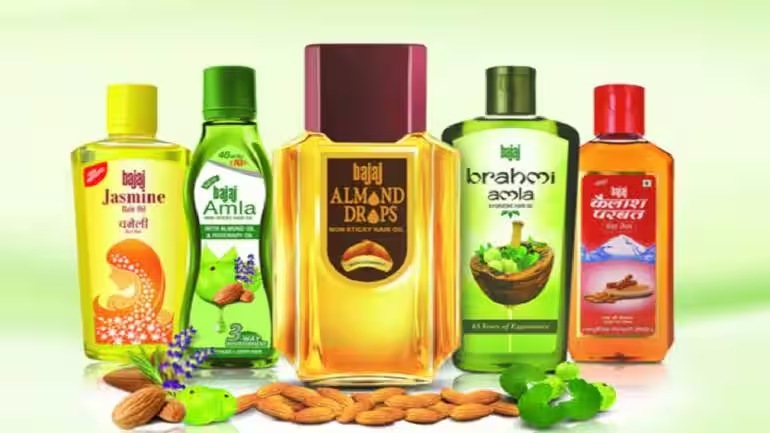
The business is deceptively simple. Hair needs oil. In India, 400 million women use hair oil regularly — this is not a niche category. It’s mass-market, rural-deep, and culturally ingrained. Bajaj Almond Drops Hair Oil owns 63% of the light hair oil (LHO) segment. That’s not market leadership. That’s market domination that would make telecom barons jealous.
How does a 63% market share survive in an Indian FMCG category? Distribution. Bajaj reaches 6 lakh direct retail outlets now (up from 4.3 lakh). When your mechanic’s wife walks into the general store in Indore, Bajaj Almond Drops is in the back room, on the top shelf, and probably the only premium option that doesn’t require brand deliberation. That’s the moat.
The rest of the portfolio — Brahmi Amla, Coco Jasmine, Kailash Parbat, Coconut Oil, and the newly acquired Banjara’s brand — sits at roughly 20% of revenue. Management explicitly stated target: increase non-ADHO to 40% of revenue by FY29. That’s a 5-year journey. Not hypergrowth. But growth.
ADHO Market Share63%Light Hair Oil
Direct Reach6 LacRetail Outlets
Direct Revenue %~80%ADHO Category
Avg Ad Spend~15%Of Revenue
Concentration Risk Note: 80% of revenue from one product is not cute. It’s the thing everyone worries about. ADHO is 45 years old, it’s mature, and EVs don’t need as much lubrication (wait, wrong company — that’s Castrol). But management is literally paying 15% of revenue every year to maintain brand awareness. That’s the “fear moat” — the tax on admitting you’re dependent on one product.
💬 Here’s the thing: Has Bajaj ever struggled to raise prices on Almond Drops? Or does it just happen automatically because your dadi buys it anyway? Drop your observations.
04 — Financials Overview: The Numbers Spoke Loud
Q3 FY26 — The Quarter That Changed Everything
Result type: Quarterly Results | Q3 FY26 EPS: ₹3.55 | Annualised EPS (Q3×4): ₹14.2 | Current P/E: 29.1x (CMP ₹350 ÷ ₹12.0 FY25 EPS)
| Metric (₹ Cr) |
Q3 FY26
Dec 2025 |
Q3 FY25
Dec 2024 |
Q2 FY26
Sep 2025 |
YoY % |
QoQ % |
| Revenue (Consol.) | 306 | 230 | 265 | +32.7% | +15.5% |
| EBITDA | 57 | 27 | 48 | +109% | +18.8% |
| EBITDA Margin % | 18.6% | 11.8% | 18.1% | +680 bps | +50 bps |
| PAT (Consol.) | 46.4 | 25 | 42 | +85.6% | +10.5% |
| EPS (₹) | 3.55 | 1.85 | 3.24 | +91.9% | +9.6% |
Gross Margin Explosion: Standalone gross margin jumped to 59.8% in Q3 (vs 51.8% in Q3 FY25). That’s 800 bps of expansion. Management attributed it to “strategic pricing, revenue management, and mix improvement.” Translation: they raised prices because they could. ADHO saw “double-digit volume growth” with “value growth in the 20s” (management’s words). Meanwhile, Coconut Oil pricing was consciously corrected upward because the company realized competing on price was stupid. That’s confidence.
05 — Valuation: Is It Worth Your Dadi’s Savings?
Three Ways to Value a Hair Oil Company