1. At a Glance – EMS With a Passport and a Price Tag
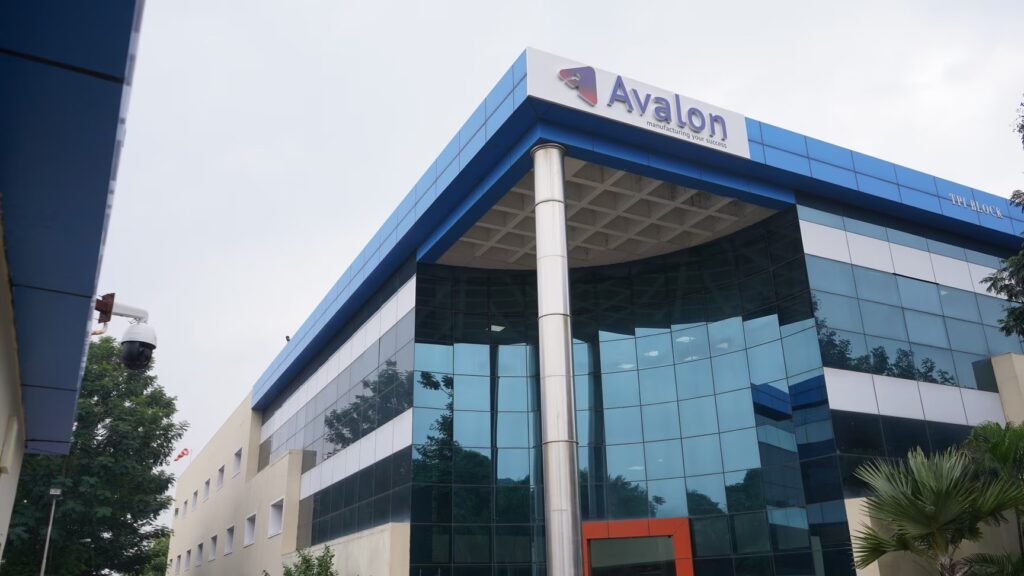
Avalon Technologies is that rare Indian EMS company that doesn’t just export products — it exports manufacturing itself. With factories in both India and the United States, Avalon enjoys a “visa-free” access to North American OEM wallets. As of Q3 FY26, the company clocks a market cap of ₹6,754 Cr, trades at ₹1,012, and casually sports a P/E of ~70×, which is Silicon Valley pricing for a Chennai shop floor.
The latest quarter was undeniably spicy: Q3 FY26 revenue at ₹418 Cr (+48.7% YoY) and PAT at ₹32.6 Cr (+35.9% YoY). EBITDA margin landed at ~11%, stable enough to keep bankers calm but not enough to justify champagne just yet. The stock has delivered ~48% returns over one year, though the last three months were basically a treadmill.
Debt is under control at ₹163 Cr, ROCE sits at 12.8%, and ROE at 10.4% — respectable, but not exactly EMS royalty. The real question: is Avalon a long-term compounding box-build machine or just a very well-travelled assembler priced like Nvidia’s cousin?
2. Introduction – From Chennai to California, With a Soldering Iron
Avalon Technologies was incorporated in 1999, back when “EMS” in India meant cable assembly and jugaad tooling. Fast forward to FY26, and Avalon is now a full-stack EMS provider doing everything from PCB design to complete box-build systems for global OEMs.
What sets Avalon apart is not just capability — it’s geography. While most Indian EMS players ship boards overseas and pray customs doesn’t sneeze, Avalon simply manufactures there. With facilities in Atlanta and Fremont, Avalon becomes the friendly neighbourhood supplier for US clients who hate geopolitical surprises.
But let’s not romanticise too quickly. EMS is a low-margin, high-discipline business. You don’t win by innovation alone; you win by execution, working capital control, and client stickiness. Avalon claims long product lifecycle customers, multi-year relationships (7+ years with several clients), and exposure to sunrise sectors like clean energy, EVs, medical devices, and digital infrastructure.
Sounds great
on a PPT slide. But does the financials back this global ambition? And more importantly — does the valuation?
3. Business Model – WTF Do They Even Do?
Imagine an OEM that designs a fancy electronic product but doesn’t want to deal with PCBs, metal enclosures, cables, transformers, plastics, testing, certification, logistics, or after-sales headaches. Avalon steps in and says: “Boss, give us the design. We’ll ship you a finished box.”
That’s the box-build model, and Avalon now derives 54% of FY23 revenue from it (up from 44.5% in FY22). This is important because box-build typically offers higher margins and deeper client integration than bare PCB assembly.
Avalon’s product capabilities include:
- PCB design & assembly (SMT + THT)
- Sheet metal & fabrication
- Cable assemblies & wire harnesses
- Transformers, chokes, magnetics
- Injection-moulded plastics
With 66 production lines (11 SMT, 12 THT, 43 assembly lines), Avalon positions itself as a high-mix, flexible-volume manufacturer — meaning small batch sizes, frequent design changes, and clients who value reliability over pennies saved.
So here’s a question for you: would you rather be Foxconn for iPhones or Avalon for niche industrial electronics?
4. Financials Overview – Growth Is Real, Margins Are… Polite
Quarterly Performance Table (₹ Cr, Consolidated)
| Metric | Latest Qtr (Q3 FY26) | YoY Qtr (Q3 FY25) | Prev Qtr (Q2 FY26) | YoY % | QoQ % |
|---|---|---|---|---|---|
| Revenue | 418 | 281 | 382 | +48.7% | +9.4% |
| EBITDA | 48 | 35 | 39 | +37.1% | +23.1% |
| PAT | 32.6 | 24 | 25 | +35.9% | +30.4% |
| EPS (₹) | 4.88 | 3.63 | 3.74 | +34.4% | +30.5% |
Annualised EPS Rule:
Q3 EPS = average of Q1, Q2, Q3 × 4
