1. At a Glance – Chemical Uncle Still Doing Push-Ups
Atul Ltd currently sits at a market cap of ₹17,173 Cr with a stock price of ₹5,834, quietly minding its business while the market keeps asking, “Why aren’t you a multibagger yet?” The company just delivered Q2 FY26 (Sep 2025) consolidated results with sales of ₹1,552 Cr, PAT of ₹182 Cr, and EPS of ₹60.88, translating into a QoQ PAT jump of ~38% and YoY growth of ~100%+ from the chemical winter lows.
Debt? Almost non-existent at ₹186 Cr with a Debt/Equity of 0.03.
ROCE is 12.8%, ROE 9.1%, and yes, valuation aunties are already whispering “28.9x P/E is not cheap beta”.
But here’s the twist: Atul isn’t chasing headlines. It’s executing a ₹2,000 Cr capex cycle, expanding epoxy, chlorine, pharma intermediates, and quietly preparing for the next upcycle. The stock may look sleepy, but the TTM profit growth is 43%, and margins are crawling back like a disciplined yogi.
So the real question: Is this boring compounder warming up… or just stretching?
2. Introduction – A 78-Year-Old Chemical Company That Refuses to Retire
Atul Ltd is not your flashy new-age specialty chemical IPO with buzzwords and PowerPoint margins. It is a 1947-born chemical dinosaur from the Lalbhai Group, inaugurated by India’s first Prime Minister. That alone gives it more pedigree than half the sector combined.
But pedigree doesn’t pay dividends. Cash flows do.
Over the last few years, Atul went through:
- Margin compression
- Sluggish volume growth
- Chemical downcycle blues
- Investors losing patience
And then suddenly… FY25–FY26 started showing pulse.
Operating margins recovered to 17% in recent quarters, PAT rebounded sharply, and capex projects started commissioning instead of just sitting in CWIP like abandoned
flyovers.
Atul’s business is boring on paper:
- Crop chemicals
- Dyes
- Epoxies
- Aromatics
- Bulk chemicals
But boring businesses, when integrated well, mint cash silently.
This article dissects whether Atul is:
- A value trap with legacy fatigue
- Or a patient capital compounder hiding behind mediocre ROE
Let’s open the drums 🛢️
3. Business Model – WTF Do They Even Do?
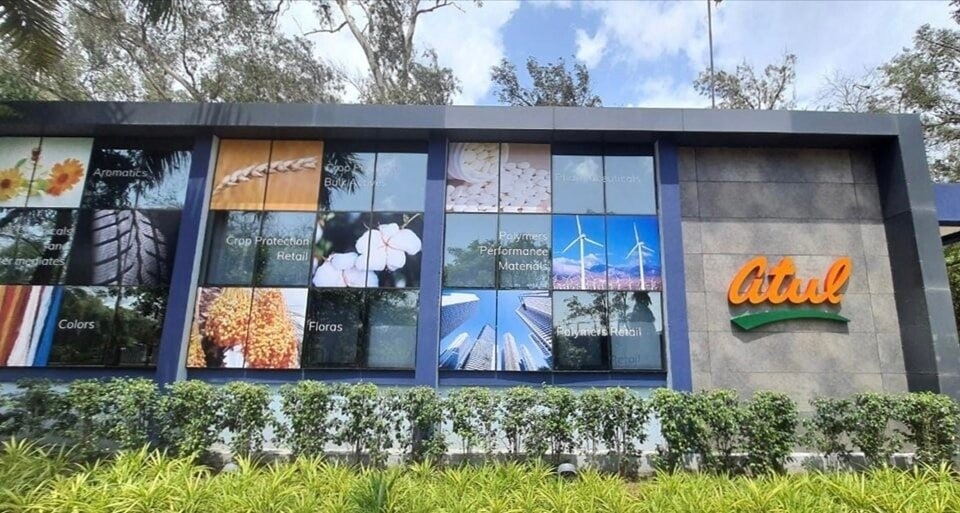
Atul Ltd operates across 9 chemical businesses, broadly divided into:
A. Life Science Chemicals (~30% of FY24 revenue)
This includes:
- Crop protection chemicals
- APIs & intermediates
- Aromatics-I
Products here include herbicides, insecticides, fungicides, biostimulants, and pharma intermediates. The star launch here is Sindica, a patented post-emergence herbicide for sugarcane launched in March 2024.
Think of this segment as:
“Stable, regulated, slow-burn margin business with occasional jackpot molecules.”
B. Performance & Other Chemicals (~70% of FY24 revenue)
This is the real cash engine:
- Colors (textile dyes, pigments)
- Polymers (epoxy resins, adhesives)
- Bulk chemicals
- Aromatics-II
Atul has 900 products, 400 formulations, ~50 brands, and supplies 30 industries across 83 countries. This is not a single-product risk story. This is a chemical supermarket.
The moat is not pricing power alone. It’s:
- Backward integration
- Chlorine captive supply
