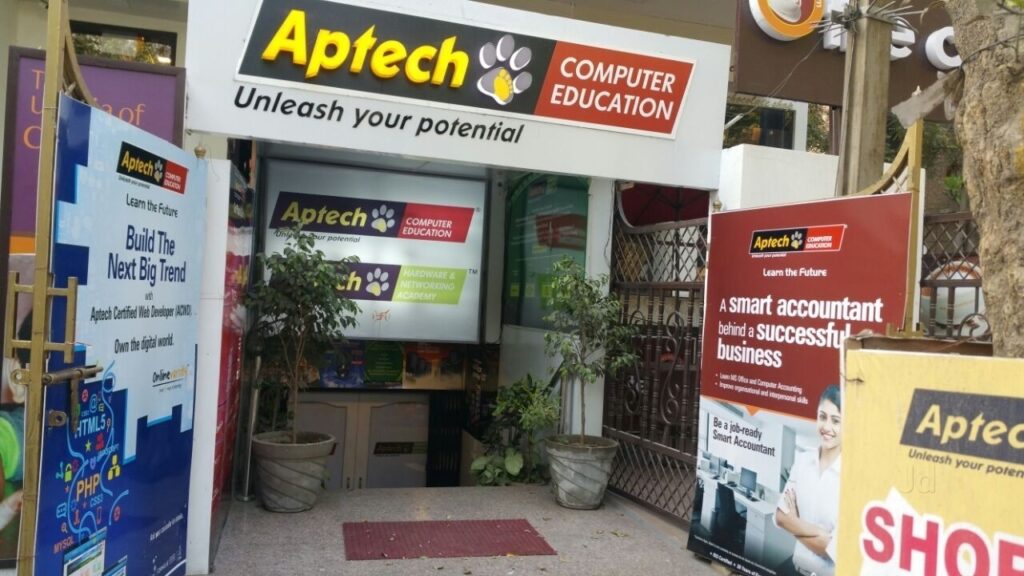
Aptech is one of those companies that can simultaneously look respectable, confusing, and slightly dramatic, like a coaching institute owner arriving at a school annual day in a BMW while saying margins are under pressure. On paper, the business has legacy, scale, and brand recall. It has been around since 1986, runs through a wide network of training centres, and plays across IT training, animation, aviation, beauty, pre-school, and enterprise assessment services. In FY24, the Global Retail Business had become the clear heavyweight, contributing 87% of revenue mix, while the Institutional Business had shrunk sharply after revenue from top customers fell. That alone tells you this is no longer just an “exam contract” story; it is increasingly a retail-skilling-and-franchise machine trying to reduce dependence on lumpy government and corporate work.
Then comes the latest quarter, and suddenly the report card looks far better than the stock chart. Q3 FY26 consolidated revenue came in at Rs. 137.11 crore versus Rs. 110.21 crore in the same quarter last year and Rs. 134.88 crore in the previous quarter. Net profit rose to Rs. 8.56 crore from Rs. 3.58 crore YoY and Rs. 6.46 crore QoQ, while operating profit improved to Rs. 13.63 crore, taking OPM to 9.94%. That is not a tiny improvement. That is the kind of jump that makes investors sit up and say, “Wait, is the old tuition teacher cooking again?”
But before anyone starts throwing rose petals at the quarterly numbers, let us remember the full backdrop. TTM sales are Rs. 511 crore, TTM PAT is Rs. 27-28 crore, stock P/E on the screen is about 16, ROCE is 13.9%, ROE is 7.63%, and debt is just Rs. 13.7 crore. Sounds decent. Yet the same dump also tells you earnings include other income of Rs. 13.4 crore, working capital days have worsened to 118, there was a managing director exit in January 2025 and appointment only in November 2024 before that, plus a tax demand notice landed in February 2026. This is not a clean Bollywood hero entry. This is more like a thriller where the hero has good marks, but the school principal keeps changing and the Income Tax department is sitting in the front row.
So what exactly is Aptech right now? A legacy skilling company with a stronger retail engine, improving quarterly profitability, decent balance sheet control, and enough corporate-governance masala to prevent anyone from sleeping peacefully. That is why this is interesting. The numbers are improving, but the story still has loose wires. And loose wires in Indian listed companies are never “just loose wires.” They are usually the trailer.
Reader question: when a company posts a strong quarter but the management chair keeps rotating faster than a game of musical chairs at a school picnic, do you clap first or verify attendance?
2. Introduction
Aptech is not a startup wearing a hoodie and calling PowerPoint “disruption.” It is an old-school education and training company that has survived multiple eras of Indian optimism: computer classes, animation dreams, aviation training, overseas retail franchises, and now the modern obsession with skills, employability, online assessments, and job-linked learning. It has built a business through two broad streams: Individual Training and Enterprise Business Group. In plain English, one side teaches people things, the other side helps institutions test or train people at scale.
Its brands cover a strange but commercially practical buffet: Arena Animation, MAAC, Aptech Learning, Aptech Aviation, Aptech International Preschool, and Lakmé Academy. That portfolio reads like someone sat down and asked, “Which aspirational sectors can Indian households still spend on despite inflation, EMI pressure, and relatives asking why the child is not already an engineer?” The answer was apparently: animation, beauty, aviation, computer skills, and preschool. Fair enough.
The big strategic shift over the last few years is that Global Retail has become the main engine. It contributed 87% in FY24 against 57% in FY22. Meanwhile Institutional Business fell to 13% from 43% in FY22, partly because revenue from the top two customers dropped sharply in FY24. That is a major change in the company’s character. The market may still casually think of Aptech as an exam-and-training vendor, but the numbers suggest it is increasingly a branded education-distribution business with international pockets and a franchise-heavy operating structure.
Now look at the drama layered on top. The company has kept winning assessment and training contracts: Rs. 2.49 crore in November 2024, a 3-year project LOI in December 2024, Rs. 3.13 crore in January 2025, Rs. 15 crore later in January 2025, Rs. 2.26 crore in May 2025, Rs. 24.77 crore in October 2025, Rs. 4.22 crore in January 2026, and Rs. 4.18 crore in February 2026. So the institutional side is not dead; it is still alive, still generating order-flow, and still showing up like that student who disappears all semester and somehow tops the viva. At the same time, the company disclosed a tax assessment order with demand of Rs. 6.37 crore and said it plans rectification under Section 154. That means the scoreboard is improving, but the umpire is still checking the replay.
And then the biggest soap-opera subplot: Atul Jain was appointed Managing Director and CEO effective November 1, 2024, but then resigned effective January 30, 2025. That is a very short tenure. Before him, Anuj Kacker retired as Whole-time Director and Interim CEO on October 31, 2024. You do not need a forensic auditor to see that leadership continuity has not exactly been doing Surya Namaskar here.
This is what makes Aptech compelling. The business is real. The brands are real. The revenue is real. The quarterly recovery is real. But the trust discount in the market is also real, because investors have seen too many Indian “education stories” where the classroom slides are glossy and the governance footnotes are where the real syllabus starts.
3. Business Model – WTF Do They Even Do?
Let us decode Aptech without using management jargon that sounds like it was written by a consultant billing by the adjective.
At the core, Aptech sells career aspiration. Not degrees, not formal university credentials, but practical, job-skilling, employability-flavoured education. This is classic non-formal training. A student wants to learn animation, VFX, gaming, aviation services, beauty and wellness, or computer applications. Aptech has a brand, a curriculum, a centre, a partner network, and a sales pitch ready. That is the retail business.
The retail side itself is split into domestic and international. Domestic retail made up about 90% of retail in FY24, with 836 centres. International retail accounted for about 10%, with presence across five continents and 190 centres. Best-ever enrolments came from Nigeria, South Asia, and Egypt, and the Vietnam master franchise got renewed again. So this is not merely a Mumbai-headquartered training chain giving local newspaper ads. It has overseas franchise legs too.
Then there is the Institutional Business. This is where Aptech works with corporations, educational institutions, government departments, and quasi-government bodies. Here, two sub-buckets matter: Assessment & Testing and Training Solutions. Assessment includes computer-based tests, digital evaluation for paper exams, pen-and-paper assessments, and document digitisation. Training Solutions covers multi-location training rollouts and learning management tools. In short, if a government body wants exams conducted at scale, or an institution wants a technology-backed assessment partner, Aptech can show up with servers, software, centres, and an invoice.
Now comes the economically interesting bit. Retail is more recurring, brand-driven, and scalable if executed well. Institutional is lumpier, contract-based, and vulnerable to timing swings. That is why the FY24 collapse in institutional revenue hurt, but it also explains management’s stated focus on scalable initiatives and reducing heavy reliance on assessment and testing. This is sensible. Nobody wants their quarterly performance determined by whether one large government contract got signed on March 29 or April 2.
Aptech has also tried new initiatives like virtual production training and the alumni engagement platform “Almanation.” That tells you management knows the old “basic computer course” image is not enough anymore. The customer now wants glamour, employability, creators’ economy buzzwords, and preferably a course title that sounds like it belongs on LinkedIn and Instagram at the same time.
So yes, Aptech is basically a branded skilling-and-assessment company monetising aspiration, employability, franchise distribution, and institutional exam execution. Elegant? Sometimes. Messy? Also yes. But at least it is a real business, not a motivational speech wearing a ticker symbol.
Reader question: would you value Aptech more as an education brand network or as a government-testing contractor with side hustles?
4. Financials Overview
The latest official heading in the dump is Quarterly Results, so EPS treatment is locked as quarterly, not half-yearly. Since this is Q3 FY26 (Dec 2025 quarter), annualised EPS must follow your rule: average of Q1, Q2, and Q3 EPS multiplied by 4. Q1 EPS was Rs. 1.16, Q2 EPS Rs. 1.11, and Q3 EPS Rs. 1.48. Average EPS = 1.25. Annualised EPS = Rs. 5.00. At CMP Rs. 78, recalculated P/E is about 15.6 times.
Quarterly Comparison Table
Metric
Latest Quarter Dec 2025
Same Quarter Last Year Dec 2024
Previous Quarter Sep 2025
YoY %
QoQ %
Revenue
137.11
110.21
134.88
24.4%
1.7%
EBITDA / Operating Profit
13.63
6.44
7.64
111.6%
78.4%
PAT
8.56
3.58
6.46
139.1%
32.5%
EPS (reported)
1.48
0.62
1.11
138.7%
33.3%
Source data from quarterly results.
Witty commentary: this quarter did not merely “improve.” It did a full Bollywood comeback montage. Revenue moved up nicely, but the real masala is margin expansion: OPM went from 5.84% in Dec 2024 to 9.94% in Dec 2025. That is why PAT jumped so sharply. The company also had lower other income this quarter than some recent quarters, so the operating improvement deserves some credit.
Still, do not ignore the full-year texture. FY25 sales were Rs. 460 crore with PAT of Rs. 19 crore, versus FY24 sales of Rs. 436 crore and PAT of Rs. 29 crore. TTM sales are now Rs. 511 crore and TTM PAT around Rs. 27-28 crore. So the company is crawling back, but it is not yet in some glorious multi-year earnings supercycle. It is more like a student who failed chemistry, aced the re-test, and now wants credit for “consistent academic excellence.” Calm down, beta. One more year first.
5. Valuation Discussion – Fair Value Range Only
Current CMP is Rs. 78 and market cap is about Rs. 452 crore. Enterprise value is about Rs. 440 crore. TTM sales are Rs. 511 crore, TTM PAT is Rs. 28.35 crore, stock P/E shown is about 15.98, and EV/EBITDA is 8.40.
Method 1: P/E-Based Range
Annualised EPS from Q1-Q3 FY26 = Rs. 5.00
Peer median P/E in the table is 24.14, while Aptech trades around 15.98.
Given management churn and contract lumpiness, a discount to peer median is reasonable.
Educational range using 14x to 18x on annualised EPS:
14 x 5.00 = Rs. 70
18 x 5.00 = Rs. 90
Method 2: EV/EBITDA-Based Range
TTM EV/EBITDA on screen = 8.40.
TTM operating profit is Rs. 36 crore. Using screen EV of Rs. 440 crore also roughly aligns with that.
Educational multiple band of 7.5x to 9.5x EBITDA:
EV range = Rs. 270 crore to Rs. 342 crore on Rs. 36 crore EBITDA? That would be too low because screen EV already implies EBITDA adjustments beyond simple operating profit presentation.
Better to anchor on screen EV/EBITDA and apply modest band around current multiple.
Using screen EV Rs. 440 crore and debt Rs. 13.7 crore, equity value is roughly close to current market cap. A band of 7.5x to 9.5x around current operating base suggests an equity zone broadly around Rs. 70-88 per share rather than something dramatically different.
Method 3: Cash Flow / DCF Framing
A strict, full DCF cannot be honestly produced from this dump alone without importing assumptions on discount rate, terminal growth, future capex, or revenue growth. That would be fantasy cricket, not analysis. What the dump does provide is free cash flow history:
FY23 FCF: Rs. 92 crore
FY24 FCF: negative Rs. 22 crore
FY25 FCF: Rs. 13 crore
That volatility tells you one simple thing: Aptech’s value should not be built on a heroic DCF unless cash conversion becomes steadier. So the DCF-style takeaway is not a precise number; it is that valuation deserves a discount until free cash flow stops behaving like an Indian monsoon forecast.
Fair Value Range
Blending P/E and EV/EBITDA approaches, while treating DCF as a cautionary cross-check rather than a precise engine, a reasonable educational fair value range looks like:
Rs. 70 to Rs. 90 per share
This fair value range is for educational purposes only and is not investment advice.
6. What’s Cooking – News, Triggers, Drama
This is where Aptech turns from an education stock into a WhatsApp family group: constant forwards, mixed emotions, and everyone pretending not to notice the awkward bits.
The positive part first: contract wins keep coming. The company received a Rs. 24.77 crore state government computer-based exam contract in October 2025, a Rs. 4.22 crore training contract in January 2026, and another Rs. 4.18 crore state government exam contract in February 2026. Earlier too, there were multiple exam-related orders including Rs. 15 crore and Rs. 3.13 crore in January 2025 and Rs. 2.26 crore in May 2025. That pipeline matters because it suggests the institutional segment, while volatile, still has commercial relevance and execution credibility in testing. A company does not keep getting exam mandates if it cannot at least manage computers, candidates, and controlled chaos. User-provided announcement dump; corroborative recent award entries visible in the documents section.
Now the uncomfortable portion. On February 11, 2026, Aptech disclosed an income-tax assessment order raising a demand of about Rs. 6.37 crore for AY 2024-25, with the company saying rectification under Section 154 is planned. Then on March 19, 2026, it disclosed that an investigative authority had visited over a 2022 subsidiary testing matter worth Rs. 19.9 lakh, while stating there was no material impact. Notice the pattern: neither disclosure screams catastrophe, but neither belongs in a perfect corporate-governance fairy tale either. This is the kind of paperwork that makes investors say, “Okay, maybe let us read page 17 of the annual report too.”
And of course, the management carousel. Atul Jain was appointed MD and CEO from November 1, 2024, then resigned effective January 30, 2025. Before that, interim CEO Anuj Kacker retired on October 31, 2024. This sort of executive volatility is not ideal in a consumer-facing, franchise-heavy education business where leadership continuity, brand direction, and partner confidence matter. Franchisees do not enjoy guessing who the boss will be next quarter. Neither do public shareholders.
The bigger strategic trigger is whether Aptech can turn recent retail momentum into sustained margin expansion while using order wins to stabilise the institutional side. If yes, the market may stop pricing it like a perpetually complicated story. If not, it will remain one of those stocks where