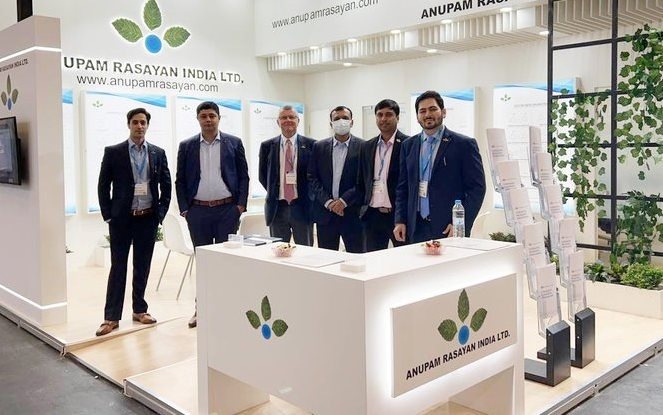
Anupam Rasayan (BSE: 543275, NSE: ANURAS) looks like the IIT topper of Indian specialty chemicals—R&D driven, global clientele, green energy goals—but its report card comes with red scribbles. At a market cap of ₹12,529 crore and price of ₹1,100 per share, the stock trades at a wild P/E of 101x, a valuation premium that makes even Pidilite blush. Book value sits at ₹259 (P/B 4.2x), while return metrics are weak: ROE 3.3%, ROCE 7.3%—basically, investors are paying Harvard fees for an engineering college placement.
Quarterly sales stood at ₹486 crore (+91% YoY) with PAT ₹34 crore (+768% YoY)—numbers that look explosive until you notice the base effect was smaller than a lab sample. Debt stands at ₹1,373 crore (Debt/Equity 0.48), with promoter holding at 59% but 17.5% pledged. So yes, it’s innovative and growing, but the balance sheet has more hair dye than Baba Ramdev’s beard.
2. Introduction
Anupam Rasayan is like that kid in class who tops chemistry Olympiads, but also owes everyone lunch money. The company makes niche specialty chemicals for agro, pharma, and personal care giants. Its client list reads like the Avengers lineup—Syngenta, Sumitomo, Dupont—and its order book of ₹8,900 crore gives it visibility of 5–7 years. Sounds dreamlike.
But peel the layers, and reality smells like ammonia. ROE is lower than a savings account, debtor days have ballooned to 186 (basically lending free credit to customers), and margins, while fat at ~28%, haven’t translated into shareholder returns. The share has doubled in a year (+51%), but long-term holders are still waiting for profits to catch up with the stock’s sugar high.
3. Business Model – WTF Do They Even Do?
Anupam Rasayan runs on the “B2B chemistry” model. No FMCG ads, no retail stores—just hardcore molecule-making.
Agrochemicals (65%) – Insecticides, fungicides, herbicides intermediates. Basically, they make the chemical bullets that MNCs pack into crop sprays.
Personal Care (17%) – UV filters, antibacterials—your sunscreen and facewash quietly thank Anupam.
Pharma (9%) – Starting materials and intermediates for APIs. Not the branded pill, just the chemistry homework behind it.
Other Chem (9%) – Pigments, dyes, polymer additives—niche, but handy for diversification.
Their moat? Long qualification cycles with MNCs (12–24 months) and sticky contracts. Their risk? 77% revenue from top 10 clients—if Syngenta sneezes, Surat catches pneumonia.
4. Financials Overview
Source table
Metric
Latest Qtr (Jun’25)
YoY Qtr (Jun’24)
Prev Qtr (Mar’25)
YoY %
QoQ %
Revenue
486 Cr
254 Cr
500 Cr
+91.1%
–2.8%
EBITDA
124 Cr
53 Cr
144 Cr
+133%
–13.9%
PAT
34 Cr
12 Cr
63 Cr
+183%
–46%
EPS (₹)
3.1
0.36
4.05
N/A
–23%
Commentary: The YoY looks like India vs Ireland cricket stats—big jumps from a tiny base. Sequentially, though, profits halved. P/E at 101x on this EPS is like buying Maggi at Oberoi Hotel prices.
Question to readers: Do you think 100x P/E is justified for “future molecule pipeline,” or is this the new-age chemicals bubble?
5. Valuation Discussion – Fair Value Range Only
P/E Method
EPS (TTM) = ₹11.2. Industry average P/E = 34x. Range = ₹380 – ₹550.
EV/EBITDA Method
EV = ₹13,775 Cr, EBITDA = ₹473 Cr. EV/EBITDA ≈ 29x. Industry averages ~15–20x. Fair value range = ₹750 – ₹950.
DCF Method
Assume FCF ~₹150 Cr/year, 15% growth for 5 years, 10% discount rate. DCF value ≈ ₹850 – ₹1,050.
Fair Value Range (educational only): ₹550 – ₹1,050
Disclaimer: This range is for educational purposes only and is not investment advice.
6. What’s Cooking – News, Triggers, Drama
Contracts Galore (2024–25): LOIs worth $195M (Feb 2025), $106M with Korean MNC (Mar 2025), plus lithium battery electrolyte salt supply (FY26–27). Looks like everyone’s signing contracts, but investors pray execution