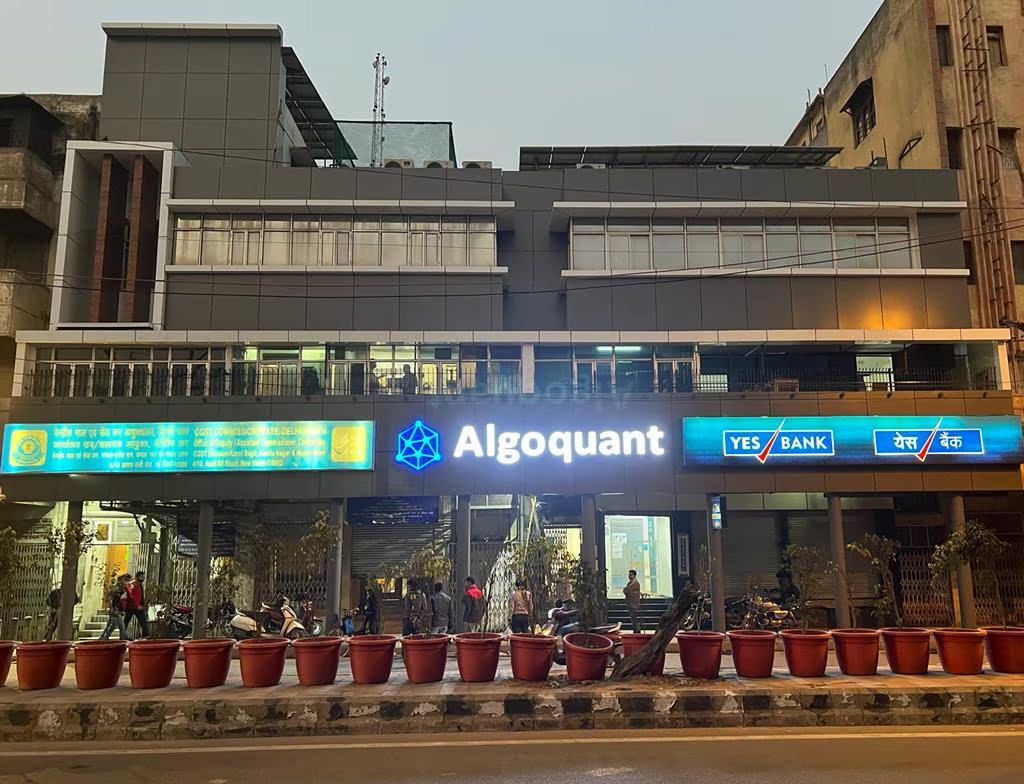
1. At a Glance
Algoquant Fintech Ltd (AFL) isn’t your friendly neighbourhood broker—it’s the quiet math nerd at the back of the class who just cracked the school’s Wi-Fi. Born in 1983 and once peddling hand tools, AFL has evolved into a high-frequency trading beast, playing the ultra-low latency game in derivatives arbitrage. In FY25, it clocked ₹235 Cr revenue and ₹32 Cr PAT, sporting a 38% ROE like it’s showing off in a modelling contest. But with a P/E of 65.5 and operating margins shrinking faster than your patience with bad Wi-Fi, investors are left wondering—genius coder or overhyped fintech cosplay?
2. Introduction
If you thought the only people who got rich from maths were your IIT coaching centre owners, think again. Algoquant Fintech is the love child of Wall Street and Silicon Valley, operating in that sweet, shady-sounding corner of finance called completely hedged derivatives arbitrage.
What does that mean? In simple terms—it’s the art of making pennies at lightning speed, millions of times a day, without technically taking a market bet. It’s about using servers so fast they can place an order in the time it takes you to blink… twice.
AFL’s transformation is straight out of a corporate Bollywood script—once known as Hindustan Everest Tools Ltd (yep, literal spanners and wrenches), it dumped the metal for math, ditched the shop floor for server racks, and now operates out of India’s own Wall Street cosplay—GIFT City, Gandhinagar.
But before you romanticise this as “The Indian Renaissance Technologies,” remember—last two quarters’ margins look like someone tripped over the power cable.
3. Business Model (WTF Do They Even Do?)
Algoquant makes money from low-risk, high-frequency trading. Think:
- Derivatives Arbitrage – Exploiting mispricing between index futures, options, and the underlying stocks.
- Hedged Positions – Always
- carrying offsetting trades so they don’t wake up bankrupt if the market sneezes.
- Technology as Weapon – Algorithms, low-latency connections, and possibly a secret room full of caffeine-fuelled quants.
Revenue comes from proprietary trading gains—not fees, not commissions. This makes AFL’s top line less about “selling a product” and more about “milking the market machine.” The more volatility + liquidity in the market, the more opportunities to scalp basis points.
Problem? This isn’t a subscription business—you can’t just raise prices when costs rise. Your “customer” is the market itself, and the market doesn’t negotiate.
4. Financials Overview
TTM Revenue: ₹235 Cr (↑ 50% YoY)
TTM PAT: ₹32 Cr (↑ 30% YoY)
FY25 OPM: 21% (vs 28% in FY24 — someone’s ISP bill went up)
ROCE: 32.5%
ROE: 37.6%
EPS (FY25): ₹20.42
📌 Fresh P/E Calculation
Latest quarterly EPS (Q4 FY25) = ₹0.39 → Annualised = ₹1.56
CMP ₹1,337 → P/E = 857 (Yes, eight hundred fifty-seven—thank Q4 slump for that absurdity)
Using FY25 EPS ₹20.42, the P/E = 65.5 (official TTM).
Colour commentary: Q4 was a crash landing—Operating Profit down to ₹2.8 Cr from ₹20 Cr in Sep’24. This isn’t a “gradual margin compression” story; it’s a “fat-finger trade”
