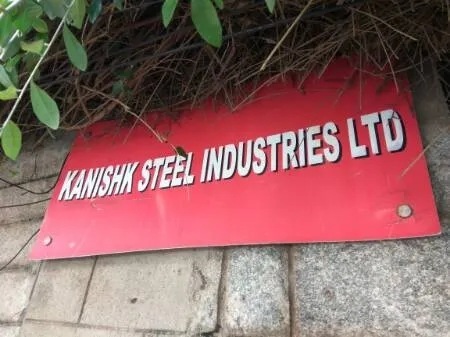
Kanishk Steel FY26: ₹407 Cr of Revenue, ₹5 Cr of Profit, and the Wind Farm That Quietly Left the Building
Spotted a factual error — a wrong number, date, or fact? Tell us and we will check the source.
General information and entertainment, not investment advice. The author is not a SEBI-registered adviser or research analyst. No recommendation, no promised returns. Markets carry risk including loss of capital. Figures may not be current. Consult a registered adviser before acting.
1 — At a Glance
Kanishk Steel closed FY26 with sales of ₹407 Cr, up from ₹360 Cr the year before — a 13% top-line gain that looks like momentum until you reach the bottom line. Net profit for the year came to ₹5.1 Cr, down from ₹8.3 Cr in FY25. Revenue rose, profit fell. That contradiction is the entire entry.
The explanation sits in the FY25 accounts: that year carried a one-off gain from the sale of the company’s wind-power assets, which lifted profit above what the steelmaking itself produced. Strip the machinery-sale year out and FY26’s operating profit of about ₹14 Cr on ₹407 Cr of sales — a 3% operating margin — is the actual pulse. A steel company converting three rupees of every hundred into operating profit is running a thin business by design of the sector, not by accident.
Two other markers frame the year. In June 2025, ICRA downgraded the company’s long-term rating to BB+ from BBB-, citing weaker-than-expected FY25 earnings. And the market currently pays roughly 29x those slim earnings, against an industry multiple near 22x.
The record for FY26, then, is a company growing volume, defending a wafer margin, carrying a fresh credit downgrade, and priced above its peer group. Each thread is examined below.
2 — Introduction
Kanishk Steel Industries, incorporated in 1989 and part of the OPG Enterprises Group, manufactures constructional and structural steel from a single unit at Gummidipoondi, north of Chennai. It is one of southern India’s larger secondary-steel producers, an ISO-certified maker of TMT bars, joists, beams, channels, angles and sponge iron conforming to Indian Standards.
The customer list reads better than the margins: public-sector names like BHEL and L&T anchor the order book, alongside project clients across cement, infrastructure and SEZ work. ICRA points to over two decades of promoter experience and a stable base of repeat orders as the operational floor under the business.
The recent strategic moves are all capacity and power. The induction-furnace billet capacity was expanded from 27,000 TPA toward 1,00,000 TPA, matching the 1,00,000 TPA rolling mill — a large step-up that spent FY25 ramping at roughly 75% utilisation, per ICRA. On the energy side, the company retired its older 10.5 MW wind assets, sold them during FY25, and planned a 10.2 MW captive solar plant, commissioning of which slipped from Q4 FY25 into Q1 FY26.
So the story entering FY26 is a bigger plant still filling up, and an energy transition mid-swap — old wind sold, new solar not yet fully landed.
Does a customer roster of BHEL and L&T guarantee anything, when the margin between winning that order and profiting from it is three percent?
3 — Business Model: WTF Do They Even Do?
They melt scrap and iron into MS ingots, then roll those ingots into bars and structural shapes that hold up buildings and bridges. That’s the whole loop, and it is backward-integrated: the furnaces feed the mill, so the company controls more of its own input chain than a pure re-roller would.
The economics of this are unforgiving in a way the About section politely omits. ICRA notes raw materials and consumables run at about 80% of operating income. When four-fifths of every rupee of sales is bought-in scrap and metal — part of it imported, which drags foreign-exchange risk in through the same door — the space left for the company to be profitable is the sliver between scrap price and rebar price. In FY26 that sliver was 3%.
Revenue is roughly 90% manufactured product, with a small traded-goods component — the share of traded goods in revenue has bounced between 4% and 40% over the past decade, sitting near 4% in the latest disclosed year, which tells you trading is a lever the company pulls opportunistically, not a pillar.
The geography compounds it. Operations concentrate in southern India, so demand is a bet on one region’s construction cycle. A commoditised structural-steel market — many players, near-identical output, no pricing power — means the product competes almost entirely on price. In that structure, scale and cost control are the only two levers, which is precisely why the company keeps pouring money into furnace capacity and captive solar power. The model isn’t broken; it’s just a treadmill where you run hard to stay in the same margin.
A wisdom line for the sector: in commoditised steel, the company doesn’t set the price — it survives the price, and the balance sheet is the seatbelt.
4 — Financials Overview
Figures are standalone, in ₹ crore. The latest reported period is the quarter ended March 2026.
Metric
Latest Q (Mar 26)
YoY (vs Mar 25)
QoQ (vs Dec 25)
Sales
114.17
+15.8%
+18.6%
Operating Profit
4.89
vs 1.68
+71.6%
PAT
1.25
vs −1.61 (loss)
−42.9%
EPS (₹)
0.44
vs −0.57 (loss)
vs 0.77
The quarter’s headline is genuine: ₹114 Cr of sales is the highest quarterly revenue in the visible record, and operating profit of ₹4.89 Cr is the strongest operating quarter across the period shown. Against the prior-year March quarter — which was an operating loss of ₹2.87 Cr — the swing is real.