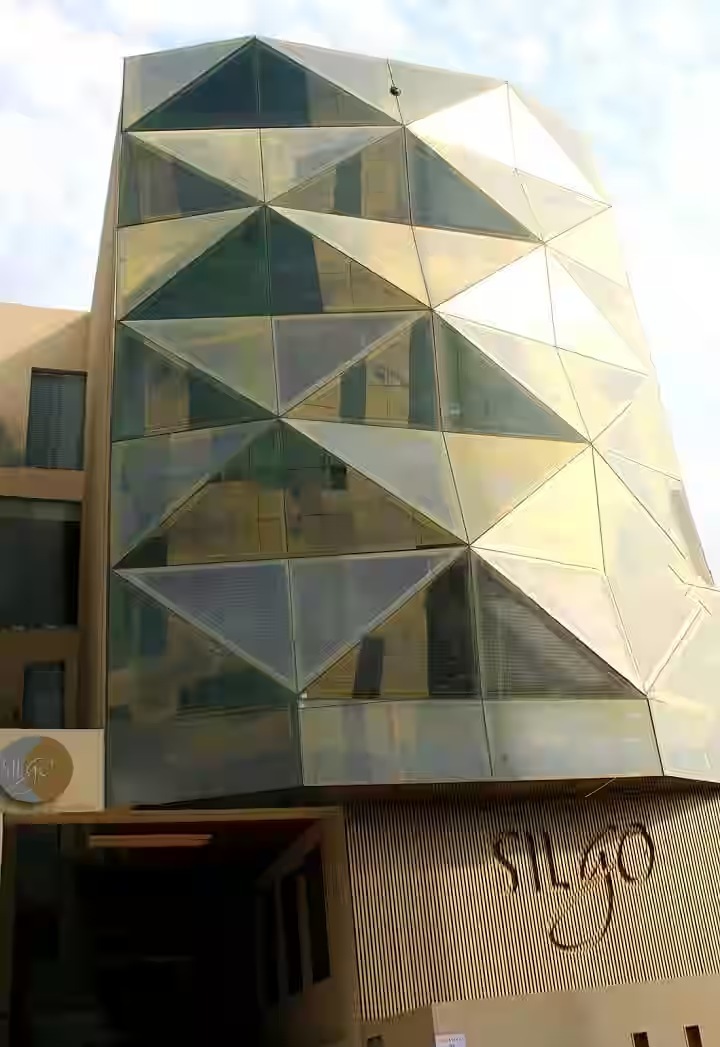
Silgo Retail FY26: A Silver Jeweller That Ended the Year Buying Solar Farms, With Inventory at 2.5x Its Own Sales
Spotted a factual error — a wrong number, date, or fact? Tell us and we will check the source.
General information and entertainment, not investment advice. The author is not a SEBI-registered adviser or research analyst. No recommendation, no promised returns. Markets carry risk including loss of capital. Figures may not be current. Consult a registered adviser before acting.
1. At a Glance
Silgo Retail closed FY26 with revenue of ₹47.03 crore and net profit of ₹5.76 crore — the highest profit in its recorded history, up 28.6% on the year. On paper, a jeweller compounding profit at 21% over five years. Underneath the paper, the ledger reads stranger.
Inventory sits at ₹120.08 crore against annual sales of ₹47.03 crore — roughly two and a half years of sales frozen as stock. Working capital days have stretched from 604 to 864. Promoter holding has collapsed from 69.93% a year ago to 40.44%, and 50 lakh of the promoter’s remaining shares are pledged. And in June 2026, a company that designs silver rings and jhumkis acquired 49% stakes in two solar developers.
The market pays about 42 times earnings for all of this, against a jewellery peer median near 18.6. A company reporting its best-ever profit while its inventory, its pledges, and its business definition all quietly rearrange themselves in the background. The record for the year is genuinely good. The record around the record is where the reading gets interesting.
2. Introduction
Silgo Retail Ltd was incorporated in 2016 and operates out of Jaipur, designing, manufacturing, retailing and wholesaling silver jewellery. It began dealing in gemstones from FY22. The catalogue is broad — rings, earrings, bracelets, necklaces, jhumki, bangles, customised pieces — all cast in 925 sterling silver and BIS-hallmarked.
The FY26 numbers arrived on 29 May 2026, audited by JKSS & Associates with an unmodified opinion. That was the calm part of the year. The rest of the FY26 calendar was busier than any product launch: a partly-paid rights issue in February raising a ₹44.29 crore issue size, a string of EGMs approving borrowing powers and corporate guarantees, an inter-corporate deposit from a single lender, promoter pledges, and finally, in June 2026, a move into solar power that has nothing to do with silver.
For a company with ₹47 crore of revenue, that is a remarkable volume of corporate action. The jewellery business, it turns out, was almost the least eventful thing about the year.
3. Business Model: WTF Do They Even Do?
Officially: silver jewellery. As of the last detailed disclosure, silver made up 99% of revenue and gemstones 1% — the gemstone diversification remaining, numerically, a rounding error. The split between making and buying was near-even, manufacturing 48% and trading 52%, which means roughly half the “manufacturer” is actually a reseller.
The Jaipur plant carries installed capacity of 7,000 kg per year, running at 27% utilisation. Three-quarters of the factory sits idle while the balance sheet holds ₹120 crore of inventory — a combination that would puzzle anyone expecting a factory and its stockroom to be on speaking terms.
Client concentration is high: the top five customers accounted for 73% of revenue and the top ten for 91%. Exports, once a line of business, were scaled back after COVID, with a stated plan to re-enter the US market that has been “planned” for some time now.
Then there’s the newest product line, which is not a product at all. In June 2026 the company acquired 49% each in Terraverde and Bluesky Renewables, and spun up ten wholly-owned “Silgo Power” subsidiaries. The business model, as of the latest filing, is: silver jewellery, gemstones, and electricity.
Does a jeweller running its factory at 27% need a second industry, or a better use of the first one?
4. Financials Overview
Figures are standalone, in ₹ crore.
Metric
FY26
FY25
YoY
Revenue
47.03
44.37
+6.0%
Operating Profit
8.82
6.26
+40.9%
PAT
5.76
4.48
+28.6%
EPS (₹)
1.80
1.87
−3.7%
Operating profit grew far faster than sales — OPM widened to 18.75% from 14.11%, the best margin on record. PAT rose 28.6%. Yet EPS fell, from ₹1.87 to ₹1.80. That is not a profit problem; it is a share-count problem. The rights issue lifted the equity base (adjusted shares moved from