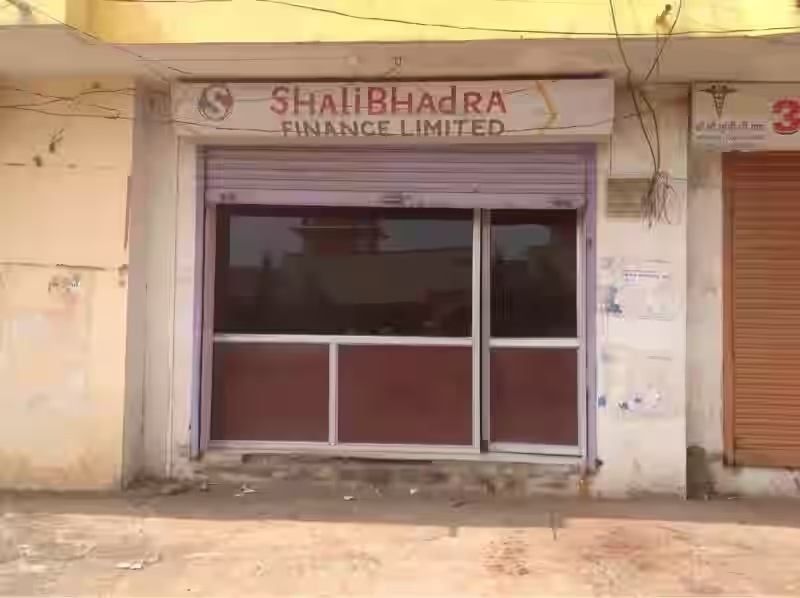
Shalibhadra Finance FY26: A ₹249 Cr Two-Wheeler Lender Trebles Its Share Count and Still Grows EPS 22%
Spotted a factual error — a wrong number, date, or fact? Tell us and we will check the source.
General information and entertainment, not investment advice. The author is not a SEBI-registered adviser or research analyst. No recommendation, no promised returns. Markets carry risk including loss of capital. Figures may not be current. Consult a registered adviser before acting.
1 — At a Glance
Shalibhadra Finance closed FY26 with revenue of ₹41.05 Cr, up 12.5% over FY25’s ₹36.48 Cr, and net profit of ₹19.48 Cr, a 21.7% climb. For a Mumbai-headquartered NBFC that lends farmers money to buy two-wheelers in rural Gujarat, that is a tidy set of numbers. The market cap sits at ₹249 Cr, and the market pays 12.8x earnings against an industry average of 22.7x.
The attention signal: profit growth has compounded at roughly 41% over five years. The worry signal sits one line below — cash from operating activity was negative ₹19.75 Cr, the second straight year of large operating cash outflow. For a lender, that is less alarm and more arithmetic; a growing loan book eats cash by design. But it is a number that deserves a chair at the table.
Equity share capital jumped from ₹7.72 Cr to ₹30.89 Cr this year — a detail that quietly rewires how every per-share figure reads.
The teaser: how does a company treble its share count and still report higher earnings per share? The answer is a bonus issue, and it is more interesting than it sounds.
2 — Introduction
Shalibhadra Finance was incorporated in 1992 and listed on the BSE in 1995. It began life financing four-wheelers in urban Gujarat, then retreated from that fight as banks crowded in, and repositioned around two-wheeler financing in rural and semi-urban pockets. Three decades later it operates 61 branches across four states, serves over 1.13 lakh customers, and runs an asset base that reached ₹232 Cr by March 2026.
The company describes FY26 as the first year of “Shalibhadra 2.0” — management’s framing for a shift from a single-product vehicle lender toward a broader rural credit platform. During the year it launched home loans and loan-against-property products, appointed a Chief Risk Officer in December 2025, and got approved for an NSE listing that began trading in April 2026.
The capital structure moved too. In June 2025 the company executed a 3:1 bonus issue, and across FY25 it raised roughly ₹45 Cr of fresh equity from promoters and high-net-worth investors. ICRA reaffirmed its long-term rating at BBB- (Stable) in March 2026 and assigned the same to a new ₹20 Cr NCD line.
The record here is of a small, old, family-run lender deciding — after thirty years of doing one thing — to become several things at once.
3 — Business Model: WTF Do They Even Do?
Shalibhadra lends small sums to rural people so they can buy vehicles, mostly two-wheelers. Ticket sizes run from ₹25,000 for a used scooter to ₹2,00,000 for a used car. Tenures stretch six to sixty months. The borrower is frequently a farmer or self-employed rural worker whose income arrives with the harvest and whose CIBIL score, if one exists, tells you little.
So the underwriting is deliberately old-fashioned. The company leans on local references — the sarpanch, an existing customer, mandi receipts, milk cooperative slips — to estimate whether a borrower can repay. It operates entirely through owned branches, no franchises, no direct-selling agents, on the logic that in villages you collect better when your own people know the streets. Nearly the entire loan book is secured against the vehicle financed, which management notes is easy to repossess when things go wrong.
The portfolio as of FY26: ₹215.98 Cr in new and used two-wheelers, ₹2.34 Cr in used four-wheelers, ₹0.91 Cr in three-wheelers, and ₹0.43 Cr in freshly launched personal loans. In other words, this is a two-wheeler lender with a rounding error of diversification — which is precisely the concentration “Shalibhadra 2.0” exists to fix.
The moat, such as it is, is unglamorous: three decades of knowing which villages pay back. That is harder to replicate than a fintech app, and considerably less fun to pitch.
Does a 5-lakh-customer relationship base built over thirty years survive a pivot into home loans, or does it just get tested by one?
4 — Financials Overview
Figures are consolidated, in ₹ crore. (The company reports standalone; there are no subsidiaries.)
Metric
FY26
FY25
YoY
Revenue
41.05
36.48
+12.5%
Operating Profit
25.72
20.71
+24.2%
PAT
19.48
16.01
+21.7%
EPS (₹)
6.31
5.18
+21.8%
Operating profit grew faster than revenue, which means the gap between what the loan book earns and what it costs to fund widened over the year. Finance costs actually fell — interest expense dropped from ₹5.43 Cr to ₹5.15 Cr even as the book grew — helped by the equity infusion reducing reliance on borrowed money.
From the concall: management flagged that yield on advances compressed from 25.4% in FY24 to 20.8% in FY26, attributing it to