Emerald Tyre H2 FY26: A ₹163 Cr Tyremaker Doubles Its Debt to Chase the World
Spotted a factual error — a wrong number, date, or fact? Tell us and we will check the source.
General information and entertainment, not investment advice. The author is not a SEBI-registered adviser or research analyst. No recommendation, no promised returns. Markets carry risk including loss of capital. Figures may not be current. Consult a registered adviser before acting.
1. At a Glance
Emerald Tyre Manufacturers closed FY26 with sales of ₹218 crore, up from ₹199 crore, and a net profit of ₹10.33 crore that barely moved from the prior year’s ₹10.43 crore. Revenue climbs, profit stalls — the gap between the two is where the year’s story lives.
Borrowings tell the loudest part of it. They jumped from ₹88 crore to ₹136 crore in twelve months, funding a capacity expansion the company says lifts its ceiling to ₹350 crore of annual sales. Against that stands ₹10.55 crore of cash — a company spending far ahead of what it currently earns.
The market pays 15.8x earnings here, below the peer median of 24x and an industry 24.2. Operating margin, meanwhile, slipped to 12.6% for the full year as raw-material costs and new-line ramp weighed on the mix.
There is an acquisition in South Africa, a tax matter headed for the Madras High Court, and a US tariff wall on Indian tyres. A small company carrying a lot of moving parts. Whether the expanded plant fills fast enough to cover the new interest bill is the question the next few halves will answer.
2. Introduction
Emerald Tyre Manufacturers was incorporated in 2002 and makes off-highway tyres — the fat, tough rubber that goes under forklifts, skid loaders, airport ground vehicles, and mining equipment. It sells them under the brand “GRECKSTER,” a name that sounds like a Marvel villain but describes solid resilient tyres and press-on bands.
The company listed on the NSE Emerge SME platform in December 2024, raising roughly ₹49 crore. Most of that went into a capacity build — new mixing plant, solid-tyre line, automatic tyre-building machines — commissioned largely through FY26. The declared aim is backward integration: bring rubber mixing fully in-house, cut external processing costs, and lift the revenue ceiling.
Exports drive the business. Management has stated 83% of revenue comes from outside India, with wholly-owned marketing subsidiaries in Belgium and the UAE. That reach is also the exposure: the United States has been a large export market, and in August 2025 the US imposed a roughly 58–60% effective tariff on Indian off-highway tyres, per the CARE rating report.
The recent moves cluster tightly. In January 2026 the board approved acquiring a 65% stake in a South African tyre firm for up to ₹14 crore. Earlier that month, a DGFT adjudication order landed, which the company plans to contest. FY26 audited results were approved on 25 May 2026, carrying a 10% dividend.
3. Business Model: WTF Do They Even Do?
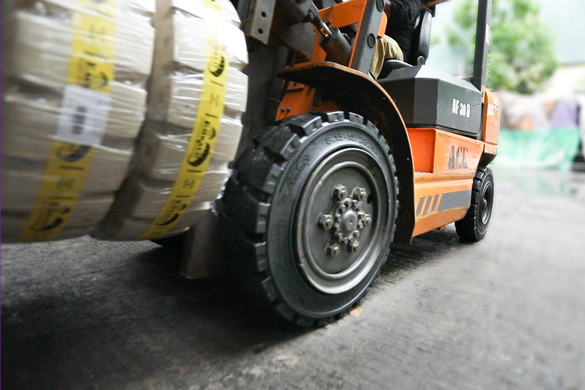
They make tyres for things that do not drive on roads. Forklifts in warehouses, reach trucks at ports, mowers on lawns, backhoe loaders at mines — anything that rolls slowly and carries weight sits on rubber Emerald might have moulded.
The portfolio splits roughly 50/50 between solid resilient tyres and industrial pneumatics, per management’s concall. Solids are the premium end — “more like an engineering piece,” as the CEO put it — sold with custom compounds that are non-marking, heat-resistant, anti-static, aqua-grip, and a half-dozen other adjectives that each solve a specific warehouse problem. Press-on bands and wheel rims round out the catalogue.
The model is customer-tailored and just-in-time, which sounds elegant until you look at the balance sheet and find inventory sitting for 220 days. That is the tax on making 1,416 SKUs, per the CARE report: to promise quick delivery on a thousand-plus variants, you warehouse a small mountain of rubber. The working-capital cycle ran 250 days on the data sheet — money goes out, tyres get made, and cash comes back the better part of a year later.
Channel mix leans on replacement demand abroad — management states exports are 80% replacement, 20% OEM, while domestic runs a 50/50 split. The subsidiaries in Belgium and Dubai don’t manufacture; they market and warehouse. Management describes them as profitability tools for the India entity rather than standalone businesses — a framing that also happens to park receivables overseas.
Does a customer-centric, thousand-SKU model earn its keep when it means a 250-day cash cycle? The margins will have to answer for the inventory.
4. Financials Overview
Figures are consolidated, in ₹ crore.
Metric
Latest Half (Mar 2026)
YoY (Mar 2025)
Prev Half (Sep 2025)
Revenue
113
101
105
Operating Profit
13
13
15
PAT
3
4
8
EPS (₹)
1.42
2.08
3.88
The top line grew year-on-year, but operating profit sat flat at ₹13 crore and PAT slipped to ₹3 crore. Half-yearly OPM landed at 11% against 14% a year earlier. Interest for the half rose to ₹8 crore from ₹5 crore — the cost of that new borrowing already showing up in the profit line. Tax rate for the half read 38%, higher than