Kataria Industries FY26: A Wire Maker Books Record Profit, Then Signs a ₹54 Crore Mumbai Property Deal With Its Own Directors
Spotted a factual error — a wrong number, date, or fact? Tell us and we will check the source.
General information and entertainment, not investment advice. The author is not a SEBI-registered adviser or research analyst. No recommendation, no promised returns. Markets carry risk including loss of capital. Figures may not be current. Consult a registered adviser before acting.
1 — At a Glance
Kataria Industries closed FY26 with sales of ₹331 crore, down about 5.6% from ₹351 crore the year before — and yet net profit rose to ₹12.1 crore, its highest on record, up from ₹10.96 crore. Revenue shrank while profit grew: the gap sits on the falling interest line, which dropped from ₹8.86 crore two years ago to ₹1.04 crore in FY26 after the IPO cleared out most of the debt.
That is the tidy part. The less tidy part is what the company did with the rest of its year. A Ratlam-based manufacturer of wires, conductors and post-tensioning accessories spent FY26 approving an amendment to its objects clause to enter real estate, then signed a development agreement for a Mahim, Mumbai property with M/s. M.J. Builders — a firm in which its own directors are partners — carrying a ₹54 crore interest-free refundable security deposit.
The operating business is steady. The corporate structure around it did a great deal of moving. A record profit and a ₹54 crore related-party deposit landed in the same twelve months.
Does a ₹12 crore profit engine explain a ₹54 crore property deposit, or is the deposit the story and the wire business the footnote?
2 — Introduction
Incorporated in 2004 and headquartered in Ratlam, Madhya Pradesh, Kataria Industries manufactures cables and conductors, LRPC stranded wire, un-galvanised and spring-steel wire, and post-tensioning anchorage accessories. It listed on the NSE SME Emerge platform on 22 July 2024, raising ₹54.57 crore through a fresh issue of 56.84 lakh shares.
The listing changed the balance sheet more than the factory. Borrowings fell from ₹63.37 crore at FY24 to ₹16.96 crore by FY25, and the interest bill fell with them. Since listing, the announcements have arrived in clusters: the FY25 acquisition of Ratlam Wires’ Wire Division on a slump-sale basis for ₹30.6 crore; a February 2026 board decision to diversify into real estate and amend the memorandum; the March 2026 Mahim development agreement; and an April 2026 EOGM approving loans, guarantees and related-party transactions running into ₹50 crore-plus limits.
The company also collected a ₹24,780 NSE fine in FY26 for a delayed Company Secretary appointment — paid, disclosed, and bookended by two CS departures inside eighteen months.
Three reportable segments carry the revenue: Wire, Cable & Conductor, and PTS accessories. For FY26 the Wire segment brought in roughly ₹225 crore of the ₹331 crore total, Cable & Conductor about ₹96 crore, and PTS about ₹11 crore — the audited segment note lays it out.
3 — Business Model: WTF Do They Even Do?
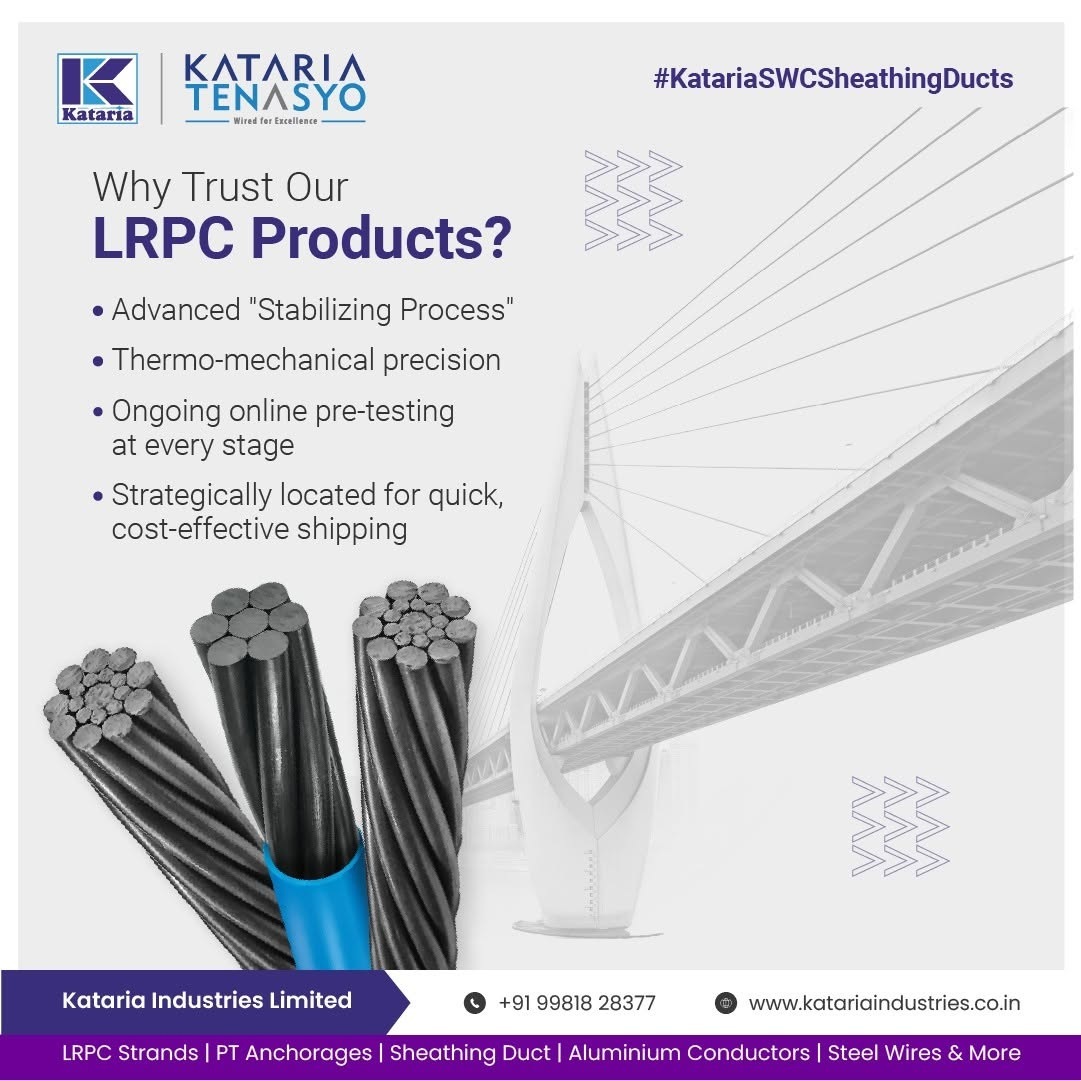
Strip away the corporate actions and Kataria makes long thin metal things and the bits that hold them in place. LRPC stranded wire — the high-tensile steel strand that gets tensioned inside concrete bridges, flyovers and metros — is the anchor product. Around it sit ACSR/AAC aluminium conductors for power transmission, un-galvanised and spring-steel wire, and the post-tensioning accessories: bearing plates, wedges, HDPE ducts, couplers.
The installed capacity reads like a hardware catalogue: 45,000 MT of wire, 31,500 MT of bearing plate, 6.75 lakh MT of HDPE duct pipe, 6,750 MT of conductor. These feed infrastructure end-markets — roads, railways, high-rise, and, per the company’s own product literature, atomic reactors and LNG tanks, which is a sentence that makes the PTS accessories sound rather more dramatic than a wedge usually gets to be.
The Wire segment does the heavy lifting, contributing the bulk of both revenue and segment profit; Cable & Conductor is the second engine, and PTS the small high-margin tail. There is also a windmill in Dewas, Madhya Pradesh, feeding power to the grid — the kind of asset a wire company acquires and then mentions once a year.
It is a real, unglamorous industrial business with genuine capacity and genuine customers. Which is precisely why the pivot into Mumbai property development, arriving mid-year, sits at such an odd angle to everything above it.
When a company that makes bridge cable amends its charter to build apartments, the interesting number is rarely on the income statement.
4 — Financials Overview
Figures are standalone, in ₹ crore. The reporting cadence is half-yearly; the latest period is H2 FY26 (ended March 2026).