Krishca Strapping FY26: ₹234 Cr of Revenue, Flat Profit, and a Steel-Strap Maker Quietly Becoming a Superalloys Company
Spotted a factual error — a wrong number, date, or fact? Tell us and we will check the source.
General information and entertainment, not investment advice. The author is not a SEBI-registered adviser or research analyst. No recommendation, no promised returns. Markets carry risk including loss of capital. Figures may not be current. Consult a registered adviser before acting.
1 — At a Glance
Krishca Strapping Solutions closed FY26 with standalone revenue of ₹233.65 crore, up 57% on the year — the kind of number that usually comes with a matching profit line. It didn’t. Net profit landed at ₹11.61 crore, fractionally below FY25’s ₹11.74 crore. Revenue grew by more than a third; the bottom line stood still.
The second-half figures sharpen the split. Sales in the March 2026 half rose about 64% year-on-year to ₹141 crore, while profit for that half fell to roughly ₹5 crore from ₹6 crore. Operating margin in the half slipped to 10% from 15%. A company that was steadily converting scale into earnings suddenly wasn’t.
Behind the numbers sits a heavier story: capital work-in-progress on the balance sheet ballooned from ₹6.29 crore to ₹88.19 crore, financing arrived through two preferential allotments, and the Chairman told investors his personal focus is moving away from steel straps toward specialty steel and superalloys.
A ten-year-old strapping manufacturer is trying to rebuild itself mid-flight. The revenue says one thing, the profit another, and the balance sheet is where the argument is being settled.
2 — Introduction
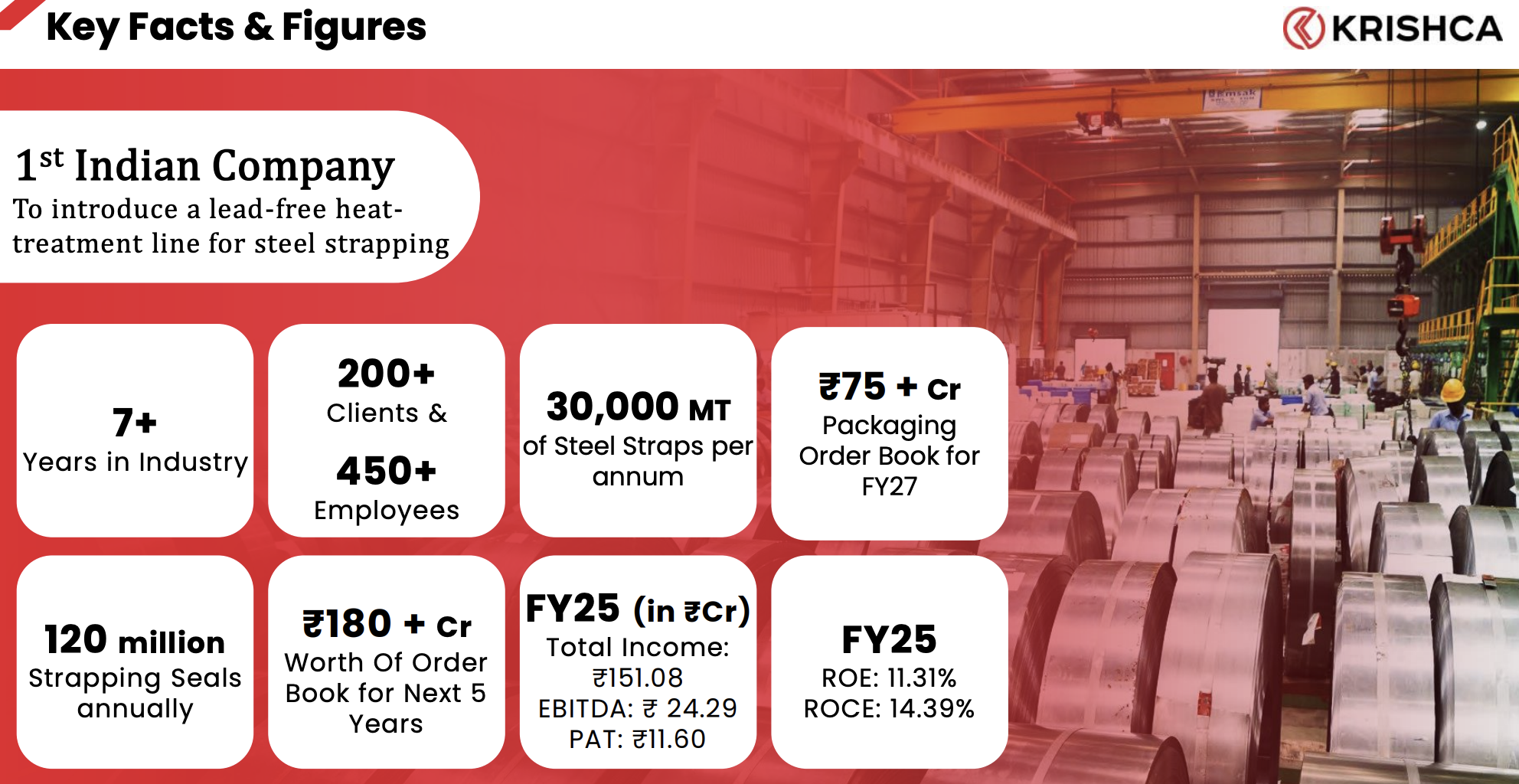
Incorporated in 2017 in Sivakasi and now run out of Mappedu, Chennai, Krishca makes high-tensile steel straps, strapping seals and the tools that tension them — the metal banding that holds steel coils, bar bundles and heavy freight together. It listed on NSE Emerge in 2023 and holds, by its own account, roughly a 10% share of the Indian steel-strapping market, with India’s first lead-free heat-treatment line as its calling card.
For most of its short public life the story was clean: revenue compounding about 90% over five years, a packaging-contracts division added, subsidiaries opened in the UAE and Singapore. Then FY26 turned into a construction year. The company began commissioning a 60,000 TPA Cold Rolling Complex in Chennai at a stated capex of around ₹80 crore, aimed at precision stainless and high-carbon strip — a segment India largely imports. Alongside it, the board approved Vajra Alloys, a subsidiary meant to push into superalloys and high-performance materials.
The FY26 results, the two preferential allotments in early 2026, and the exchange clarification that followed are all part of one thing: a strapping company deciding it wants to be a metals company. This entry records where that stood at year-end.
3 — Business Model: WTF Do They Even Do?
At its core, Krishca sells the least glamorous product in the steel supply chain: the band that stops other people’s steel from falling off the truck. Steel straps are the flagship; steel seals and tensioning tools round out the kit. Durable, boring, necessary — the packaging equivalent of a seatbelt nobody thinks about until it’s missing.
The more interesting layer is the packaging-contracts business, where Krishca doesn’t just sell straps but takes over a client’s coil-strapping and wrapping operations on multi-year deals. Management has said this vertical touched roughly a third of H1 FY26 revenue and is the piece it wants to grow toward half the topline — the logic being that contracts are stickier than selling banding on spot pricing. Marquee names appear on the client list: Tata Steel, JSW, SAIL, Shyam Metalics, and ESL of the Vedanta group.
Then there’s the portfolio sprawl. What began as straps now officially includes tarpaulins, HDPE rolls, dunnage air bags, lashing belts, PET straps, desiccants, silica gel and VCI corrosion coatings. It reads less like a product line and more like the contents of a very ambitious industrial supply closet.
And sitting on top of all of it now: cold-rolled precision strip and, eventually, superalloys. That’s three businesses at three different maturity levels — a cash-generating strapping operation, a barely-started strip mill, and a superalloys venture that exists mostly as a board resolution.
Does a company with 10% of the strapping market need a superalloys division? The answer costs ₹88 crore of capital work-in-progress to find out.
4 — Financials Overview
Figures are standalone, in ₹ crore.
Metric
Latest Half (Mar 2026)
YoY
Prev Half (Sep 2025)
Revenue
141
+64%
93
Operating Profit
14
+8%
15
PAT
5
−17%
6
EPS (₹)
3.65
−18%
4.34
The March half is the whole entry in miniature: revenue sprinting, operating profit walking, PAT and EPS drifting backward. Revenue rose 64% while operating profit added only 8% — margin did the losing. Operating margin in the half came in near 10%, down from