General information and entertainment, not investment advice. The author is not a SEBI-registered adviser or research analyst. No recommendation, no promised returns. Markets carry risk including loss of capital. Figures may not be current. Consult a registered adviser before acting.
1. At a Glance
Srivari Spices & Foods closed the March 2026 half with revenue of ₹95.65 crore, up 61.9% over the same half a year earlier, and profit of ₹9.04 crore, up 87.9%. For a Hyderabad spice-and-atta maker that first listed on the NSE SME platform in August 2024, that is a topline moving at a pace most food companies would frame and hang on a wall.
Then there is the second number that travels with it. For the full year, the company earned ₹16.17 crore in net profit — and its operating activities consumed ₹14.03 crore in cash. Profit rose; cash left the building. Both figures are audited, both carry an unmodified auditor opinion, and both are true at the same time.
The gap between them lives in the working capital. Receivables reached ₹57.24 crore against ₹171.81 crore of full-year sales, and inventory sits at ₹45.65 crore. A company can book a sale and still be waiting for the money, and this one is waiting on a lot of it.
The record here is a growth story and a collections story stapled together. The rest of this entry works through both, plus a subsidiary that was sold to the people who run the company, and an approved plan to sell more shares.
2. Introduction
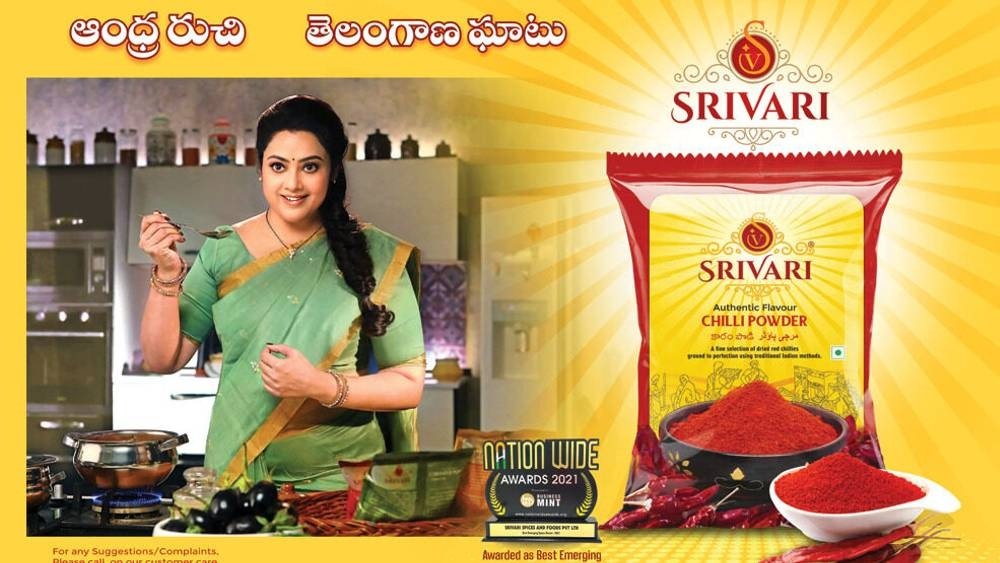
Srivari Spices and Foods was incorporated in 2019 and, per its filings, describes itself as an FMCG company in the business of food and food-related products. It began in spice manufacturing and expanded into atta, masalas, edible oils and groceries, operating out of two manufacturing facilities in Telangana. The brand carries over 88 SKUs, with a separate online grocery line historically run under the “Poushtik” name.
The company reached the public market in August 2024 through an SME IPO of 21.42 lakh equity shares raising ₹899.64 lakh. In October 2024 it raised a further ₹25 crore through a rights issue, deploying the proceeds toward oil-plant capex (₹8.64 crore), unsecured-loan repayment (₹1.9 crore), working capital (₹10 crore) and general corporate purposes (₹4 crore).
More recently, in January 2026 the board proposed increasing authorised capital and pursuing a Further Public Offering of up to ₹35 crore, which shareholders approved by postal ballot in February 2026 with 99.84% of votes in favour. So within eighteen months of listing, the company has run an IPO, a rights issue, and secured approval for an FPO. The capital-raising cadence is, at minimum, energetic.
The year also carried one corporate-structure change worth its own section later: the wholly-owned subsidiary Srivari Supply Chain Private Limited was sold to the promoter directors and ceased to be part of the group as of 30 September 2025.
3. Business Model: WTF Do They Even Do?
They grind and pack the things that make Indian food taste like anything. Spices and masalas, whole wheat and Sharbati atta, edible oils, and a grocery range spanning pulses, grains and ghee. Atta and spices are the two load-bearing walls — roughly 51% and 49% of FY25 revenue respectively — which means this is, at heart, a flour-and-chilli-powder business wearing an FMCG jacket.
Production runs through two Telangana plants: spices and masala at 3,600 MTPA, atta at 14,400 MTPA, and a newer 7,200 TPA oil line. The geographic footprint is deliberately narrow — Telangana and Andhra Pradesh, with products in over 18,000 retail stores, a shelf presence in Ushodaya and Balaji Grand Bazar outlets, and online availability through DMart. This is a two-state operator, and it does not pretend otherwise.
The go-to-market is described as an integrated B2B, B2C and e-commerce model serving general trade, modern trade and institutional (HoReCa) clients, with a B2B partnership through Jumbotail. Management has characterised the bulk of sales as flowing through general trade rather than direct-to-consumer.
The tell of a company this young is the SKU ladder — sachets to bulk packs, built to cover every price cohort in a general-trade market. It is a distribution philosophy that trades margin per unit for shelf ubiquity. Whether shelf ubiquity in two states is a moat or a starting line is the question the rest of the numbers keep asking.
Does a two-state, 18,000-store footprint constitute reach, or is it the on-ramp to needing much