Shri Dinesh Mills FY26: A ₹200 Cr Textile Relic Where Other Income Out-Earns the Looms
Spotted a factual error — a wrong number, date, or fact? Tell us and we will check the source.
General information and entertainment, not investment advice. The author is not a SEBI-registered adviser or research analyst. No recommendation, no promised returns. Markets carry risk including loss of capital. Figures may not be current. Consult a registered adviser before acting.
1. At a Glance
Here is a 91-year-old textile company whose factory produces less profit than its investment portfolio. In FY26, Shri Dinesh Mills posted sales of ₹67.72 Cr and an operating profit of ₹3.24 Cr — a 4.78% operating margin. Sitting right beside that thin sliver is other income of ₹8.72 Cr, comfortably more than twice what the actual mills earned. Net profit landed at ₹7.6 Cr.
The company is near debt-free, carrying just ₹3.96 Cr of borrowings against a net worth of ₹200 Cr. It trades at 0.99 times its book value of ₹358. Working capital days swung from 254 to a staggering 880 over the period — a number that would make most CFOs check their spreadsheet twice.
Meanwhile, the promoter families have signed a settlement agreement and the board has approved an in-principle demerger of the FELT business into its own entity. A company this quiet rarely restructures itself. When it does, the record is worth reading closely.
Does a balance sheet stuffed with ₹170 Cr of investments make the operating business relevant, or has it already become a footnote to its own portfolio?
2. Introduction
Incorporated in 1935, Shri Dinesh Mills has spent nine decades in worsted fabrics, papermakers’ felts and industrial textiles. The worsted-fabrics line — the menswear cloth that carried the name for generations — was discontinued from October 2018 at the Vadodara and Ankleshwar facilities. What remains on the textile side are press felts, dryer screens, and industrial filter fabrics.
For years the group also ran a pharmaceutical arm through subsidiary Dinesh Remedies, a maker of empty hard gelatin capsule shells. That chapter closed in September 2025, when the company completed the sale of Dinesh Remedies for ₹5.43 Cr, and the subsidiary — which contributed roughly 30% of consolidated turnover — exited the fold.
So the FY26 entry records a company in the middle of shedding skin: out of worsted, out of pharma, and now proposing to split its felt operations away from everything else. The audited results for the year ended 31 March 2026 were approved by the board on 27 May 2026, with an unmodified audit opinion from R.K. Doshi & Co LLP. The figures below are consolidated, in ₹ crore.
3. Business Model: WTF Do They Even Do?
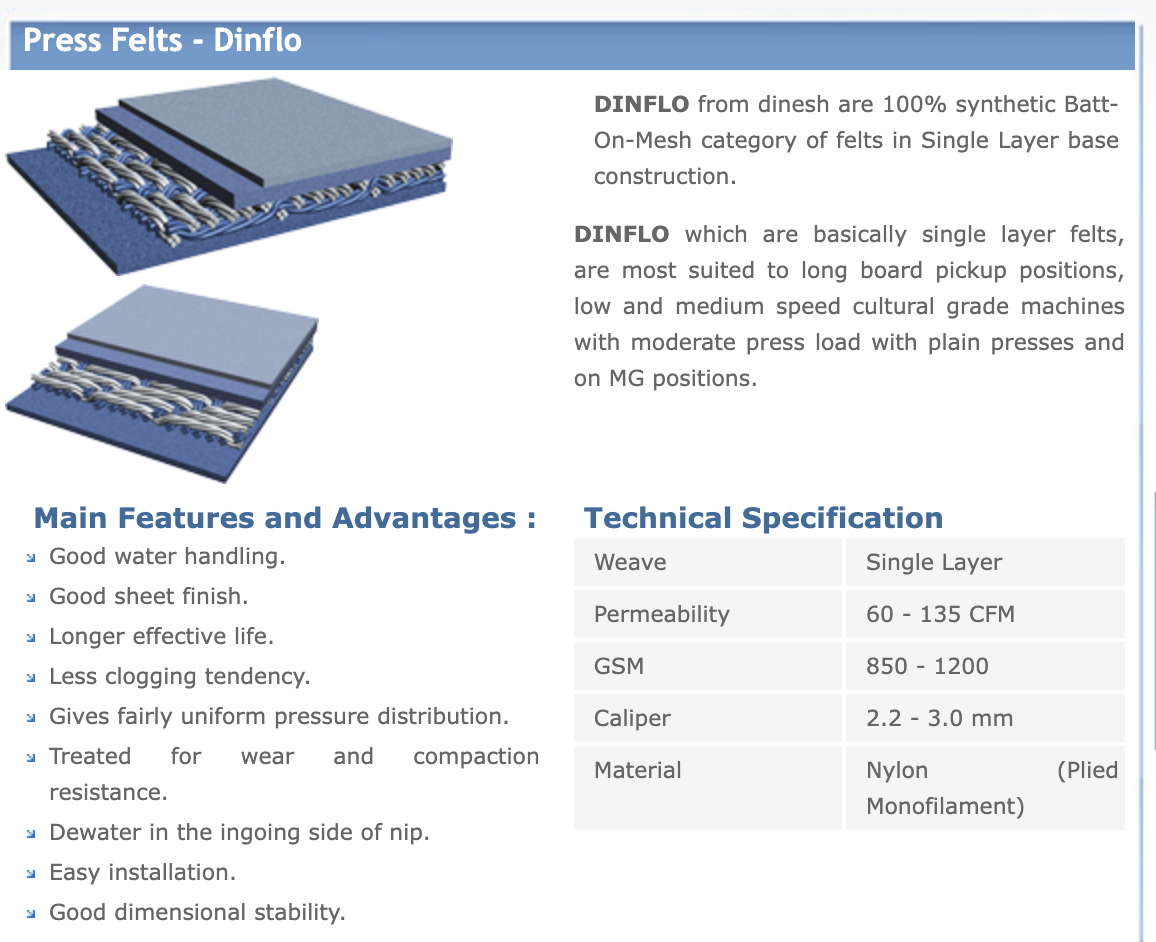
Strip away the heritage and Dinesh Mills makes felt — specifically the felts and screens that live inside paper machines. Press felts (Dinflo, Dinvent, Dinply), dryer screens (Hi Contact Mono, Spiral Dryer Fabrics), and fibre-and-asbestos felts (Dinasorb) are the catalogue. It is a genuinely niche, unglamorous, consumable industrial product — the kind of thing a paper mill buys, wears out, and reorders, forever.
That should be a decent annuity business. The problem is scale: FY26 sales of ₹67.72 Cr are lower than the ₹94.58 Cr the company booked back in FY17. Over five years, sales have compounded at negative 1.43%. This is a business whose top line has been walking backwards for the better part of a decade.
What has been growing instead is the investment book — ₹170.59 Cr parked in investments against a ₹229 Cr balance sheet. Somewhere along the way, a textile manufacturer quietly became a holding company with a felt division attached. The FELT demerger now makes that structural reality official.
Exports were around 9% of revenue as last disclosed; the rest is domestic. The pharma segment that once contributed nearly 39% of the mix has been sold. What’s left is a smaller, felt-shaped company whose earnings increasingly depend on what its portfolio does, not what its looms weave.
If a manufacturer’s investments earn more than its factory, is it still a manufacturer — or an investment trust that happens to own machines?
4. Financials Overview
Figures are consolidated, in ₹ crore. The March 2026 quarter is the latest period.