Suryalata Spinning Mills FY26: A ₹192 Cr Yarn Maker Where Profit Doubled While Sales Went Nowhere
Spotted a factual error — a wrong number, date, or fact? Tell us and we will check the source.
General information and entertainment, not investment advice. The author is not a SEBI-registered adviser or research analyst. No recommendation, no promised returns. Markets carry risk including loss of capital. Figures may not be current. Consult a registered adviser before acting.
1 — At a Glance
Suryalata Spinning Mills closed FY26 with revenue of ₹483.8 crore, almost exactly where it sat in FY23 at ₹484 crore. Three years, a full round-trip, back to start. Yet net profit for the year landed at ₹35.5 crore, up from ₹15.4 crore the year before — a 131% jump on a top line that shrank 2%.
That gap is the whole story. When profit more than doubles while sales stand still, the money is coming from somewhere other than selling more yarn. Operating profit did recover to ₹51 crore from ₹38 crore, but sitting beside it is Other Income of ₹15.4 crore — up from ₹4.75 crore — carrying a Telangana government interest-subsidy reimbursement.
The market currently pays 5.4 times earnings here, against an industry multiple of 24 and a peer median near 23. The company holds a book value of ₹700 per share and trades below it. A profit that doubled, a multiple that didn’t move — that tension runs through every section below.
2 — Introduction
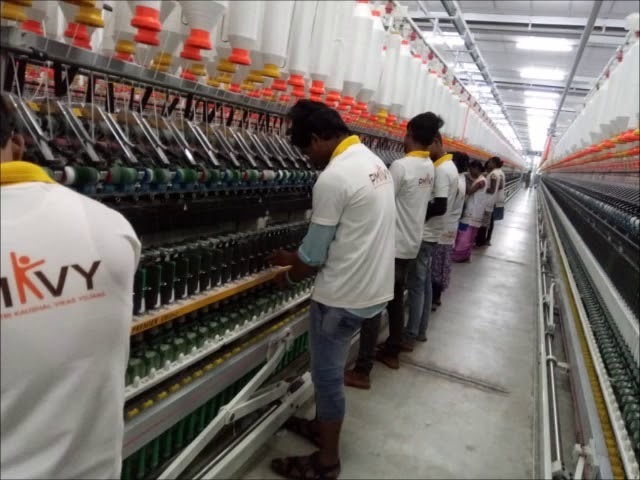
Suryalata was incorporated in 1983 in Telangana and has spent four decades doing one thing: spinning synthetic yarn. It runs two facilities, at Kalwakurthy and Urkondapet, with a combined capacity of roughly 119,280 spindles. The promoter family — the Agarwals — still holds 70.36% of equity, and the founder, Vithaldas Agarwal, remains Managing Director.
The recent moves are modest but real. In FY26 the company took a debt-funded capex to install eight additional vortex spinning machines, adding capacity equivalent to 12,000 ring spindles. Vortex spinning produces a more uniform, low-hairiness yarn; the company has built infrastructure to scale that line further over coming years. The credit rating stayed at IND BBB+/Stable, affirmed in November 2025.
The other limb of the business is solar. Suryalata’s wholly owned subsidiary, Suntree Solar Energy, runs a 10 MW plant in Telangana under a 20-year power-purchase agreement with the state, roughly 12 years of which remain. In FY26 the solar segment contributed ₹11.8 crore of the ₹499 crore consolidated revenue — small, but steady.
At the May 2026 board meeting, the company recommended a 20% equity dividend of ₹2 per share to non-promoter holders only; the promoters voluntarily waived their portion. An 8% dividend on cumulative redeemable preference shares was also cleared. A retired IPS officer, Gautam Damodar Sawang, joined as independent director.
3 — Business Model: WTF Do They Even Do?
They turn petroleum by-products into thread. Polyester staple fibre — priced off crude oil — and viscose staple fibre go in one end; spun yarn in counts from Ne 10s to Ne 60s comes out the other, in single, two-ply and multifold varieties. There are melange yarns, slub yarns, fancy yarns, sewing thread. If it can be spun and sold to someone stitching a shirt, Suryalata spins it.
The product sheet is genuinely long, which is the polite way a commodity business signals it will make whatever the market wants this quarter. This is the core problem the numbers keep circling back to: yarn is a price-taker’s game. The credit assessment flags it plainly — limited bargaining power with suppliers, margins exposed to raw-material swings, and an industry crowded with small unorganised players. When your input is linked to crude and your output is a fragmented commodity, you don’t set prices; you accept them.
Which is why the two side-ventures matter more than their revenue suggests. Solar power meets a chunk of the plants’ energy needs at a fixed low tariff, insulating the one cost line a spinner can actually control. And the vortex line is an attempt to climb slightly up the value ladder toward a more differentiated yarn.
Sales volumes tell their own tale: 22,862 tonnes in FY25 against 27,467 the year before. Fewer tonnes, but a better realisation per kilo — polyester yarn realisation rose to roughly ₹178 per kg. The business sold less and earned more per unit, which is either discipline or the market simply moving under its feet.
Does a decades-old spinner with a solar sideline and a new vortex line have a moat, or just a lower electricity bill? Hold that thought.