GP Petroleums FY26: Promoters Sold Half Their Stake — And the Numbers Barely Noticed
Spotted a factual error — a wrong number, date, or fact? Tell us and we will check the source.
General information and entertainment, not investment advice. The author is not a SEBI-registered adviser or research analyst. No recommendation, no promised returns. Markets carry risk including loss of capital. Figures may not be current. Consult a registered adviser before acting.
1. At a Glance
Something strange happened at GP Petroleums over the last three years, and the income statement is the last place you’d find it. Promoter holding fell from 63.44% in mid-2023 to 37.05% by March 2026 — a parent group quietly walking out the front door, stake by stake. Meanwhile the actual business did almost nothing dramatic: revenue of ₹643 Cr in FY26, up from ₹609 Cr a year earlier, net profit of ₹26.47 Cr against ₹26.32 Cr. Two full years of ownership upheaval, and PAT moved by ₹0.15 Cr.
The company makes lubricants under the IPOL brand and holds exclusive India rights to Spanish major Repsol’s automotive line. Operating margin sits at roughly 6% — where it has sat, give or take, for a decade. Borrowings are down to ₹23 Cr against a net worth of ₹355 Cr. The market pays about 7x earnings here, against a peer median near 13x.
The tension worth watching: a company whose financials are placid to the point of boredom, wrapped inside a promoter exit and a management chair that keeps changing occupants. Does the ₹355 Cr net worth care who owns 37% of it? The next few sections lay out what the record shows.
2. Introduction
GP Petroleums Ltd was incorporated in 1983 and manufactures and markets industrial and automotive lubricants, rubber process oils and greases, alongside trading in base oil, bitumen and fuel oil. It is the listed Indian arm of the Gulf Petrochem group, with UAE-based GP Global APAC Pte Ltd as the parent promoter.
The recent chapters are mostly about that parent. Per India Ratings, the group has been reorganising and restructuring its wider operations, and GP Global APAC has been selling down its GPPL stake — an aggregate 13.89% went to Singapore-based Incubit Energy, while the other promoter, Nivaya Resources, offloaded its holding in the market entirely. India Ratings notes management has given an undertaking that the group-level restructuring will not draw cash out of GPPL, and that there are no inter-company loans or guarantees. The rating stands at IND BBB-/Stable.
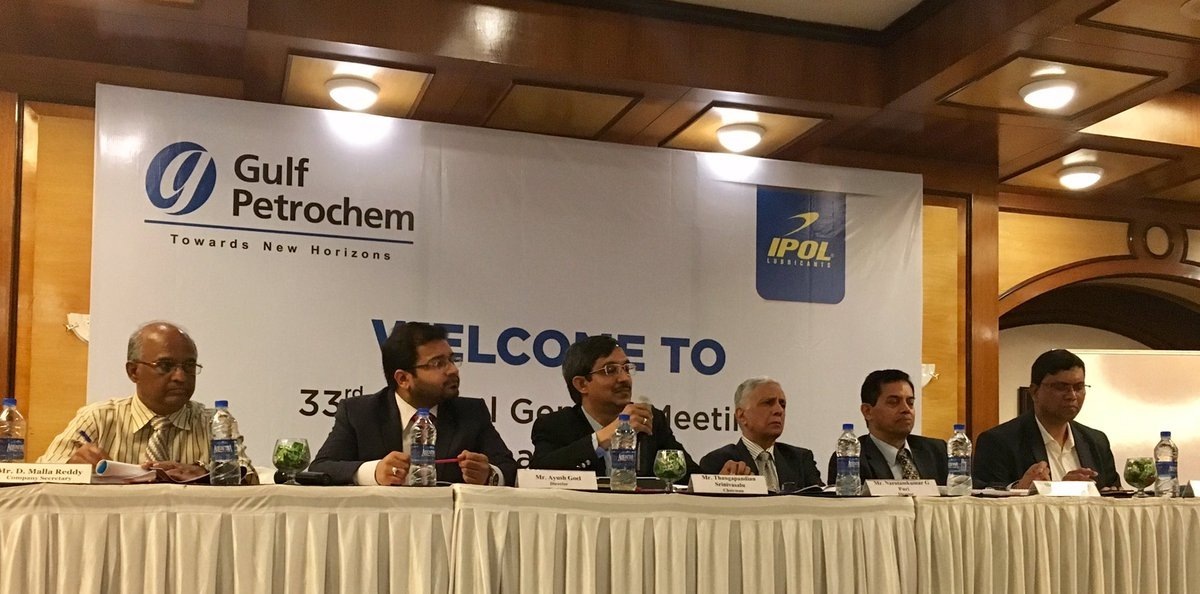
The management churn has been near-continuous. Ayush Goel was appointed Chairman & Managing Director in January 2026 for a five-year term. Two CEO figures have exited in recent quarters, most recently Pradeep Kishore Mittal stepping down as CEO-Lubricants in January 2026. And at the May 2026 board meeting, one director resigned while two were appointed. A lot of doors opening and closing above a shop floor that keeps running.
3. Business Model: WTF Do They Even Do?
They make oil that other oils rely on. IPOL covers automotive engine oils, gear oils, greases, coolants, brake fluids; the industrial side runs metalworking fluids, corrosion preventives, quenching oils and specialty greases; and there’s a rubber-process-oils vertical selling aromatic, naphthenic and paraffinic oils. Underneath a single manufacturing facility in Vasai with 80,000 KL annual lubricant capacity and 15,000 KL of oil storage.
The crown jewel is a 2016 tie-up with Repsol, giving GPPL exclusive rights to make and sell the Spanish major’s premium automotive lubricants across India. This is the part of the business that gets to charge more.
The rest is a tale of two segments. In FY26, manufacturing brought in ₹536 Cr of revenue and ₹38.5 Cr of segment profit; trading brought ₹107 Cr of revenue and ₹1.4 Cr of profit. Read that again: trading is 17% of revenue and roughly 4% of segment profit. It is the business equivalent of running a second job that pays in bus fare. Management has told India Ratings it will curtail trading volumes and lean on manufacturing — which is another way of saying the segment that barely makes money will be allowed to make even less of it, on purpose, and the margin mix should improve for the trouble.
Does a lubricant maker need a bitumen-trading side hustle? The FY26 mix suggests the company is asking itself the same question.
4. Financials Overview
Figures are consolidated, in ₹ crore. The latest reported period is the quarter ended March 2026.
Metric
Latest Q (Q4 FY26)
YoY
QoQ
Revenue
162.66
−11.0%
−3.9%
Operating Profit
12.53
−2.5%
+44.5%
PAT
9.33
+8.2%
+78.0%
EPS (₹)
1.83
+8.3%
+77.7%
Revenue fell year-on-year, yet PAT rose — a gap that tightens once you see the March quarter carried a lighter cost