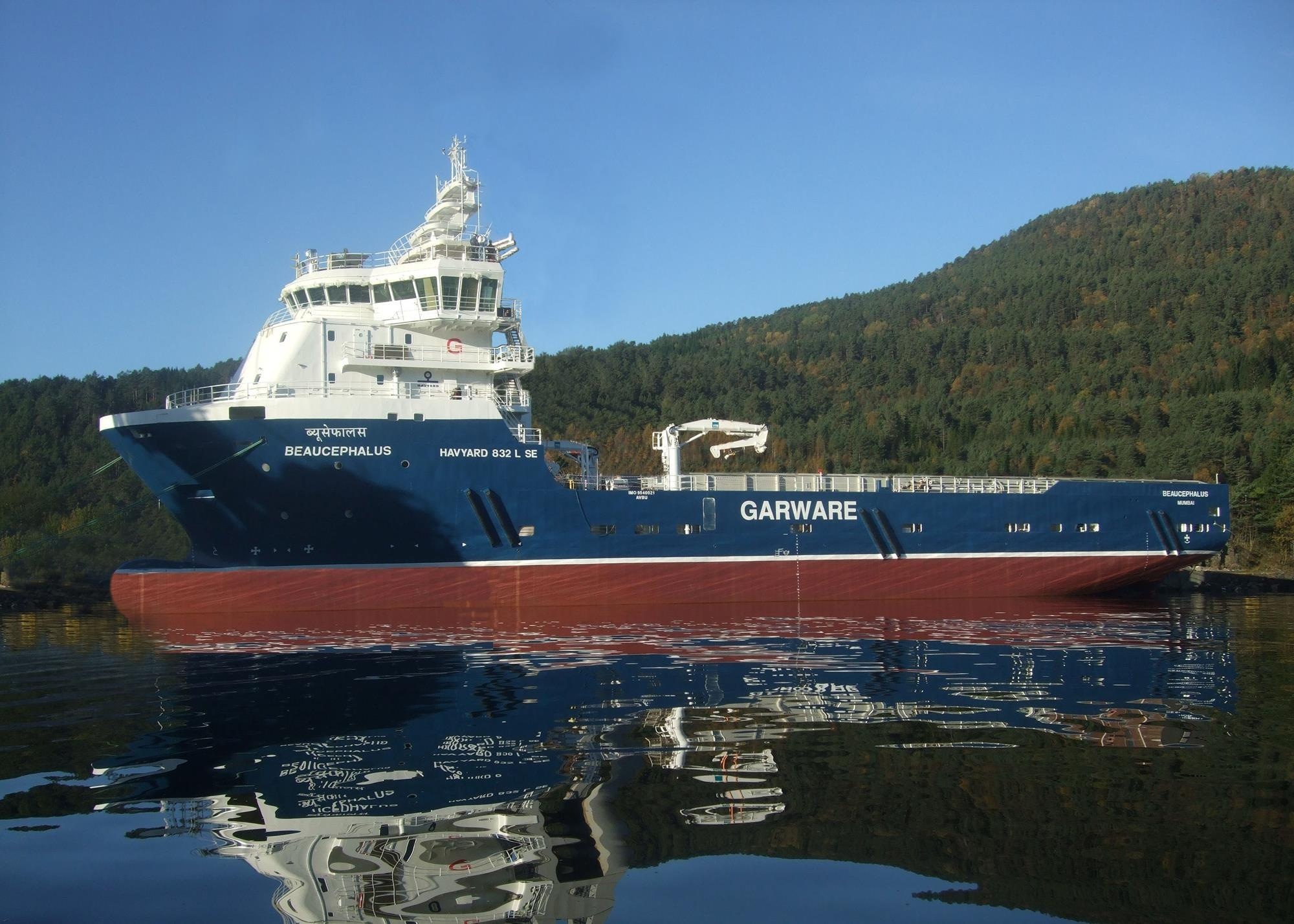
Garware Offshore Services FY26: Three Vessels, ₹172 Crore, and a Loss the Operating Line Didn’t Order
Spotted a factual error — a wrong number, date, or fact? Tell us and we will check the source.
General information and entertainment, not investment advice. The author is not a SEBI-registered adviser or research analyst. No recommendation, no promised returns. Markets carry risk including loss of capital. Figures may not be current. Consult a registered adviser before acting.
1 — At a Glance
Garware Offshore Services closed FY26 with revenue of ₹35.72 crore, up from ₹32.75 crore a year earlier, and an operating profit of ₹6.55 crore at an 18.3% margin. So far, a recovery story. Then the rest of the income statement arrives: depreciation of ₹18.10 crore, interest of ₹4.44 crore, and the year ends in a net loss of ₹9.29 crore against a ₹3.65 crore profit the prior year.
The number that explains the swing is not on the operating line. FY24 had carried a ₹37.67 crore profit built largely on ₹61.62 crore of other income — debt-settlement and write-back gains, not chartering. As those one-offs taper (other income fell to ₹7.55 crore in FY26), what remains is a three-vessel fleet trying to cover a depreciation and interest load sized for a much larger company.
The market caps it at ₹172 crore — about 1.38 times book value of ₹40.6 per share. ROCE sits at -5.87% and ROE at -11.6%. The order book, meanwhile, is filling: a fresh letter of award in June 2026 for one vessel at ₹31 crore a year, for four years plus an option. The tension for the year is whether the new contracts arrive fast enough to outrun the depreciation that fleet expansion drags behind it.
2 — Introduction
Incorporated in 1976 and known until recently as Global Offshore Services, the company owns, operates and charters offshore support vessels — the workboats that ferry crew, cargo and anchors out to oil-and-gas rigs. Its history is a single long arc bent by one event: the 2015 oil-price crash, after which most of its charters were terminated or repriced. A fleet that once ran to fifteen vessels was reduced, through asset sales to repay lenders, to two.
The post-crash decade has been a restructuring exercise. The company has settled dues with its lenders and, by FY26, is rebuilding. The board approved a name change to Garware Offshore in December 2025, an NSE re-listing application, and the setup of three wholly-owned subsidiaries — two of which, Mahanadi Offshore Services and Kamet Offshore Services, were incorporated in early 2026 but had not commenced operations by year-end.
Leadership changed at the top too: Aditya A. Garware was appointed Chairman and Managing Director effective 1 November 2025. The fleet now stands at three vessels — M.V. Kamet, M.V. Mahanadi and M.V. Mahananda — with the company targeting two to three more mid-size vessels between 2026 and 2028.
3 — Business Model: WTF Do They Even Do?
They rent out boats. Specifically, three offshore support vessels — one DP2 platform supply vessel and two anchor-handling tug-cum-supply vessels — chartered to oil-and-gas operators who need things moved around the deep water near their rigs.
The model is brutally simple and brutally cyclical. Revenue is one segment only: charter of offshore support vessels. There is no second leg to lean on, no consumer business to smooth the lumps. When a vessel is on a long-term contract, it earns; when it’s between contracts, it’s a depreciating steel asset with a USD loan attached. As of March 2026, two of the three vessels were on long-term charter — the third the swing factor in every quarter’s revenue.
The economics rhyme with a taxi that costs ₹18 crore a year just to keep parked, since that’s roughly what FY26 depreciation ran. The client list is genuinely blue-chip — ONGC, Vedanta, BP, Shell, Petrobras across a four-decade history — which is the reputation a vessel owner trades on. But reputation doesn’t depreciate; vessels do. The average fleet age has crept toward the high teens, and offshore assets have a sustainable working life of around 27 years, which is the clock every acquisition decision is racing.
The strategic pitch is “secure term contracts, guarantee visibility, generate positive operating profit.” On the operating line, FY26 delivered exactly that. The trouble is everything below it.
Does a three-vessel fleet earn enough on charter to outrun what three vessels cost to own?
4 — Financials Overview
Figures are consolidated, in ₹ crore.
Metric
Latest Q (Mar 2026)
YoY (Mar 2025)
QoQ (Dec 2025)
Revenue
12.48
8.97
12.24
Operating Profit
2.73
1.43
4.40
PAT
-5.58
-1.85
-2.00
EPS (₹)
-1.82
-0.60
-0.65
Quarterly revenue of ₹12.48 crore is the highest of the four periods shown and up 39% year-on-year, with operating profit of ₹2.73 crore positive across the line. The loss of ₹5.58 crore sits below operating profit, and the filing names the parts: depreciation rose by ₹144 lakh in the quarter — a one-time provision for short depreciation booked in earlier quarters, per the