Spotted a factual error — a wrong number, date, or fact? Tell us and we will check the source.
General information and entertainment, not investment advice. The author is not a SEBI-registered adviser or research analyst. No recommendation, no promised returns. Markets carry risk including loss of capital. Figures may not be current. Consult a registered adviser before acting.
1 — At a Glance
Aastha Spintex is raising ₹170 crore in fresh capital, and before a single rupee lands, ₹121.51 crore of it is already committed — ₹111.51 crore as part payment to acquire Falcon Yarns Private Limited and ₹10 crore parked with Falcon as an inter-corporate deposit. The IPO, in other words, is largely a funding mechanism for a single acquisition.
The financials underneath show a company that found its stride suddenly. Profit after tax went from ₹1.06 crore in FY23 to ₹16.29 crore in FY24 to ₹22.92 crore in FY25 — a near twenty-three-fold climb across two years. PAT margin moved from 0.44% to 6.53% over the same stretch. For the nine months ended December 2025, PAT stood at ₹17.56 crore on total income of ₹314.02 crore.
The market is being asked to pay 25.65x post-issue earnings for this record, against a listed-peer P/E set clustered near 11–14x (with one outlier at 106x). Promoter holding steps down from 74.23% to 53.21% after the issue.
A company that earned ₹1 crore three years ago now wants ₹170 crore. The trajectory between those two numbers is the entire story — and whether it holds is the question the price band is quietly betting on.
2 — Introduction
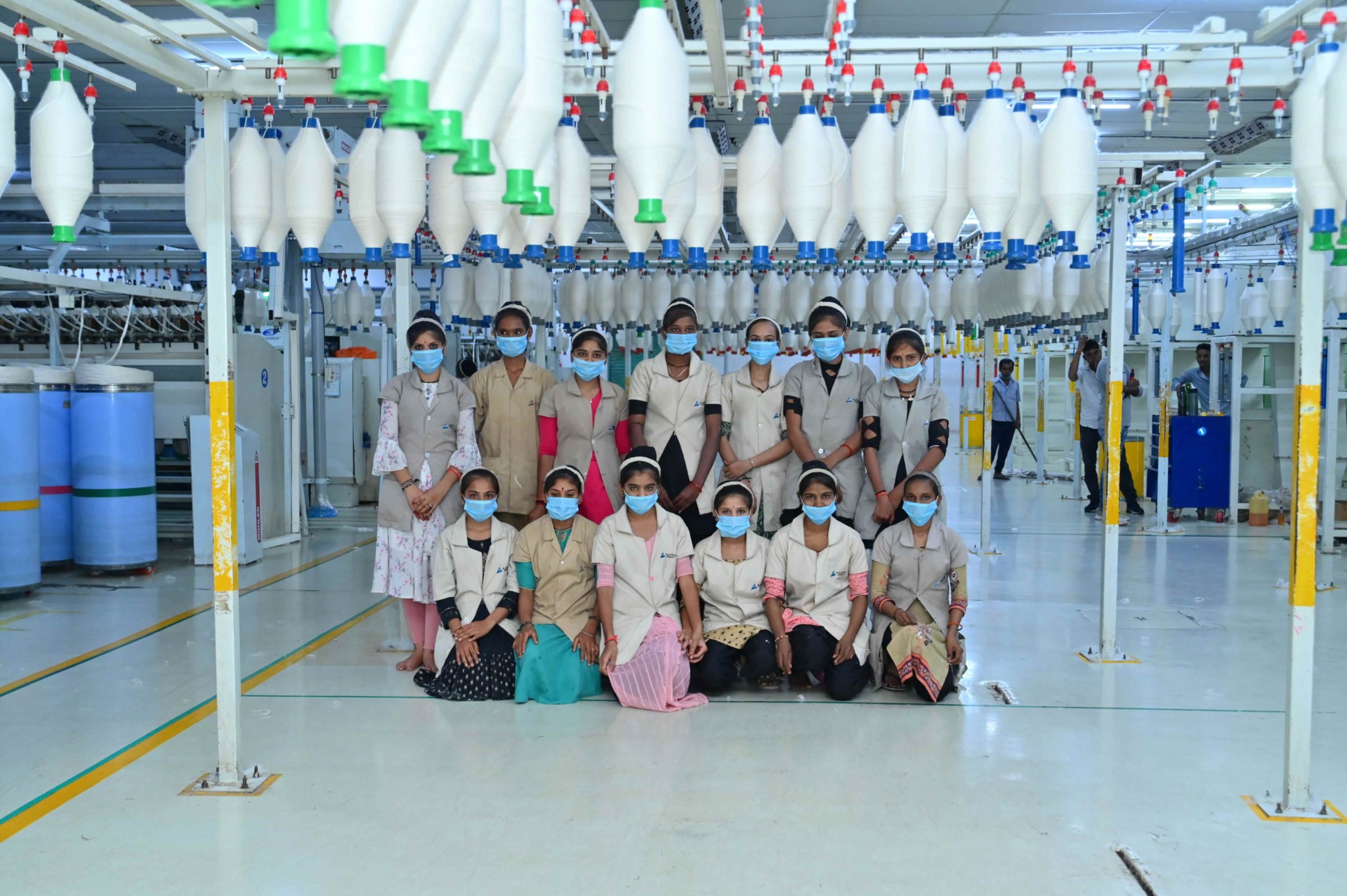
Incorporated in 2013, Aastha Spintex Ltd. (ASL) manufactures and trades carded, combed, and compact combed cotton yarns and cotton bales, operating a semi-automated, integrated spinning and ginning facility at Halvad, Morbi, in Gujarat. It produces 100% cotton yarn in counts ranging from Ne 26 to Ne 40 — finer counts sit at the higher end of that range. As of December 31, 2025, it employed 205 people.
The defining corporate event of this period is the proposed acquisition. ASL has signed a Share Purchase Agreement for 100% of Falcon Yarns Private Limited, a fellow Gujarat spinner running a facility near Gondal, Rajkot, with installed capacity of 9,757 MT per annum. Post-acquisition, ASL’s spinning capacity is set to rise from 7,700 MT to 17,457 MT per annum — roughly a 2.3x jump in scale. Falcon itself has booked revenue of ₹249.44 crore, ₹220.35 crore, and ₹228.75 crore across its last three fiscals.
That last detail deserves a pause. Falcon’s standalone revenue runs close to — and in years past, exceeded — ASL’s own. This is not a bolt-on; it is a company buying something its own size and asking the public to fund the cheque.
The issue opened June 29, 2026, closes July 1, and is slated to list on the BSE and NSE on July 6. It constitutes 28.32% of post-issue paid-up capital.
3 — Business Model: WTF Do They Even Do?
ASL turns raw cotton into yarn, and the leftovers into more revenue. The ginning line separates lint from cottonseed; the lint becomes bales, the seed gets sold to oil and animal-feed buyers, and the spinning process throws off comber and hard waste that finds a home with non-woven and open-end yarn makers. By the company’s own account, non-sellable waste runs just 0.1–0.3% of yarn produced. It is, in spirit, a business that monetises nearly the whole cotton boll and frowns at anything left over.
The end product lands in denim, terry towels, shirting, sheeting, sweaters, socks, bottom wear, home textiles, and industrial fabrics. ASL sells exclusively B2B — to textile manufacturers, yarn exporters, bulk purchasers, and fabric processors. No retail brand, no consumer-facing story, just spools moving to other factories.
Here is the structural quirk. Inside Gujarat, ASL sells directly. Outside Gujarat — including export markets — the majority of cotton yarn sales are routed through a reseller arrangement with a single entity, 7 Seas Impex. The company frames this as staying focused on manufacturing while outsourcing the logistical and regulatory legwork. The plainer reading: a large slice of the customer relationship for everything beyond home turf sits with one outside party.
A spinner that has handed its out-of-state demand to a single reseller has built efficiency and concentration into the same arrangement. Both live in that one contract.
Does a B2B yarn maker with one external reseller for everything outside Gujarat own its growth, or rent it?
4 — Financials Overview
Figures are restated, in ₹ crore. One caveat the offer document itself flags and this entry carries forward: the FY25 numbers are drawn from a pro forma consolidated statement, while FY24 and FY23 are standalone. The years below are therefore not a clean apples-to-apples ladder — they are two different reporting bases stacked together.