General information and entertainment, not investment advice. The author is not a SEBI-registered adviser or research analyst. No recommendation, no promised returns. Markets carry risk including loss of capital. Figures may not be current. Consult a registered adviser before acting.
1 — At a Glance
Superhouse closed FY26 with ₹677 crore of consolidated revenue, barely 2% above the prior year, and ₹3.68 crore of net profit — down from ₹9.11 crore the year before. Operating profit actually rose, from ₹33 crore to ₹41 crore, which makes the profit drop the strange part of the story. The explanation sits lower in the statement: profit before tax of ₹7.24 crore met a tax charge of ₹6.65 crore, a 92% effective rate, and what survived was a rounding error with a dividend attached.
The market prices this at 47.5x earnings — identical to the quoted industry multiple — while simultaneously valuing the company at 0.36 times its book value of ₹422 per share. Those two facts describe the same business: a company with substantial accumulated reserves whose current-year earnings have nearly evaporated. A leather-and-textile exporter that ships to 78+ countries can hold half a billion rupees in net worth and still post a sub-1% return on equity.
A company can grow its operating profit and shrink its net profit in the same twelve months; the distance between the two lines is where interest, depreciation, and the taxman live.
The teaser worth holding: how does ₹41 crore of operating profit become ₹3.68 crore of net profit, and is the 92% tax rate a one-year event or a feature?
2 — Introduction
Superhouse Ltd, incorporated in 1980 and headquartered in Kanpur, is the listed arm of the Superhouse group — a manufacturer and exporter of finished leather, leather footwear, leather accessories, textile garments, and horse-riding products. It is a Government of India recognised Export Trading House, which is the kind of title that ages well on letterhead.
The recent corporate calendar has been steady rather than dramatic. The board met on 30 May 2026 to approve audited FY26 results and recommended a final dividend of ₹0.80 per share, with a record date of 15 September 2026. In September 2025, the AGM reappointed the Managing Director, Joint Managing Director, and Deputy Managing Director for a three-year term running to September 2028, and amended Article 24 of the articles of association.
On the financing side, Acuité reaffirmed the company’s “A-/Stable” rating across ₹219 crore of bank facilities. The disclosure of that reaffirmation arrived late, prompting a clarification to the exchange in June 2026; the company explained that the rating letter reached it well after issuance, and that because nothing in the rating changed, it had not initially treated the matter as material. An earlier action, in May 2025, had moved the outlook to Negative, citing revenue decline and weaker margins.
Does a three-year management reappointment signal continuity, or just the absence of a contest?
3 — Business Model: WTF Do They Even Do?
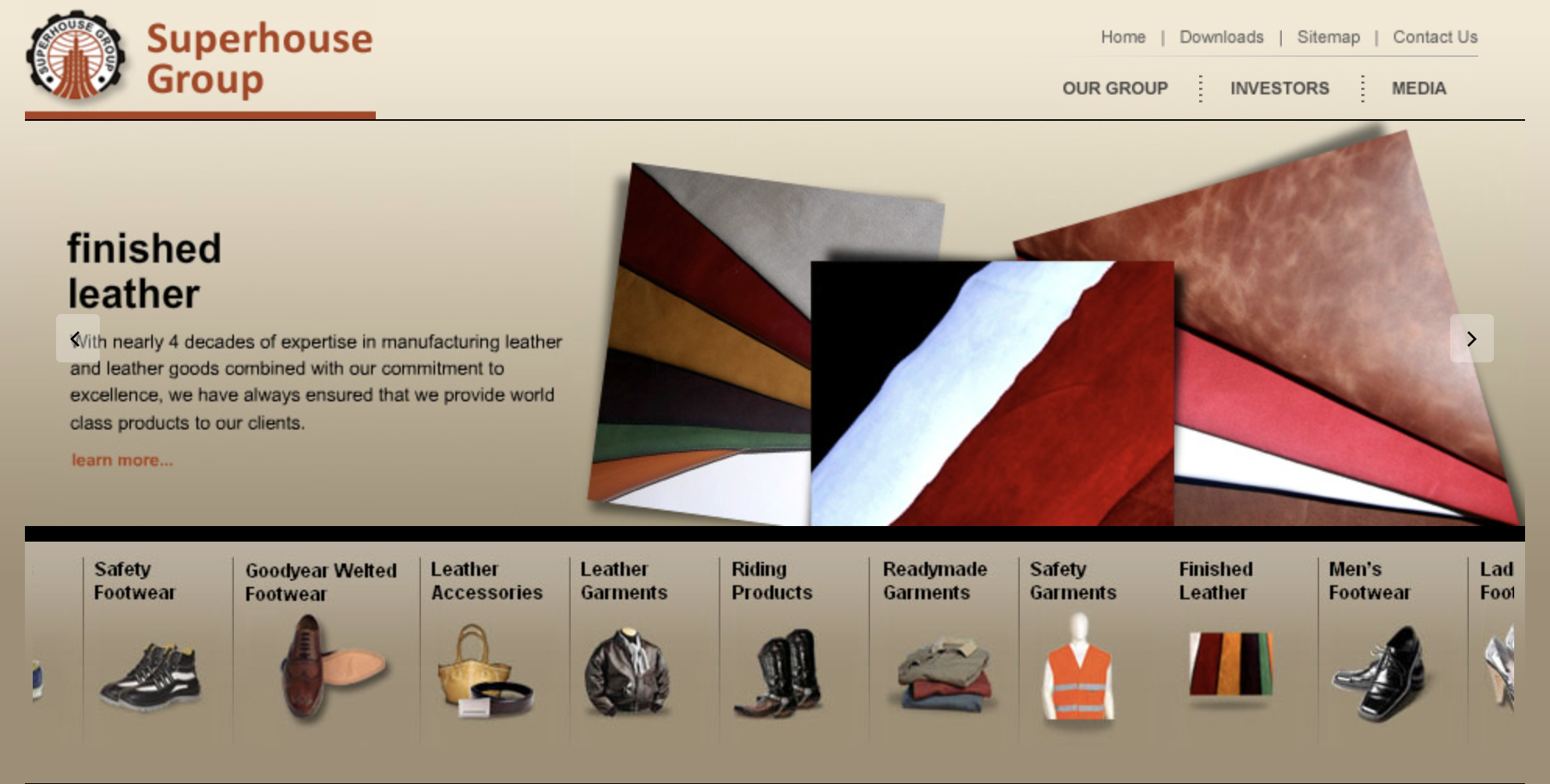
Superhouse is, at heart, a tannery that learned to accessorise. Finished leather is the foundation — three tanneries running roughly 2.5 million square feet of monthly capacity — and from there the business fans out into almost every place a cow can plausibly end up. Men’s, ladies’, and children’s footwear. Safety footwear and rubber-vulcanised boots through Desma machines. Sports and school shoes. Bags, belts, wallets. Riding products, because someone, somewhere, still needs a saddle. And then, in a tonal swerve, textile garments and socks.
The brands carrying this are Allen Cooper and Double Duty — the former formal and footwear-forward, the latter pointed at the safety-and-workwear end. Roughly 85% of revenue came from leather and leather products in the FY23 mix, with textiles around 11% and other operating income making up the rest. Exports were about 77% of sales; the domestic market took the remaining 23%.
The structure that makes this complicated is the subsidiary map. Wholly-owned subsidiaries sit in the UK, the US, the Middle East, Spain, Germany, and France, and the FY26 consolidated accounts fold in entities that individually posted losses — five subsidiaries reported combined negative net profit at the year level, per the auditor’s report. A company exporting to 78+ countries through a lattice of overseas arms gets geographic reach and, with it, a collection of foreign subsidiaries that each have their own profit-and-loss mood.
The model isn’t confused about what it sells. It’s a vertically integrated leather house