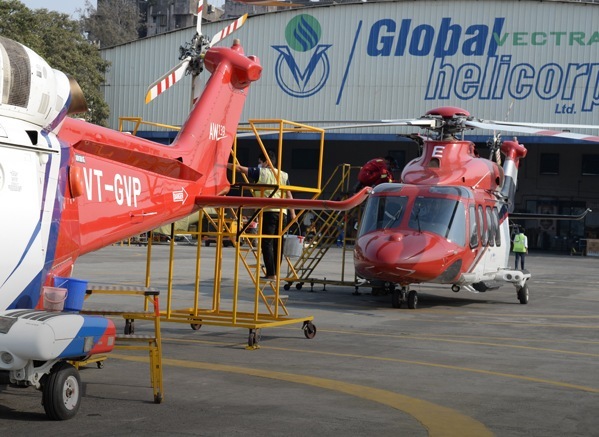
Global Vectra Helicorp FY26: Operating Profit of ₹21 Cr, Other Income of ₹57 Cr, and a Net Worth That Went Below Zero
Spotted a factual error — a wrong number, date, or fact? Tell us and we will check the source.
General information and entertainment, not investment advice. The author is not a SEBI-registered adviser or research analyst. No recommendation, no promised returns. Markets carry risk including loss of capital. Figures may not be current. Consult a registered adviser before acting.
1 — At a Glance
Global Vectra Helicorp flies helicopters for India’s offshore oil-and-gas sector, and in FY26 it posted revenue of ₹521 Cr against a net loss of ₹32.3 Cr — the deepest loss in the decade on the data sheet. Operating profit shrank to ₹21 Cr from ₹55 Cr a year earlier, while other income climbed to ₹57 Cr, meaning the non-operating line was larger than the operating one. The March quarter turned the operating line negative outright, to -₹8.3 Cr.
Net worth crossed into negative territory at -₹8.1 Cr as accumulated reserves of ₹7.3 Cr flipped to -₹22.1 Cr. Borrowings stood at ₹601 Cr. The auditors issued an unmodified opinion while drawing attention to a material-uncertainty-on-going-concern note — a combination that puts the entire FY26 record in one frame: a flying business that still flies, attached to a balance sheet that no longer balances in its owners’ favour.
A company servicing ONGC and Reliance for over two decades does not lose ₹32 Cr by accident; FY26 is the year the lease-heavy model and the customer penalties met on the same page. The market caps it at ₹233 Cr.
What does a ₹233 Cr market cap price in when the equity itself reads negative?
2 — Introduction
Incorporated in 1988 and part of the Vectra group, Global Vectra is described in its filings as the largest private helicopter-services operator in India, with a record of more than 2.6 lakh accident-free flying hours. Its core market is offshore crew-change and production support for oil-and-gas exploration, alongside onshore work spanning religious pilgrimage routes, geophysical survey, powerline inspection, election flying and VIP charter.
The customer roster is reputed and concentrated. Per the CARE rating report, the top five customers contribute more than 90% of revenue, with ONGC alone at roughly 64% as of March 2025. Contracts typically run three to ten years including extensions, which gives medium-term revenue visibility on paper.
The recent record is one of management response to external pressure. The FY26 results note attributes the year’s losses to supply-chain disruption affecting aircraft availability, contractual penalties levied by the customer for service disruption, and rupee depreciation against the dollar and euro. In response, management states it inducted a dedicated standby aircraft, set up consignment-stock arrangements with OEMs, ran a fleet-rationalisation programme, and negotiated improved contract values going forward. On the people side, the CEO, Ashley Roy, resigned effective 30 November 2024 per the announcement.
3 — Business Model: WTF Do They Even Do?
They own a few helicopters, lease most of them, and rent the lot out by the hour — overwhelmingly to oil companies who need bodies moved to platforms in the Arabian Sea. As of September 2025, per CARE, the fleet was about 28 aircraft, of which four were owned; the remaining two-dozen sat on operating and finance leases, several of them from group entities.
That last detail is the whole model in miniature. The aircraft are leased, so lease rentals (₹80 Cr in FY26) and depreciation on right-of-use assets are permanent fixtures of the cost base, whether the helicopters fly or sit. The balance sheet carries a Right-of-Use asset of ₹470 Cr against lease liabilities of roughly ₹502 Cr — the business is, in accounting terms, mostly a stack of leased rotors.
Revenue, per the FY23 breakup, was about 84% sale of services, 8% embedded-lease income and 8% other. The trouble with serving one customer that is 64% of your revenue is that when that customer levies penalties for service disruption, there is no second customer to dilute the pain — and per the filings, that is exactly the penalty mechanism that has dragged profitability for several years.
A fleet that is mostly rented, serving a customer base that is mostly one name: the operating leverage runs in both directions, and FY26 is the year it ran the wrong way.
Does long-term contract visibility mean much when the same contracts carry the penalty clauses doing the damage?
4 — Financials Overview
Figures are in ₹ crore. The company has no subsidiaries, so standalone and consolidated results are the same. The latest period is the quarter ended March 2026.