Lords Chloro Alkali Ltd — FY26: From ₹6 Crore to ₹28 Crore PAT, and the Solar Plant Doing the Heavy Lifting
Spotted a factual error — a wrong number, date, or fact? Tell us and we will check the source.
General information and entertainment, not investment advice. The author is not a SEBI-registered adviser or research analyst. No recommendation, no promised returns. Markets carry risk including loss of capital. Figures may not be current. Consult a registered adviser before acting.
1. At a Glance
Lords Chloro Alkali Ltd (LCAL) closed FY26 with revenue of ₹390 crore, EBITDA of ₹66.38 crore, and PAT of ₹28.49 crore — a 361% jump in net profit on a 44% jump in revenue. The company manufactures caustic soda and related chemicals from a single facility in Alwar, Rajasthan. It is a ₹382 crore enterprise.
The numbers carry two distinct stories. The first is operational: volume grew to 84,690 MT of caustic soda in FY26 against 65,275 MT in FY25 — a 30% lift, enabled by capacity expansion from 210 TPD to 300 TPD completed in FY25. The second is structural: power and fuel cost, which had consumed 51% of production costs in FY25, fell to 42% in FY26, per the investor presentation, as the 16 MW solar plant at Bikaner came online. Those two levers — more volume, lower unit cost — produced the EBITDA swing from ₹25.60 crore to ₹66.38 crore.
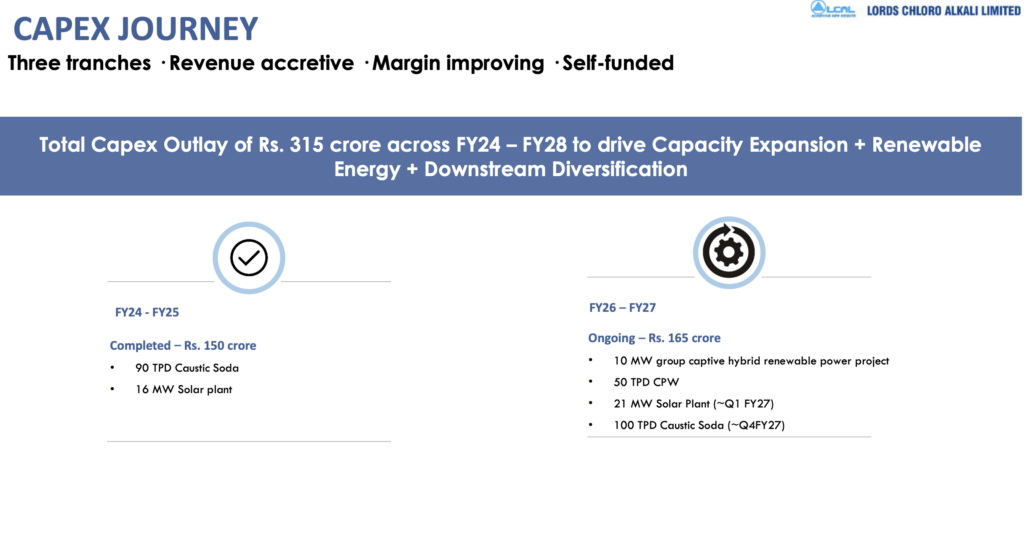
The tension the numbers encode: the same capex cycle that enabled the recovery also loaded ₹174 crore of borrowings onto a balance sheet that carried ₹22 crore two years prior. Interest charges rose from ₹5.72 crore in FY25 to ₹11.27 crore in FY26. Free cash flow was negative at -₹27 crore. The company is mid-cycle on a ₹315 crore total capex programme — the next tranche (21 MW solar, 100 TPD caustic expansion, 50 TPD CPW expansion) is underway.
ROCE returned to 13.6% after turning negative in FY24. The market prices the company at 13.4x earnings, while the peer median sits at approximately 20.8x across the commodity chemicals universe on Screener.
One wisdom drop: cost structure is a business decision made years before its benefit appears on the income statement. LCAL’s FY26 earnings are in large part the outcome of FY24–25 capex choices.
2. Introduction
Lords Chloro Alkali was incorporated in 1979 and commenced caustic soda production in April 1983. Originally known as Modi Alkalis & Chemicals, it converted from mercury-cell to membrane technology in 1992 for environmental reasons. The Dhir Group and associates took over management in 2015–2016 and made an open offer in 2021, raising promoter holding to 74.72%.
The company’s manufacturing facility is located at the Matsya Industrial Area in Alwar, Rajasthan. The North India location matters strategically: freight economics make it difficult for Gujarat-based producers to compete on price in the northern market, per management’s characterisation. LCAL estimates its North India market share at approximately 20% of the region’s ~1,600 TPD installed capacity, set to rise toward 26–27% after the ongoing 100 TPD expansion, management said on the June 2026 concall.
FY26 was the year the expansion investments from FY24–25 began generating returns. Capacity utilisation ran at approximately 80% on the expanded 300 TPD base. The 16 MW solar plant, commissioned in FY25, reduced power costs in a business where power constitutes 60–70% of input expenses, per ICRA. A 10 MW hybrid group-captive renewable project at Jaisalmer was also established.
The company converted 35,00,000 warrants at ₹122 each in February 2026, raising ₹42.70 crore and increasing paid-up capital from 2,51,53,861 shares to 2,86,53,861 shares. NSE and BSE approved listing of these shares on 8 April 2026. Promoter holding moved from 74.66% pre-allotment to 74.97% post-allotment, per the exchange filing.
3. Business Model: WTF Do They Even Do?
Lords Chloro Alkali makes caustic soda, which is the workhorse chemical behind aluminium smelting, paper pulp, textile processing, soaps, and pharmaceuticals. It is not a glamorous business. Caustic soda is produced by running electricity through brine (salt water), a process called chlor-alkali electrolysis. The output is caustic soda lye on one side, and chlorine gas on the other — whether the manufacturer wants the chlorine or not.
That involuntary chlorine co-production is the structural challenge of this industry. At times, chlorine sells at negative realisations — meaning LCAL pays freight and offers discounts to offload it, management confirmed on the concall. The company currently utilises approximately 63% of its chlorine output internally through downstream products: sodium hypochlorite (bleaching/disinfection), chlorinated paraffin wax (CPW), and hydrochloric acid. The remaining 37% goes to nearby customers — a proximity advantage the Alwar location provides.
CPW deserves attention. Chlorinated paraffin wax is a flame retardant, plasticiser, and lubricant used in PVC pipes, cables, rubber, leather, and paints. LCAL expanded CPW capacity from 20 TPD to 50 TPD in FY25 as part of its downstream integration strategy. A further expansion to 100 TPD is ongoing. Management described CPW as converting historically volatile chlorine into a “value-added downstream product,” per the concall — which is a polite way of saying: they would rather sell CPW than pay someone to take chlorine off their hands.
The product suite also includes hydrogen gas (sold to oils and fats processors and chemical manufacturers) and hydrochloric acid (steel pickling, effluent treatment, pharmaceuticals).
The entire operation runs from one plant. There is no geographic diversification. Marquee customers include Hindustan Unilever, Godrej Consumer Products, SRF, Century Pulp & Paper, and IOL Chemicals — companies that require reliable supply of commodity chemicals they cannot easily substitute.
Power is the dominant input cost — not raw materials. In a caustic soda plant, electricity is the raw material. The company consumed ₹165.01 crore of power in FY26 on revenues of ₹390 crore. That ratio defines the business: manage power cost, manage the business. The solar programme is not an ESG badge; it is the margin model.
4. Financials Overview
Figures are consolidated, in ₹ crore.
Annual Results — FY26
Metric
FY26
FY25
YoY Change
Revenue
390.14
270.22
+44.4%
EBITDA
66.38
25.60
+159.2%
PAT
28.49
6.18
+360.9%
EPS (₹)
9.94
2.46
+304.1%
Q4 FY26 (Latest Quarter)
Metric
Q4 FY26
Q4 FY25
YoY
Q3 FY26
Revenue
97.64
79.78
+22.4%
93.95
EBITDA
13.61
9.96
+36.6%
10.73
PAT
4.39
2.60
+68.8%
4.61
EPS (₹)
1.53
1.03
+48.5%
1.83
The annual story is clean: volume up, power cost ratio down, leverage up, earnings recovered. The quarterly story is bumpier. Q1 FY26 delivered ₹10.45 crore PAT and Q2 ₹9.04 crore; Q3 and Q4 pulled back to ₹4.61 crore and ₹4.39 crore respectively. Management attributed the Q3–Q4 softness to caustic soda prices declining and an electrolyser shutdown for overhaul — changing anodes, cathodes, and membranes — which increased per-unit power consumption, management said on the concall.
The grid tariff also rose in October 2025: JVVNL revised rates, pushing landed grid power from approximately ₹7/unit to ₹8.2–8.3/unit, a 15–18% increase per management, which compressed Q4 margins relative to the solar-assisted Q1 and Q2.
Concall highlights (Jun 2026): Management characterised FY26 as “a landmark year” where “volume growth is combined with cost discipline.” On the 21 MW solar plant: management expected commissioning “around mid-June ’26” and noted this would “ease meaningfully” the grid-rate headwind. The sulfuric acid