Zodiac Energy FY2026: ₹544 Crore Revenue, ₹21 Crore PAT, and a Balance Sheet That Grew Faster Than the Profit Did
Spotted a factual error — a wrong number, date, or fact? Tell us and we will check the source.
General information and entertainment, not investment advice. The author is not a SEBI-registered adviser or research analyst. No recommendation, no promised returns. Markets carry risk including loss of capital. Figures may not be current. Consult a registered adviser before acting.
1 — At a Glance
Zodiac Energy closed FY2026 with standalone revenue of ₹544 crore — a 33% jump from ₹408 crore in FY2025, which itself was an 85% jump from FY2024. Three-year revenue CAGR stands at 58%. The growth column, in other words, is doing its job.
The profit column is a quieter conversation. PAT moved from ₹20 crore in FY2025 to ₹21 crore in FY2026, a 5% crawl while revenue grew 33%. PAT margin compresses to 3.9% on standalone figures. EBITDA held better — operating profit reached ₹56 crore on a 10.2% OPM, a modest improvement — but interest costs more than doubled from ₹8.7 crore to ₹18.8 crore, absorbing much of the EBITDA expansion before it could reach the bottom line.
The balance sheet grew the most dramatically. Total standalone assets rose from ₹339 crore to ₹485 crore in a single year, with borrowings climbing from ₹175 crore to ₹217 crore. The debt funds a real asset — 26.56 MW of commissioned solar capacity under PM KUSUM with a 25-year PPA locked in at ₹3.00/kWh with UGVCL (rated CARE AA+). That is the structural bet: the IPP business trades short-term leverage for long-term annuity cash flow.
CARE upgraded ZEL’s rating to BBB; Stable in August 2025, citing scale improvement and the PPA’s revenue visibility. The working capital cycle, chronically stretched, compressed to 23 days by year-end per screener, though CARE’s own GCA calculation for FY25 showed 159 days — a gap worth keeping in mind.
The market prices the company at 20.1x trailing earnings against a sector median of 18.1x (119-company peer set). The question the numbers leave open: can the IPP business grow its contribution fast enough to thicken margins before EPC working capital demands and interest costs erode what the revenue line gains?
2 — Introduction
Zodiac Energy Limited was incorporated in 1992 in Ahmedabad as Zodiac Genset Private Limited, originally in diesel-based power generation. The company pivoted to solar EPC, was rebranded Zodiac Energy Private Limited in 2007, and listed on the stock exchanges in 2017. It operates out of Ahmedabad, Gujarat, under the managing directorship of Kunj Shah, who has led the business for over three decades.
The FY2026 reporting year is notable for a structural shift: ZEL’s consolidated financial results are published for the first time in Q4 FY26, incorporating four solar project LLPs as subsidiaries — Radhavallabh Solar Projects LLP, Priyapritam Solar Projects LLP, Dharmik Solar Projects LLP, and Shamli Solar Projects LLP. These entities hold the IPP solar assets. Standalone figures, which form the primary basis for historical comparison in this entry, are broadly similar at the revenue and PAT level.
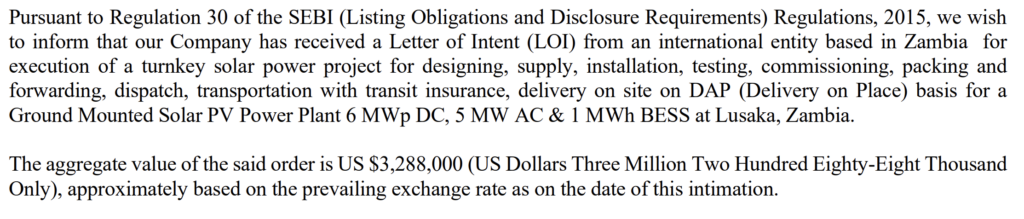
The year also saw ZEL’s first international EPC order — a ₹30.85 crore (~US$3.29 million) LOI for a 6 MWp ground-mounted solar plant in Zambia, received in April 2026 and to be executed within nine months. In May 2026, ZEL commissioned a 10.8 MWp captive solar plant for Amanta Healthcare in Kheda, Gujarat. The board, at its May 25, 2026 meeting, approved a final dividend of ₹0.75 per share (face value ₹10), subject to shareholder approval at the AGM.
CARE upgraded ZEL’s long-term bank facilities to BBB; Stable in August 2025. The orderbook stood at ₹394 crore as of May 31, 2025, per CARE’s report, executable over the following 6–12 months. In June 2026, the company appointed Suraj Dhruv as Business Head and Senior Management Personnel, bringing 13 years of renewable energy sector experience across Adani Group, Reliance Industries, Gensol Engineering, and others.
3 — Business Model: WTF Do They Even Do?
Zodiac Energy is, at its core, a solar EPC contractor that has recently begun moonlighting as a power producer. The primary revenue engine is turnkey Engineering, Procurement, and Construction work across three formats: residential rooftop, commercial and industrial (C&I) rooftop, and ground-mounted captive/utility projects. “Turnkey” means ZEL designs, supplies, installs, tests, commissions, and optionally maintains the system. The client gets a functioning solar plant; ZEL gets paid and moves on to the next one.
The product mix, per company filings, is dominated by solar PV module trading and EPC contract execution — treated as one reportable segment. The second segment, Power Generation, began contributing meaningfully only in FY2026 after 26.56 MW was commissioned across 12 Gujarat sites under PM KUSUM Component C. Segment revenue from Power Generation was ₹15.58 crore for the full year versus ₹528 crore from EPC & trading.
The EPC business has a fundamental economics problem that the company manages with discipline: fixed-price contracts of 6–18 months with no price escalation clause, in an industry where solar module prices swing. CARE flags this directly as a key constraint. The mitigation is back-to-back procurement — ZEL locks in module prices close to order execution rather than speculating on inventory. It works until it doesn’t.
The IPP pivot attempts to solve the lumpy, project-by-project nature of EPC revenue with a 25-year annuity. The PPA with UGVCL (CARE AA+ rated off-taker) provides fixed revenue at ₹3.00/kWh for the full 26.56 MW capacity. That’s the upgrade: from “we build and leave” to “we build, stay, and collect.” The business is currently about 97% EPC and 3% power — so the model is solar contractor with power-producer ambitions, not yet a hybrid in any balanced sense.
Geographically, ZEL has served 15+ states and expanded to Africa in FY25. The client roster from the About section includes Amul, BoB, BSNL, ISRO, L&T, SBI, Torrent Power, Toyota, and Vodafone. Landmark projects include 40 MW utility solar for UGVCL, 37.5 MW for Ahmedabad Municipal Corporation, and 5.2 MW C&I rooftop for Honda Motorcycle & Scooter India.
The working capital structure is the business model’s honest autobiography. EPC requires upfront material procurement, labour deployment, and project management — all before billing. The receivables and inventory sit on the balance sheet until the client pays. When the order book grows 50% year on year, the working capital requirement follows.
Does a 3% power segment justify a doubled balance sheet? Or does the EPC engine need to carry that question until the IPP grows?
4 — Financials Overview
Figures are standalone, in ₹ crore, for the year ended March 31, 2026.
The divergence between EBITDA growth (+49%) and PAT growth (+5.5%) traces directly to interest costs: ₹18.80 crore in FY26 against ₹8.71 crore in FY25, per the standalone financial statement. Depreciation also rose sharply — from ₹2.69 crore to ₹9.95 crore — as the IPP solar assets entered service.
Revenue from Q4 FY26 (January–March 2026) alone was ₹211 crore — more than the entire FY2022 annual revenue of ₹143 crore. Q4 OPM was 10%, in line with the full-year figure.
The auditors (NPKU & Associates, FRN: 127079/W) issued an unmodified opinion on both standalone and consolidated results for FY2026.