Emami Realty Ltd — FY2026 Annual Results: A ₹2,302 Cr Balance Sheet Held Together by Group Goodwill and Deferred Tax
Spotted a factual error — a wrong number, date, or fact? Tell us and we will check the source.
General information and entertainment, not investment advice. The author is not a SEBI-registered adviser or research analyst. No recommendation, no promised returns. Markets carry risk including loss of capital. Figures may not be current. Consult a registered adviser before acting.
1 — At a Glance
Emami Realty is a ₹448 crore company that posted ₹93 crore in revenue for FY2026, lost ₹189 crore at the PAT line, and carries ₹2,002 crore in borrowings against a net worth that has turned deeply negative at ₹-248 crore (equity capital ₹9 crore plus reserves of ₹-257 crore). The ROCE sits at -6.9%. Debtor days improved from 44 to 27 — one of the few metrics moving in a flattering direction.
The balance sheet stays alive on two oxygen lines: ₹12,760 crore in deferred tax assets, and a related-party loan book from the parent Emami group that, per Ind-Ra, comprised roughly 85% of total debt as of FY2025. Without both, the consolidated net worth would require a considerably more uncomfortable conversation.
Revenue grew 13% year-on-year in FY2026 after five years of compounded -13% decline — a TTM bright spot worth watching without over-indexing on a single year. The operating margin was -158%, a figure that has been negative in each of the last four years. PAT growth registered -49% TTM. The EPS for the full year was ₹-43.22.
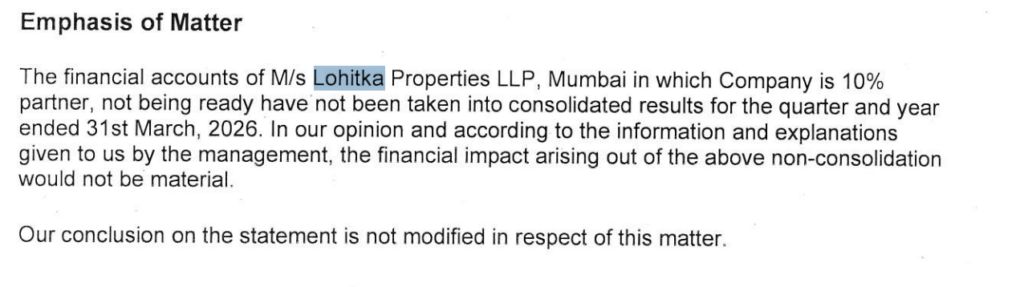
One genuine attention signal: India Ratings affirmed the IND A- rating with a Stable outlook in January 2026, citing Emami group support and an 84%-sold ongoing project portfolio. One worry signal: the company is 10% partner in Lohitka Properties LLP whose accounts were not finalised in time for inclusion — auditors flagged it as an Emphasis of Matter.
The central tension in one line: a brand-backed real estate arm with a 24 million sq ft pipeline, running on group capital while its own P&L accumulates losses into a fourth consecutive year.
2 — Introduction
Emami Realty was incorporated in 2006 as the real estate arm of the Kolkata-based Emami group — a conglomerate with roughly four decades of operating history and diversified interests spanning FMCG, paper, edible oil, pharmacy, and healthcare, with a combined group turnover of ₹23,283 crore in FY2025 per Ind-Ra.
The company’s FY2026 results were approved at a board meeting on 27 May 2026. The same meeting appointed Ram Krishna Agarwal — former Managing Partner of S.R. Batliboi & Co. (EY), a gold medallist of the ICAI, and a director with 50+ years of post-qualification experience — as an Additional Non-Executive Director effective 1 July 2026.
On the capital structure front, April 2026 saw the conversion of 82 lakh warrants (issued in April 2025 to promoter group entities Suraj Finvest Private Limited and Diwakar Finvest Private Limited at ₹128.50 per share) into fully paid equity shares. The conversion was made by offsetting unsecured loans, not by fresh cash inflow. Post-conversion, paid-up capital rose from ₹8.77 crore to ₹10.41 crore, and promoter holding reached 73.42% in April 2026 — up from 63.45% a year prior.
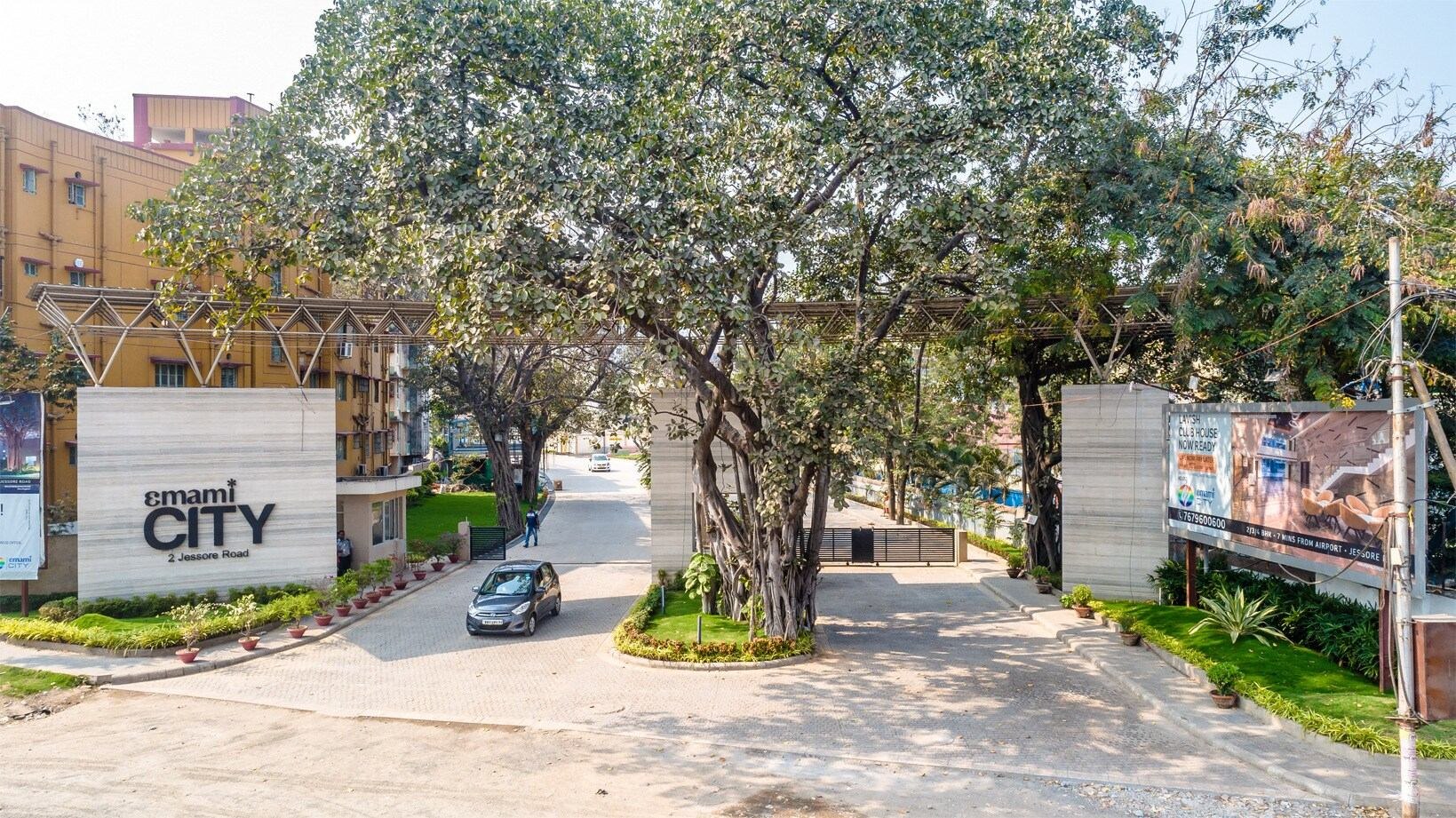
The company operates across residential, retail, and commercial segments. Its ongoing portfolio as documented by Ind-Ra (January 2026) comprises four projects: Emami Nature (Jhansi), Emami Business Bay, Emami Aastha, and Emami Aamod (all in Kolkata). Emami Nature was 99.7% complete on construction cost at end-October 2025. Emami Aamod, the most recent launch (November 2024), stood at 13% of construction cost incurred.
3 — Business Model: WTF Do They Even Do?
Emami Realty develops real estate — residential, retail, and commercial — through a mix of wholly owned subsidiaries, special purpose vehicles (SPVs), and joint ventures. The company does not build projects on its own balance sheet in the conventional sense; the economics flow through SPVs and associates, some of which are at varying stages of completion and consolidation.
The group’s cumulative development track record stands at over 3.7 crore sq ft across seven Indian states plus Sri Lanka, per the About. Completed projects include South City Kolkata (45 lakh sq ft), Urbana Kolkata (70 lakh sq ft, 66 acres), Swanlake Hyderabad (11 lakh sq ft lakeside), Montana Mumbai (17 lakh sq ft), and Altair Colombo (13 lakh sq ft, Moshe Safdie-designed). These are done; the company is no longer selling them.
The active revenue engine today is four ongoing owned projects totalling ~4 million sq ft of saleable area, of which 84% had been sold as of October 2025. The company plans to launch approximately 24 million sq ft over FY27–FY29 — roughly six times the current active portfolio — across Chennai, Jhansi, Bhubaneswar, and other markets, per Ind-Ra. The land for this pipeline sits not on ERL’s own books but in the group’s 1,561-acre land bank, available to ERL for development.
The model therefore runs on a distinctive fuel mix: brand equity from Emami group, land from group entities, construction finance partly external and partly via group inter-corporate deposits, and pre-sales collections as the working cash engine. Revenue recognition in real estate development runs on percentage of completion, which means a quarter with high project expenses and low completion-stage bookings produces deeply negative operating margins — precisely what FY2026 delivered.
A business model where 85% of your debt is from the parent and your land bank lives in related parties is not conventional independence — it’s a franchise arrangement dressed in listed-company clothes. That is not a critique; it is simply what the structure is.
Does ₹2,002 crore in borrowings — overwhelmingly intra-group — make the company stronger or more fragile than the standalone P&L suggests?
4 — Financials Overview
Figures are consolidated, in ₹ crore.
Quarterly Results
Metric
Mar 2026 (Q4 FY26)
YoY (Mar 2025)
QoQ (Dec 2025)
Revenue
73
-18%
+1,460%*
EBITDA
-56
-70 → -56
-26 → -56
PAT
-66
-80
-37
EPS (₹)
-15.02
-21.05
-8.50
*Q3 FY26 revenue was ₹5 crore; Q4 FY26 was ₹73 crore. Real estate revenue recognition is lumpy by design — project completion stages drive the timing.
Note: The Q4 FY26 figures are the balancing figure between the audited full-year and the published nine-month numbers, per the auditors’ report. The quarterly standalone operating loss of ₹56 crore comes against revenues of ₹73 crore — an OPM of -76% for the quarter.
Full-year revenue of ₹93 crore against total expenses of ₹240 crore produced an operating loss of ₹147 crore. Interest costs for FY2026 were ₹97 crore, consuming more than the entire year’s revenue.
The auditors (Agrawal Tondon & Co., Firm Reg. 329088E) issued an unmodified opinion on both standalone and consolidated results. One Emphasis of Matter was flagged: the accounts of Lohitka Properties LLP (in which the company holds a 10% partnership) were not finalised and