Spotted a factual error — a wrong number, date, or fact? Tell us and we will check the source.
General information and entertainment, not investment advice. The author is not a SEBI-registered adviser or research analyst. No recommendation, no promised returns. Markets carry risk including loss of capital. Figures may not be current. Consult a registered adviser before acting.
1 — At a Glance
Tiger Logistics closed FY26 with revenue of ₹572.82 crore — up 6.8% year-on-year — carried almost entirely by a 34.5% surge in TEU volumes to 92,614 units. The market paid for the volume story; the income statement delivered a different one.
PAT fell to ₹21.52 crore from ₹27.02 crore the previous year, a 20.3% contraction, even as the company was moving more boxes than ever. EBITDA margin compressed to 4.6% from 5.8%, and the fourth quarter landed the harshest number: a 1.0% operating margin, the lowest in recent memory. Infomerics reaffirmed the company’s IVR A-/A2+ credit ratings in June 2026 — but revised the outlook from Stable to Negative, flagging deteriorating unit-level economics and a stretched receivable cycle that reached 98 days.
The tension is structural: Tiger runs a cost-plus model, which means revenue closely tracks freight rates. Freight rates fell sharply in FY26, per management’s own framing. Volume grew impressively; realisation per TEU fell roughly 20.5%, per the Infomerics report. The business moved more cargo and earned less for it.
Prices referenced in this article are not live — the CMP of ₹37.2 is the last available reference price.
Does a 34.5% volume jump with a 20% profit decline represent the cost of building scale, or the cost of mispriced growth? The filings don’t settle the question.
2 — Introduction
Tiger Logistics (India) Limited, incorporated in 2000 and publicly listed first on BSE’s SME platform, then the BSE main board, and most recently on NSE (September 2025), is a New Delhi-headquartered international logistics company. Its registered office sits in Okhla Industrial Area; its corporate office is at Nehru Place.
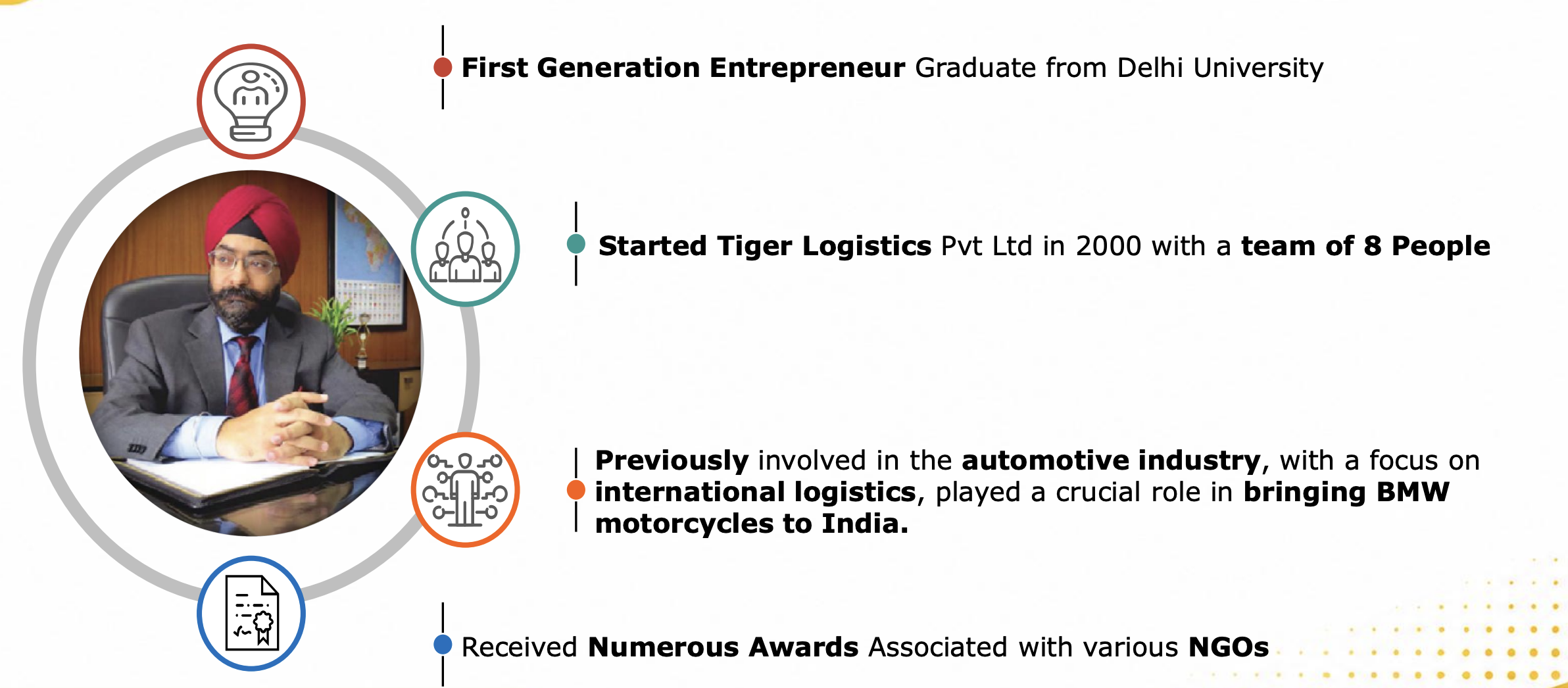
The company’s founder, Harpreet Singh Malhotra, is a first-generation entrepreneur who began in the automotive sector — the investor presentation notes his involvement in bringing BMW motorcycles to India — before founding Tiger Logistics with a team of eight people. He was re-appointed as Chairman and Managing Director from May 8, 2026 to May 7, 2031, per the board resolution disclosed in February 2026 and confirmed by shareholder postal ballot in March 2026.
FY26 was a year of notable structural moves alongside the financial turbulence. The company listed on NSE’s main board in September 2025. It received approval to raise ₹400 crore through equity shares or convertible instruments, earmarked for technology upgradation (FreightJar 2.0), infrastructure expansion, and TiGreen, per the filings. A ₹4 crore BHEL import break-bulk project for 13 ODC units from Italy, executable over six months, was won in June 2026, per the BSE announcement.
On the regulatory front, an RBI letter dated February 3, 2026, cited a FEMA valuation-report contravention, with compounding possible and a 45-day filing requirement. The company disclosed it was evaluating the matter.
3 — Business Model: WTF Do They Even Do?
Tiger Logistics is a third-party international logistics provider. It does not own ships, aircraft, or warehouses at scale — the company explicitly operates an asset-light model, with 98% of its fleet hired from truck vendors. What it owns is relationships: with shipping lines, customs authorities, trade partners across 120+ countries, and a client list that reads like an automotive hall of fame (Honda, TVS, Bajaj, Hero, Maruti Suzuki) alongside government entities (BHEL, HPCL, ONGC, DRDO).
The core business is ocean freight forwarding — FCL and LCL shipments — integrated with customs clearance and multimodal transport. Multimodal contributes roughly 94–96% of segment revenue. The company holds a Multimodal Transport Operations (MTO) licence, which accounts for 95% of revenue share in FY25.
Over the past several years, management has grafted on three growth verticals:
TiGreen is the renewable-energy logistics arm, focused on solar module imports, wind turbine components, and EV logistics. By Q3 FY26 it was contributing over 40% of total revenue, per management’s concall commentary. The vertical operates across trade lanes into China, Vietnam, Indonesia, Malaysia, and Cambodia. Management described it as positioning Tiger among the top five service providers in solar-sector logistics.
FreightJar is a digital freight booking and management platform launched in April 2023, now on version 2.0 — covering air cargo, LCL, and imports. It is positioned as the technology spine of the business.
CUBOX is the LCL consolidation and B2B product launched in early 2025, targeting small and medium-sized freight forwarding companies. Management described it as breaking even and slightly profitable by Q3 FY26, though acknowledged the pace of scale was slower than anticipated.
The industry revenue mix in FY26 shows automobiles at roughly 48%, projects (including renewables) at 20%, with the balance spread across commodities and others — a meaningful pivot from earlier years when autos dominated at 83–90%.
The asset-light structure is elegant when volumes are growing; it is less elegant when freight rates compress and the cost-plus model transmits every rate move directly into revenue without a corresponding relief on the cost line.
4 — Financials Overview
Figures are standalone, in ₹ crore. The result type is Quarterly (most recent: Q4 FY26, March 2026) and Annual (FY26).
Quarterly — Q4 FY26
Metric
Q4 FY26
Q4 FY25 (YoY)
Q3 FY26 (QoQ)
Revenue
₹162.55 Cr
₹114.50 Cr (+41.97%)
₹160.47 Cr (+1.3%)
EBITDA
₹1.68 Cr
₹7.19 Cr (–76.6%)
₹9.78 Cr (–82.8%)
PAT
₹2.22 Cr
₹6.44 Cr (–65.5%)
₹8.42 Cr (–73.6%)
EPS
₹0.21
₹0.61
₹0.80
Annual — FY26 vs FY25
Metric
FY26
FY25
YoY
Revenue
₹572.82 Cr
₹536.31 Cr
+6.8%
EBITDA
₹26.33 Cr
₹30.92 Cr
–14.8%
PAT
₹21.52 Cr
₹27.01 Cr
–20.3%
EPS
₹2.04
₹2.56
–20.3%
EPS and P/E computation: FY26 is a full-year result. Full-year PAT ₹21.52 crore ÷ shares 10.57 crore = EPS ₹2.04 (matches the data sheet). P/E at reference price of ₹37.2 = 37.2 ÷ 2.04 = 18.2x.
Concall — Q3 FY26 (February 2026):
Management described the operating environment as “turbulent” on the EXIM side, attributing headwinds to US tariffs and geopolitical conditions, including “business constraints in the Gulf region.” The key framing from management: revenue compression was a product of the cost-plus model intersecting with the “lowest-ever” freight rates in the quarter, not a deterioration in volume traction. Management said volume grew 52% year-on-year and 9% quarter-on-quarter in Q3.