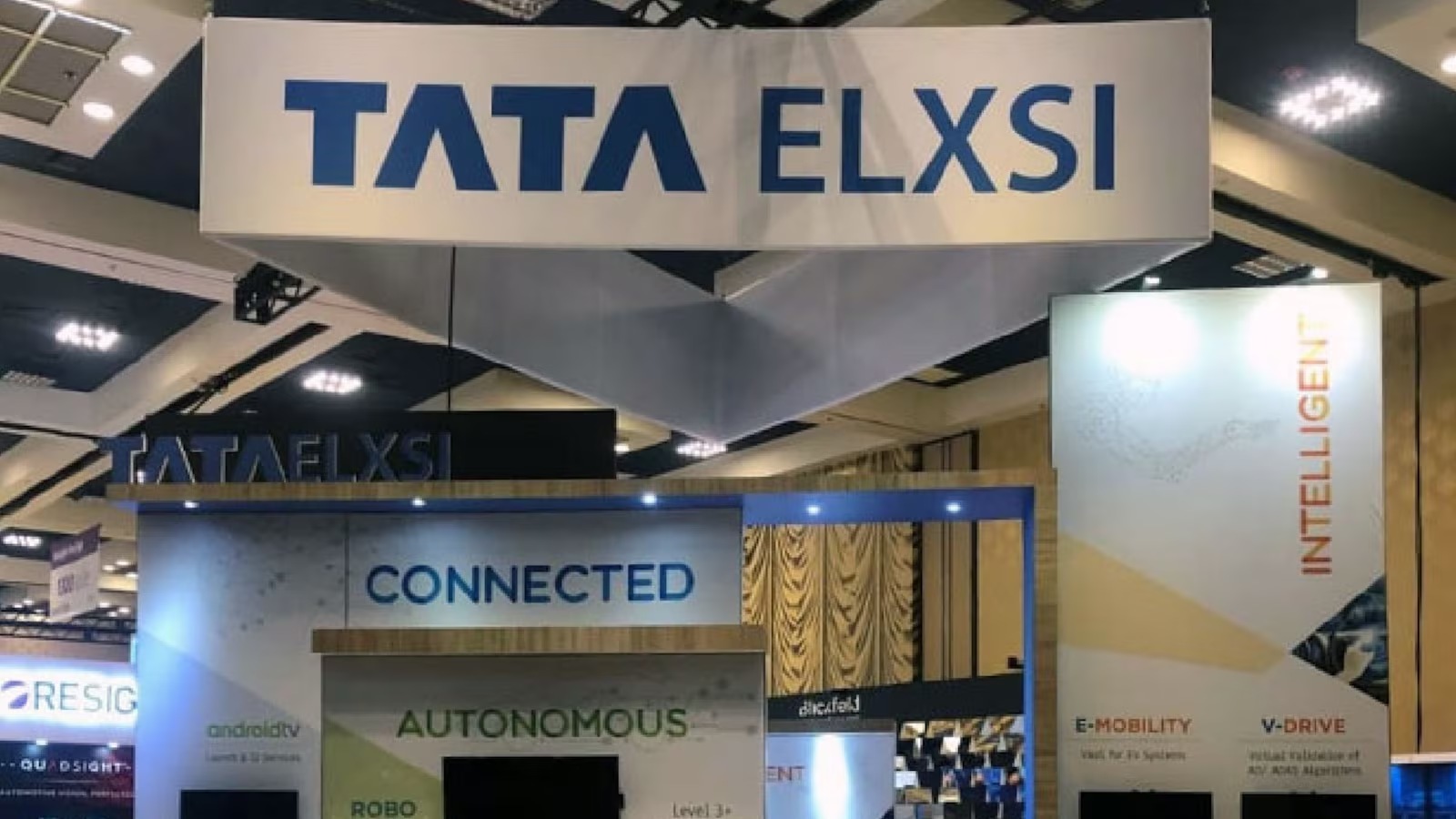
Tata Elxsi FY26: Engine Sputtering, Margins Walking a Tightrope
General information and entertainment, not investment advice. The author is not a SEBI-registered adviser or research analyst. No recommendation, no promised returns. Markets carry risk including loss of capital. Figures may not be current. Consult a registered adviser before acting.
1 — At a Glance
Tata Elxsi’s FY26 revenue landed at ₹3,757 crore—barely 0.8% above FY25. The company is walking a tightrope: net profit fell 19.9% to ₹628 crore while EBITDA margins climbed to 24.6% by year-end, propped up heavily by currency tailwinds and operational leverage.
Headcount is down from 13,341 to 12,414. Transportation, which anchors 56.6% of business, grew modestly. Healthcare halted mid-quarter; Media & Communications had to borrow growth from consolidation deals. The market pays 36.4x earnings—a gap widening against the IT services peer median of 21.2x.
Profit growth over the past 3 years has contracted at 2.77% annually. Client concentration spiked to 59.4% from top ten. A question lingers: does ₹628 crore in profit power a ₹25,346 crore market cap?
2 — Introduction
Tata Elxsi spent FY26 pulling levers without moving the needle much. Revenue inched forward; profit fell hard. The company calls this a reset. The stock returns tell a different story—down 36% in the past year.
Demand picked up in pockets. Two named OEM wins (APAC new-age, US mobility) signal confidence in a portfolio shift toward original equipment manufacturers. But the order book hasn’t translated into revenue scale yet. Management flagged a 9-month to 12-month ramp cycle for new business, which means patience is priced in somewhere below the water line.
Healthcare was the year’s grit. Deals pushed from Q4 into Q1, management says—a claim that hinges entirely on execution now. Media remains under structural pressure from industry cost-takeouts and M&A duplication. GenAI tools (DevStudio.ai, NEURON platform) are live, but monetization remains a sketch waiting for revenue ink.
In March 2026, CFO Gaurav Bajaj exited after nearly a decade. Nalin Rana took over effective May 30, 2026—a management shift that matters if strategy pivots. An income-tax demand of ₹1.79 crore arrived March 6, with appeal plans noted. Neither event is material to the earnings story, but both signal friction.
3 — Business Model: WTF Do They Even Do?
Tata Elxsi is a global design-and-engineering firm masquerading as a software company. That’s not sass; it’s structure.
The company stitches “design, engineering and digital” across three verticals: Transportation (56.6%), Media & Communications (31.1%), and Healthcare & Life Sciences (10.8%). Services span ideation through deployment—firmware, mechanical design, software, validation, all the way to market introduction.
Transportation is the heavyweight. OEMs now represent 77% of transport revenue; Tier-1 suppliers are shrinking, by management’s own admission. Tata Elxsi claims it can take complex work offshore, which Tier-1s historically resisted. OEMs, facing pressure to “do more with less,” are opening the door. But the wins announced (APAC, US mobility) are not yet revenue—they’re pipeline theater with a 9-month curtain.
Media & Communications remains a collage: telecom operators, device OEMs (video, broadband), content platforms, AdTech players. Industry consolidation is a tailwind here, though a weird one—when two media companies merge, engineering teams overlap and the combined entity cuts external suppliers. Tata Elxsi benefits from the transaction itself, not the industry’s health.
Healthcare & Life Sciences was supposed to be a growth engine. Instead, deals got stuck in negotiation gridlock. Management cites a six-month sales cycle. The Terumo partnership (offshore development center for cardiac/vascular solutions) is real, but early-stage IP-building, not yet revenue. The company also lists regulatory workflow automation (RegAI) and a next-gen drug preparation system for a US pharma player as “wins,” but large deals in med-tech are slow burns.
The delivery model is 73% offshore, 27% onsite. This is Tata Elxsi’s claimed moat—the ability to manage complex embedded product work from India at scale. Nobody else claims this. The test is what happens when OEM ramp deals hit the execution grind.
4 — Financials Overview
Figures are consolidated, in ₹ crore.
Metric
Q4 FY26
YoY Change
QoQ Change
Revenue
993.75
9.7%
4.2%
EBITDA
244.57
12.0%
13.8%
PAT
220.35
27.8%
101.9%
EPS
35.37
—
—
Full year FY26: Revenue ₹3,757 crore (+0.76% YoY), Net Profit ₹628 crore (-19.9% YoY), EPS ₹101 (full FY).
Concall Colour: Q4 FY26 (Reported April 21, 2026)
Management attributed Q4’s sharp PAT jump to currency tailwinds (+150–155 bps EBITDA margin), operating leverage (+65 bps), offset partially by salary increases (-90 bps). Currency was the hero; underlying operations were solid but incremental. Utilization improved to ~73%, a lever worth 25–30 bps per percentage point.
Segment performance was uneven. Transportation flatlined (+0.2% QoQ in constant currency), despite wins announced. Healthcare cratered (-13.1% QoQ) due to deal delays pushed into Q1. Management claims early Q1 closures are already underway—a narrative that demands verification. Media & Communications grew 5.6% QoQ, lifted by a “world-leading device OEM” win for video/broadband products and a consolidation deal where Tata Elxsi took over engineering for legacy systems.
Management flagged fixed-price contracts as a profitability lever but warned against overshooting—”not advisable” to push beyond current levels lest revenue leakage and margin dip hurt. This candour is rare; it also signals that fixed-price execution risk is real.
5 — Market Expectations & Historical Multiples
This section describes how the market is currently pricing the company and how that compares with its own history and peer group. It is descriptive, not predictive.
Metric
Current
Historical Average (5Yr)
Peer Median (IT Services)
P/E
36.4x
26.8x
21.2x
EV/EBITDA
23.1x
~20x
~18x
P/B
8.33x
~6.2x
~2.9x
ROE
23.6%
28.6%
—
ROCE
30.0%
36.0%
—
The market pays 36.4x current earnings against a peer median of 21.2x and its own 5-year average of 26.8x. This multiple premium sits above both anchors. The P/B ratio of 8.33x is also elevated versus history (6.2x) and peers (2.9x), signalling the market is pricing in either recovery to past ROE levels or a structural re-rating of the asset.
Return on equity has declined: 5-year average 28.6%, 3-year average 29%, most recent year 23.6%. ROCE