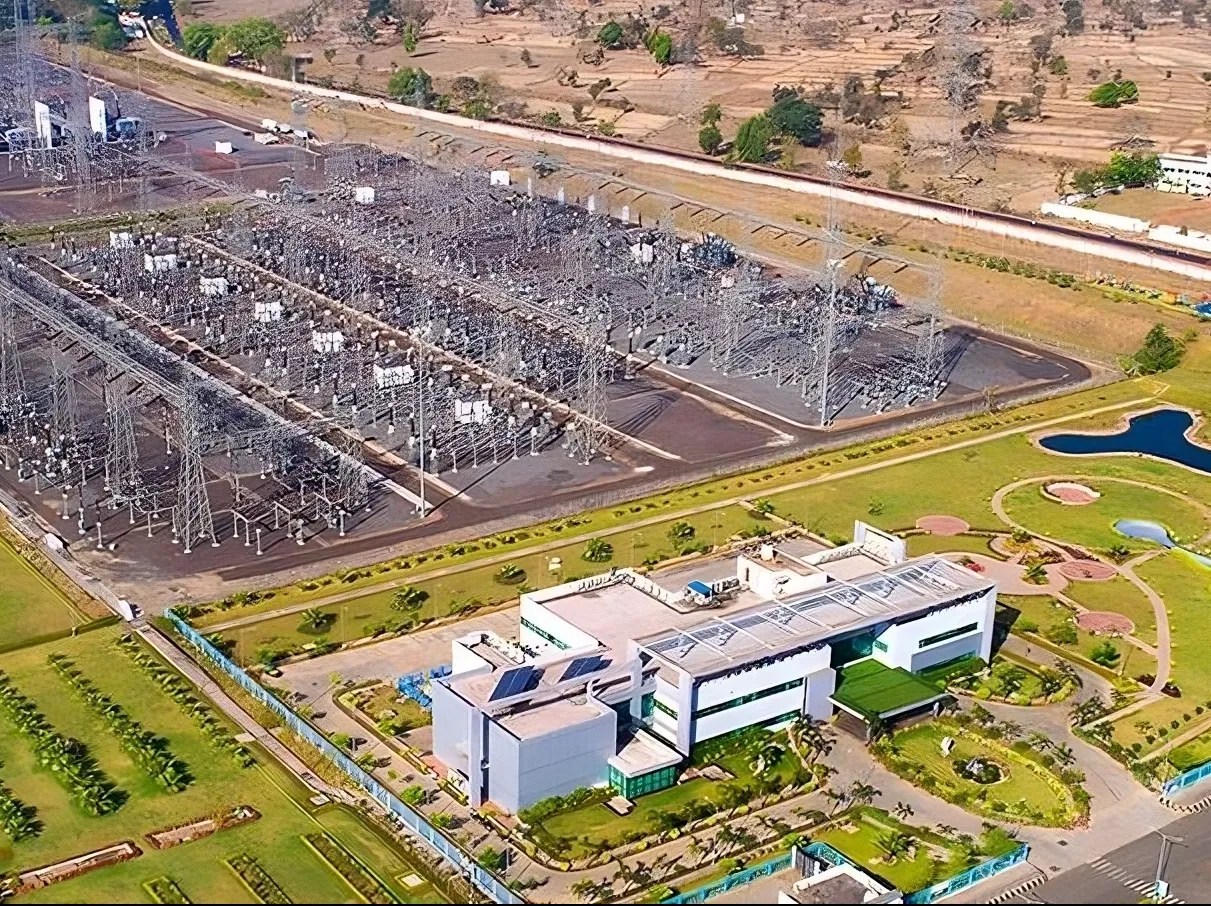
Adani Energy Solutions FY26: Growth Bifurcated; Capital Intensity Rising
General information and entertainment, not investment advice. The author is not a SEBI-registered adviser or research analyst. No recommendation, no promised returns. Markets carry risk including loss of capital. Figures may not be current. Consult a registered adviser before acting.
1. At a Glance
Three business levers, three different stories: transmission holds the factory running on cost-plus tariffs; distribution claws back margin through ruthless efficiency; smart metering scales faster than the company can hire installers. The stock trades at 78x current earnings, a price that assumes all three engines work without hiccups.
FY26 net profit rose 115% to ₹2,283 crore. An outlier year, buoyed by a one-off: the fully commissioned Mumbai HVDC project, which the company flags as generating ₹1,300 crore in annualized tariff starting FY27.
Debt climbed 23% to ₹49,176 crore. Capital intensity is not a looming problem—it is already here. Management guides to ₹22,000 crore capex in FY27 and ₹23,000 crore in FY28, creating a structural need for equity raises and internal cash conversion to stay within leverage bands.
The tension: growth requires capital the company does not yet own. Orders exist; funding does not.
2. Introduction
Adani Energy Solutions (AESL) owns four streams: transmission, distribution, smart metering, and trading/cooling. The first two are regulated utilities with long-term customer contracts and 99%+ availability. The last two are optionality bets, one scaling rapidly and one in lab phase.
In FY26, the company commissioned the Mumbai HVDC (a 1,000 MW link feeding renewable energy into India’s financial capital), completed five transmission projects, installed 113.6 lakh smart meters cumulatively, and maintained operational transmission availability of 99.7% across a 27,949 circuit-km portfolio.
Three months ago, in June 2026, AESL signed a binding deal to acquire IntelliSmart for ₹3,050 crore—a strategic bet on consolidation in the smart metering vendor space.
The market cap is ₹1,79,509 crore. The stock price referenced here is ₹1,492 as of 15 Jun 2026, and is not live.
3. Business Model: WTF Do They Even Do?
AESL runs transmission lines, distributes electricity in Mumbai, installs smart meters for states, trades power, and offers district cooling to offices and data centers. A mashup of boring and shiny.
Transmission (40% of revenue, FY26): The company operates 27,949 circuit-km of high-voltage transmission lines across 16 states under long-term service agreements (TSAs) with off-takers backed by central government or state utilities. Projects are commissioned based on bids. Most older projects are cost-plus (the company recovers fixed costs + a 15.5% post-tax return on equity). New projects are competitively bid and fixed-tariff. Management admits the shift from cost-plus to competitive is real and the margin compression is real. But availability-linked incentives (the grid pays more if the line uptime exceeds 95%) offset part of the toll.
Distribution (50% of revenue, FY26): The company operates the Mumbai licence area under Adani Electricity Mumbai Limited (AEML), serving 13+ million consumers in metropolitan Mumbai and Mundra SEZ. The business is regulated tariff, cost-pass-through, and the company has crushed distribution losses from 8.5% (at acquisition in 2015) to 4.21% in FY26. Strategy is steady capex (₹1,500–2,000 crore/yr) to harden the network, while keeping tariffs flat and pocketing efficiency gains.
Smart Metering (3% of revenue, FY26): Under DISCOM Bench Mark (DDB) / DBFOOT contracts across 10 states, AESL installs and maintains smart meters for state utilities. The model is lumpsum payment on installation + O&M revenue over 7–10 years. Revenue accrual is long-tail. The company has installed 113.6 lakh meters cumulatively and targets 1 crore (10 million) installations in FY27. The management call flagged a “perpetual” business—implying future rebids and contract extensions.
Trading & Cooling (7% of revenue, FY26): Bullion, commodity, and power trading; district cooling systems in Gandhinagar and a newly awarded Chennai concession. Too small to move the needle today.
The business is essentially: regulated wires that convert into cash. The route to more cash is either bigger wires (more transmission capex) or better wires (smart meters). Neither is cheap.
4. Financials Overview
Figures are consolidated, in ₹ crore.
Latest Annual Result (FY26)
Metric
FY26
FY25
YoY Change
Revenue
27,588
23,767
+16.1%
EBITDA
8,005
7,067
+13.3%
Net Profit
2,283
1,060
+115.4%
EPS
19.0
8.82
+115.4%
Annual Narrative
Revenue grew 16% year-on-year, driven by transmission project commissioning (full-year run-rate impact of FY26 capex) and smart meter installation acceleration. EBITDA margin compressed to 29% (from 30% in FY25), reflecting a high capex year and the relative dilution of high-margin cost-plus transmission revenue by low-margin smart metering revenue.
Net profit doubled, but the chart is unclean: FY25 included a one-off charge of ₹827 crore (regulatory asset write-off in the distribution business post tariff order approval). Stripping that, like-for-like net profit growth is ~35–40%.
Latest Quarterly Result (Q4 FY26)
Metric
Q4-FY26
Q3-FY26
QoQ Change
Revenue
6,730
6,596
+2.0%
Operating Profit
1,995
1,955
+2.0%
Net Profit
552
534
+3.4%
Q4 showed seasonal strength (typical in utilities), with modest margin expansion. Operating margin held at ~30%, consistent with the full year. The quarter was clean—no one-offs, no regulatory reversals, just baseline operations.
5. Market Expectations & Historical Multiples
This section describes how the market is currently pricing the company and how that compares with its own history and peer group. It is descriptive, not predictive.