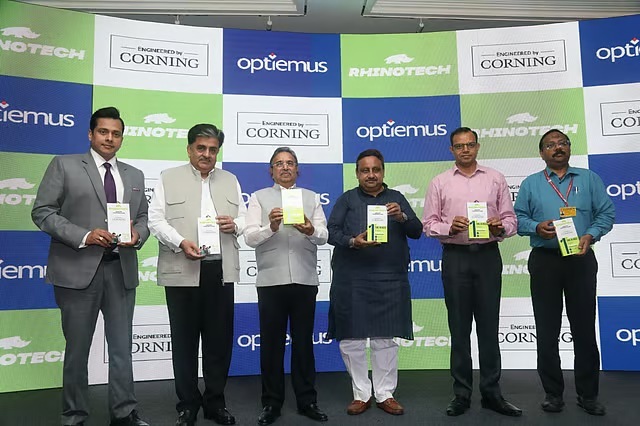
Optiemus Infracom FY26: Distribution Stumbles, Manufacturing Flexes
General information and entertainment, not investment advice. The author is not a SEBI-registered adviser or research analyst. No recommendation, no promised returns. Markets carry risk including loss of capital. Figures may not be current. Consult a registered adviser before acting.
Prices referenced are not live; figures are consolidated, in ₹ crore, as of March 31, 2026.
1. At a Glance
Revenue dipped 6.4% to ₹1,769 Cr in FY26. Profit jumped 16% to ₹66 Cr.
The company exited volatile brand partnerships mid-year—mobile handset distribution is splintering—and pivoted hard into manufacturing: electronics assembly (EMS) and a greenfield cover glass play in partnership with Corning Inc. The cover glass factory, ₹550 Cr capex, is under construction in Tamil Nadu.
Operating margin tightened to 5.5% from 5.2%, odd for a pivot to “higher-margin” manufacturing. EBITDA rose 7% despite the revenue fall: ₹138 Cr. The math is tight.
The core tension: distribution revenue contracting while the company bets on manufacturing scale-up and a 40–45% revenue CAGR over the next three years—a claim that assumes flawless execution and order velocity from customers not yet fully named.
2. Introduction
Optiemus Infracom was built on mobile handset distribution—a business it operated for 25 years. In FY26, that heritage fractured.
The company supplies handsets (Nokia, Samsung, HTC historically) via 650+ distributors and 10,000+ retail partners across India. That unit has been struggling. Response: exit loss-making brand partnerships and raise the bar on customer credit quality. Translation—smaller order book, tighter terms, higher customer bar.
Simultaneously, the group owns three manufacturing subsidiaries: Optiemus Electronics Ltd (OEL; wearables, smartphones), GDN Enterprises (networking kit, telecom gear), and a 70:30 JV with Corning called Bharat Innovative Glass Technologies (BIGTECH).
In FY26, manufacturing overtook distribution by revenue. BIGTECH’s factory was inaugurated in Tamil Nadu in December 2025. Trial production is complete. Commercial operations are expected 12–15 months away. That’s a long bet.
3. Business Model: WTF Do They Even Do?
The company has split itself into three legs.
Distribution (shrinking): mobile handsets, now under pressure from Apple stores, brand websites, and e-commerce. Optiemus is no longer the gatekeeper. FY26 revenue was flat; the company culled unprofitable brand partnerships. Likely to stay flat or shrink.
Electronics Manufacturing (scaling): OEL assembles wearables (smartwatches, hearables), smartphones, and IT hardware for global brands—Boat, Xiaomi, ASUS, Realme, and others. GDN makes networking equipment and routers for telecom OEMs. FY26 saw new partnership wins announced for IoT modules, AI+ smartphones, and PhonePe Soundbox. This leg is volume-hungry and margin-lean but growing faster than distribution.
Cover Glass (greenfield, mothballed revenue): BIGTECH manufactures Gorilla Glass (cover glass for phones, tablets, wearables) in partnership with Corning. The facility cost ₹550 Cr. Capex is “largely completed.” Commercial operations are 12–15 months away, meaning zero revenue contribution until late 2027 or early 2028. High entry barrier (Corning’s IP, customer relationships), high risk (ramp-up, offtake), high working capital need.
The company claims all three together will deliver 40–45% revenue CAGR over three years. The math assumes both the new EMS wins and BIGTECH ramp at their stated schedules—a pair of big assumptions.
4. Financials Overview
Figures are consolidated, in ₹ crore.
FY26 Results (Year ended Mar 31, 2026)
Metric
FY26
FY25
Change
Revenue
1,769
1,890
-6.4%
EBITDA
138
129
+6.9%
PBT
91
77
+18.2%
PAT
66
63
+4.2%
EPS
7.44
7.26
+2.5%
Q4 FY26 (Quarter ended Mar 31, 2026)
Metric
Q4 FY26
Q4 FY25
Revenue
485
449
EBITDA
39
32
PAT
22
22
Revenue contracted year-on-year in FY26, but EBITDA and profit grew. The company held cost and squeezed operating leverage. Q4 rebounded to ₹485 Cr revenue (vs. ₹449 Cr in Q4 FY25).
Why did profit beat revenue? Other income of ₹40 Cr (vs. ₹21 Cr in FY25) pushed the needle. That’s a red flag: profit growth is coming from the balance sheet, not operations.
5. Market Expectations & Historical Multiples
This section describes how the market is currently pricing the company and how that compares with its own history and peer group. It is descriptive, not predictive.
Metric
Current
5-Year Avg
Peer Median
P/E
57
60
58
EV/EBITDA
30
—
—
Price/Book
4.8
—
4.2
ROE
9.2%
10%
4.3%
ROCE
10.9%
10%
7.8%
The market pays 57× earnings here. Its own five-year average P/E is 60×. Peer median is 58×. There is no bargain being priced in; the multiple is flat to slightly compressed.
What is the market pricing? Likely a scenario where distribution stays pinned in place, manufacturing ramps modestly, and BIGTECH comes online in