PTC Industries FY26: Revenue ₹603 Cr (+96%), PAT ₹102 Cr (+66%), ROCE Stuck At 8%
General information and entertainment, not investment advice. The author is not a SEBI-registered adviser or research analyst. No recommendation, no promised returns. Markets carry risk including loss of capital. Figures may not be current. Consult a registered adviser before acting.
1. At a Glance
The numbers are split. Revenue nearly doubled from ₹308 Cr to ₹603 Cr in FY26—a 96% jump—riding aerospace and defence order wins at Aerolloy Technologies (ATL), the subsidiary. Profit after tax climbed 66% to ₹102 Cr. But beneath that headline sits a builder’s paradox: operating margins compressed from 24% to 22% as the company scales new titanium and superalloy foundries (capacity expansion costs). Return on capital employed flatlined at 8.4%, barely above cost-of-funds territory, signalling equity is still finding its feet on the new capex.
The market prices the stock at 276x trailing earnings. The peer median sits at 25x. This gap is not a misprint.
2. Introduction
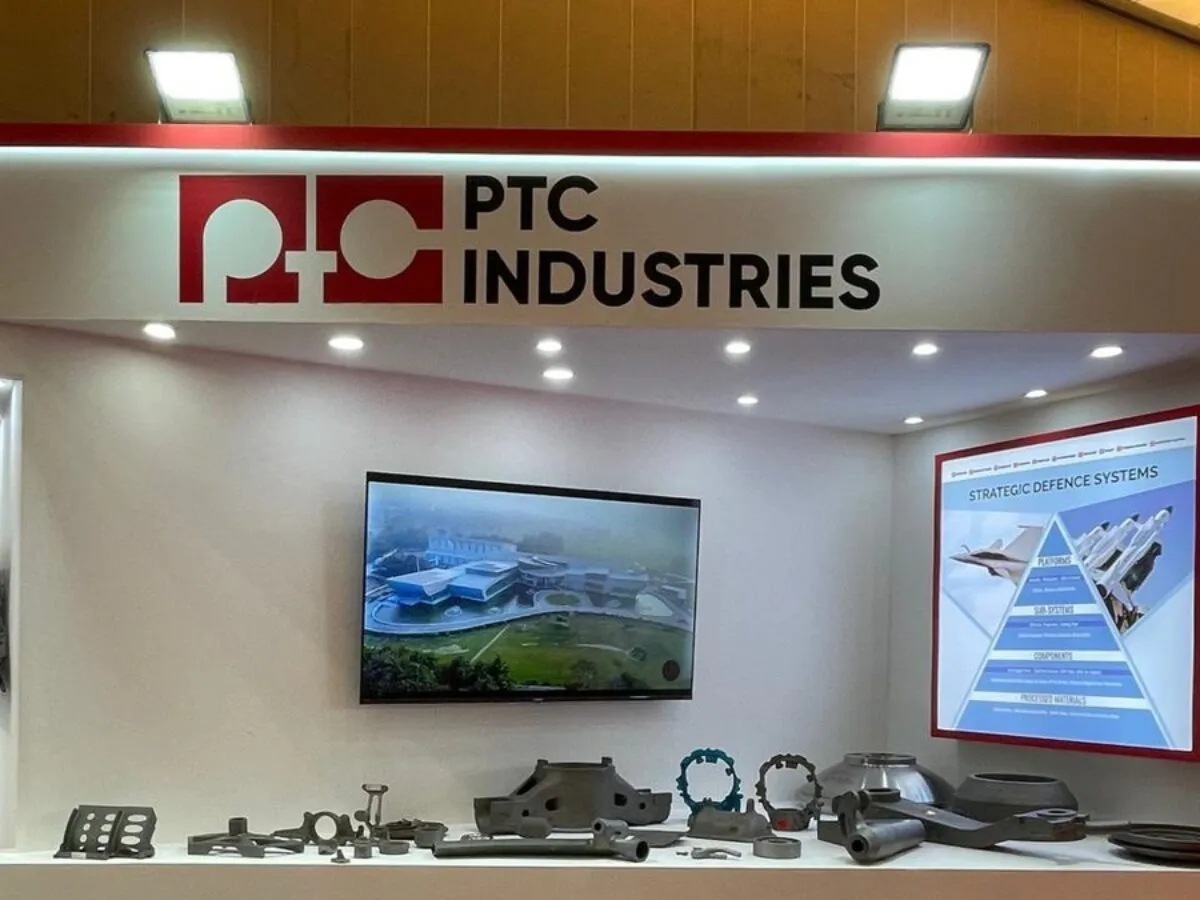
PTC Industries manufactures precision metal castings for aerospace, defence, oil & gas, and marine industries. Founded in 1963, it operates three foundries and CNC machine shops across Uttar Pradesh and Gujarat. Last year it acquired Trac Precision Solutions (UK) to deepen aerospace machining capability, and in September 2024 raised ₹700 Cr via QIP to fund its Lucknow strategic materials complex—a ₹700 Cr capex programme, two-thirds deployed.
The company’s wholly-owned subsidiary Aerolloy Technologies (ATL) manufactures titanium and superalloy castings for aerospace and space missions. ATL has commissioned a 1,500 TPA titanium ingot furnace (VAR), a 600 TPA superalloy melting unit (VIM), and is setting up the world’s largest single-site titanium recycling facility (EBCHR)—5,000 TPA capacity. Exports account for 80% of FY25 revenues; the domestic/defence segment is growing.
Recent wins: Blue Origin contracts for BE-4 superalloy engine castings (two-year supply, January 2026); Honeywell long-term supply agreement for precision castings (December 2025); ISRO/GTRE orders for single-crystal turbine blades and VSSC’s titanium ingot conversion work (January 2026); and a confidential GTRE purchase order for post-cast single-crystal turbine blades (October 2025). The ₹110 Cr BrahMos Aerospace order sits in the pipeline.
3. Business Model: WTF Do They Even Do?
PTC makes metal castings weighing from a few grams to metric tonnes. Its in-house technologies—Replicast, RapidCast, ForgeCAST, centrifugal casting, powder metallurgy—enable it to produce components from stainless steel, duplex, super-duplex, nickel-cobalt superalloys, and titanium. Customer list reads like a geopolitics textbook: Rolls-Royce, Dassault Aviation, Siemens, GE, Alstom, Emerson, HAL, Blue Origin, Israel Aerospace Industries, and global defence ministries.
The business is one part legacy industrial (oil & gas, LNG, marine ship propulsion components) and one part moonshot (titanium for rocket engines, single-crystal blades for jet turbines). The legacy bit is 20-30% margin, recurring, dull. The aerospace-defence bit is margin-accretive (30%+), qualification-heavy, multi-year contracts, higher execution risk—and is now the company’s obsession.
FY26 breakdown: approximately 38% of revenue came from EU customers, 19% Norway, 16% India (growing), 13% USA, 8% China, 6% rest-of-world. This is diversified by design—no single customer above 5% revenue. But within aerospace, a few custodies (Rolls-Royce, HAL, Blue Origin) matter disproportionately once contracts ramp.
4. Financials Overview
Figures are consolidated, in ₹ crore.
Metric
FY26
FY25
YoY Change
Revenue
603
308
+96%
EBITDA
172
108
+59%
PAT
102
61
+66%
EPS (Reported)
67.7
40.7
+66%
Q4 FY26 was lumpy. The quarter notched ₹225 Cr sales (annualises to ₹900 Cr run-rate) and ₹60 Cr PAT, but that profit spike came after three preceding quarters averaged ₹98 Cr sales and ₹15 Cr PAT each. The operating margin in Q4 was 32% vs. a 9% mean in Q1–Q3. Lumpiness is seasonal (aerospace order batches) and project-completion driven.
From Investor Presentation (3 June 2026): Management called the FY26 results a “major milestone” driven by Lucknow SMTC commissioning and ATL order ramp. Operating profit margin (OPM) guidance for FY27–28 was stated as 20–22% (vs. 22% reported in FY26), implying further scale-up will dilute margins before leverage kicks in. PAT CAGR from FY26 to FY28 was not guided, but the tone was volume-accretion led, not margin expansion.
5. Market Expectations & Historical Multiples
This section describes how the market is currently pricing the company and how that compares with its own history and peer group. It is descriptive, not predictive.
Metric
Current
Historical Avg (5y)
Peer Median
P/E
276
277
25.0
EV/EBITDA
163
—
28.8
ROE
7.0%
7.4%
13.2%
ROCE
8.4%
—
16.2%
The market currently pays 276x earnings for PTC, against a five-year historical average of 277x and a peer set median of 25x. The P/E is not an outlier; it is the company’s structural pricing.
EV/EBITDA sits at 163x vs. the peer median of 29x. This reflects two things: (1) the market is pricing-in multi-year high-growth visibility in aerospace, defence, and space segments; and (2) EBITDA today is a trough relative to FY28 run-rate assumptions. If management’s implied FY28 PAT growth delivers, the denominator swells, compressing the multiple.
ROE at 7% trails the peer median of 13%. The company’s equity base just expanded (₹700 Cr QIP in September 2024), which diluted returns this cycle. ROCE at 8.4% lags both history