Gujarat Energy Q4 & FY26: A ₹3,200 Cr Tax Loss Chest Meets a Rebranded Company Worth Asking Questions About
General information and entertainment, not investment advice. The author is not a SEBI-registered adviser or research analyst. No recommendation, no promised returns. Markets carry risk including loss of capital. Figures may not be current. Consult a registered adviser before acting.
1 — At a Glance
After three decades as Gujarat Gas, the company has been swallowed by GSPC and GSPL in the largest gas-sector merger on record. As of June 2026, it is now Gujarat Energy Limited. The shell has changed; much of what was inside stays.
The numbers on the quarterly results card: ₹5,792 cr in sales (Q4, up 41% YoY), but PAT of only ₹210 cr (down 27% YoY). Full-year sales ₹23,614 cr; net profit ₹1,678 cr. The company sits on ₹1,900 cr of unused tax-loss carryforwards with eight years to deploy them—a silent cash subsidy worth ~₹500 cr once absorbed.
Meanwhile, the Morbi industrial cluster has unexpectedly come roaring back as propane premiums over natural gas hit 50%. This is a problem dressed as an opportunity. Margins in gas trading have inflated to ₹1,334 cr on lower volumes (₹4.9 mmscmd net external), thanks to a ₹200 cr one-off on a regasification cargo swap. The “normalized” number is closer to ₹1,050–1,100 cr—a detail that matters if you read the concall.
The company is debt-free and sits on ₹1,314 cr in cash. The stock: ₹388 on 12 June 2026 (prices referenced are not live). Consolidation—not distraction—is what the market will judge in the months ahead.
2 — Introduction
Gujarat Gas Limited was born in 2005 as a City Gas Distribution (CGD) player carved out of GSPC. For two decades it was the uncontested leader in its segment, returning 13–17% ROE and paying out steady dividends. In August 2024, the Gujarat government announced a merger: GSPC, GSPL (transmission), and GSPC Energy would fold into Gujarat Gas, with the transmission undertaking to be spun off as Gujarat Transmission Limited.
The scheme was approved by the Ministry of Corporate Affairs on 17 April 2026. Effective 1 May 2026, the merger took legal effect. The company was renamed Gujarat Energy Limited (GEL) on 14 May. On 12 May, the record date passed; 62.27 crore new shares were allotted to GSPC and GSPL shareholders, diluting the base from 68.84 cr shares to approximately 131 cr. GTL (transmission) listing is pending, expected by end-July 2026.
What this means operationally: GEL now owns City Gas Distribution (CGD), Gas Trading, Exploration & Production (E&P), and wind power. The transmission pipes—once the cash engine of GSPL—are gone. Creditors and public shareholders of the old Gujarat Gas saw their economic claim diluted by ~45% before listing of GTL. Promoter stakes in the parent companies (GSPC, GSPL) transferred wholesale to the new company.
The numbers in this article are on a consolidated basis for GEL. Comparisons to FY25 are fraught: FY25 included transmission business for nine months; FY26 excludes it for the full year. Like-for-like is not available. Management flagged this caveat explicitly.
3 — Business Model: WTF Do They Even Do?
GEL operates across four business segments. Here’s the split by earnings (FY26 consolidated):
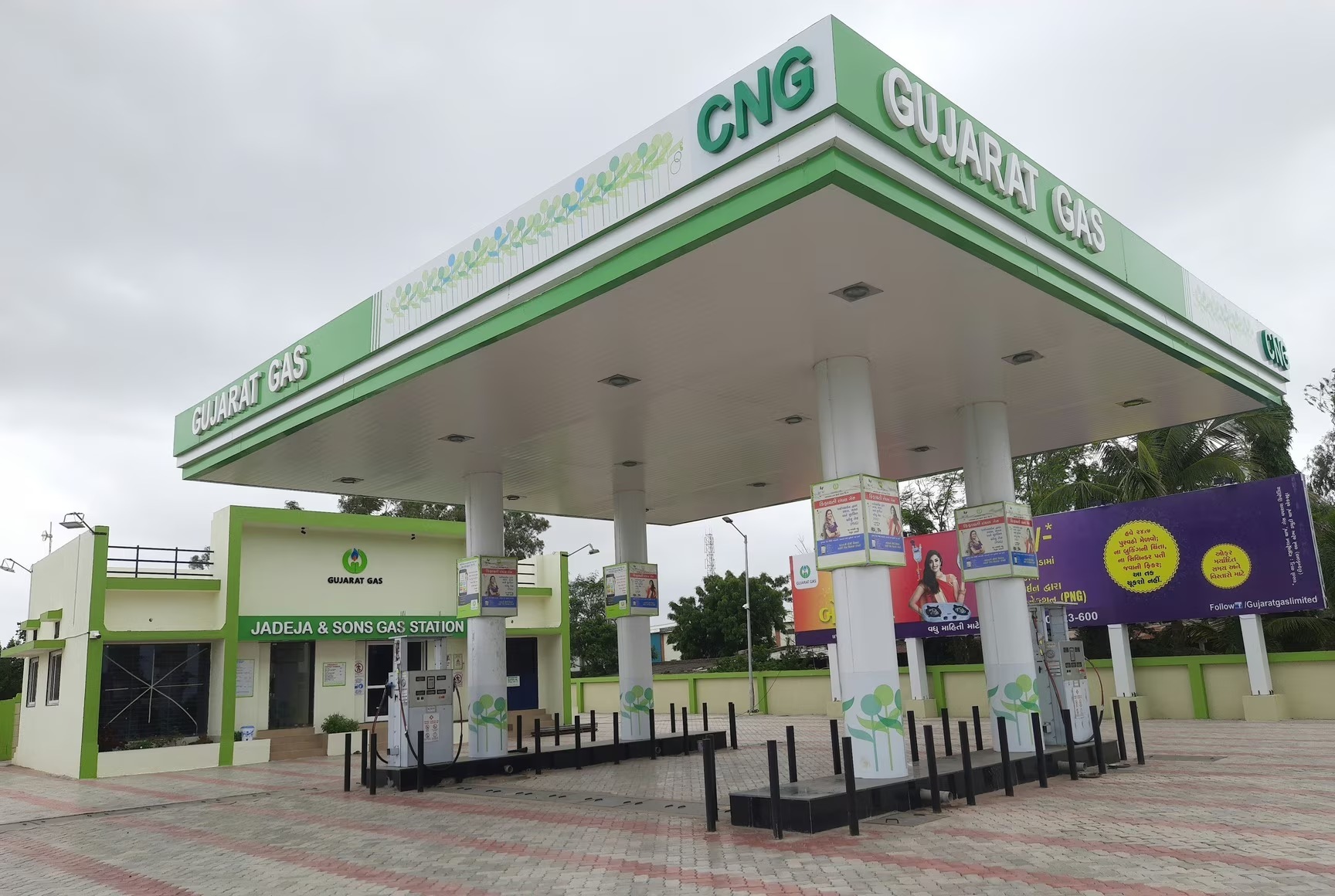
City Gas Distribution is the crown jewel by stable contribution—₹1,900 cr EBITDA on ~9.4 mmscmd of sales (CNG 29%, Domestic PNG 18%, Industrial 53%). Presence spans 27 authorizations across 44 districts in 6 states and 1 UT. Network: 839 CNG stations, 24.18 lakh domestic connections, >16,000 commercial connections, ~4,400 industrial offtake units.
Gas Trading is the merged jewel—GSPC’s core business, now internal to GEL. Imported LNG and domestic natural gas flow through long-term contracts (existing 2.96 MTPA LNG, plus two new 1.36 MTPA SPAs signed in FY26 with Qatar and Uniper). In FY26, trading volumes net of intersegment sales hit 4.9 mmscmd externally; the segment earned ₹1,334 cr EBITDA, but this includes ~₹200 cr one-off from a cargo diversion/regasification arbitrage and ~₹50 cr duty refund. Run-rate sustainable EBITDA: ₹1,050–1,100 cr annually, per management guidance.
Exploration & Production (E&P) contributes ₹29 cr EBITDA on minimal operating activity (reserves: 6.71 mmboe). The business includes tail assets and higher depreciation; operating profit pre-depreciation is positive, but after depreciation, a ₹31 cr loss in FY26. Management acknowledged that if gas prices exceed $6–7/MMBtu, the asset base becomes relevant again.
Wind Power (renewal): ₹46 cr EBITDA in FY26, a modest contribution from 702 MW at GSPC Pipavav Power Co. The plant runs at 1% PLF due to uneconomical gas-fired power generation without long-term PPAs at fixed cost recovery. Management is “exploring strategy revisions”—a euphemism for hunting for a buyer or a pivot.
The business is operationally thick: 27 CGD licenses, 2.25 MMTPA regasification capacity (Dahej), long-term LNG SPAs locked in until 2037, and a distribution network built over 20 years. Moats exist, but they are under pressure. Middle East conflict cut two LNG cargoes in May–June 2026. Morbi industrial segment is volatile—propane arbitrage is a short-term boon, not a structural shift.
4 — Financials Overview
Figures are consolidated, in ₹ crore.
Metric
Q4 FY26 (Audited)
YoY Change
Q3 FY26 (Unaudited)
Revenue from Ops.
6,002
+8.3%
6,204
EBITDA
943
+19.4%
754
PAT
151.8
-74%
590.16
EPS (₹)
3.75
(unann.)
7.00
Metric
FY26 (Audited)
YoY Change
FY25 (Restated)
Revenue from Ops.
24,425
-13.6%
28,313
EBITDA
3,772
+16.4%
3,241
PAT
1,678
-48.5%
3,257
EPS (₹)
21.55
(unann.)
36.21
FY26 Results Context (Concall):
Revenue decline reflects the exit of transmission business (₹1,113 cr in FY25). CGD grew, but was masked by an industrial (Morbi) slowdown through Q1–Q3. Q4 saw recovery as propane tightness forced ceramics units back to gas.
EBITDA expanded 16% despite lower revenue, signaling favorable mix (higher CNG and non-Morbi commercial) and trading margin capture. PAT cratered because FY25 benefited from a one-time tax credit of ₹2,011 cr (deferred tax reversal on loss carryforwards from merged entities). FY26 tax rate normalized to 31% (vs. -10% effective in FY25).
Management explicitly stated that FY26 trading EBITDA of ₹1,334 cr includes ~₹200 cr one-off (cargo diversion/regasification economics) plus ~₹50 cr duty refund. Removing these, normalized segment EBITDA ≈ ₹1,050–1,100 cr, materially lower. This detail is critical for forward valuation.
CGD EBITDA per scm in FY26: ₹6.16. Management guided to ₹5.5–6.5 forward, acknowledging volatility. The variance reflects industrial volume sensitivity (Morbi is the key swing factor) and gas-price pass-through dynamics.
Dividend: ₹8.90/share (445% of face value) recommended for FY26, aggregating ₹835 cr. Payout ratio: ~50% of consolidated PAT (excluding one-offs).
5 — Market Expectations & Historical Multiples
This section describes how the market is currently pricing the company and how that compares with its own history and peer group. It is descriptive, not predictive.
Metric
Current (June 12, 2026)
5-Yr Avg
Peer Median
P/E (TTM)
15.0x
26.3x
15.0x
EV/EBITDA
7.66x
(NM)
7.66x
Price/Book
1.45x
(NM)
1.68x
ROE
13.2%
17.0%
13.74%
ROCE
18.5%
(NM)
17.9%
What the Market Appears to Be Pricing:
The market trades GEL at 15x TTM earnings—aligned with the peer median (Adani Total Gas 126x,