Tankup Engineers FY26: Orders Triple While Cash Burns
General information and entertainment, not investment advice. The author is not a SEBI-registered adviser or research analyst. No recommendation, no promised returns. Markets carry risk including loss of capital. Figures may not be current. Consult a registered adviser before acting.
1. At a Glance
Tankup Engineers limped into June 2026 as a company mid-transformation. Orders hit ₹42.67 Cr—mostly defence and aerospace, which sound like growth stories until you notice the operating cash flow is negative ₹34.36 Cr.
The stock trades at 114x earnings (P/E of 113.99). The market cap is ₹545 Cr.
FY26 sales jumped 182% to ₹57.25 Cr, profit rose 214% to ₹4.78 Cr, but debtors ballooned to 246 days—meaning cash is stuck in customer wallets while the company borrows at ₹36 Cr. Debt-to-equity is 1.21, and borrowings tripled in two years.
ROE is 26.3%—good—but ROCE tumbled to 19% from 21% last year. The balance sheet grew, the production capacity didn’t.
2. Introduction
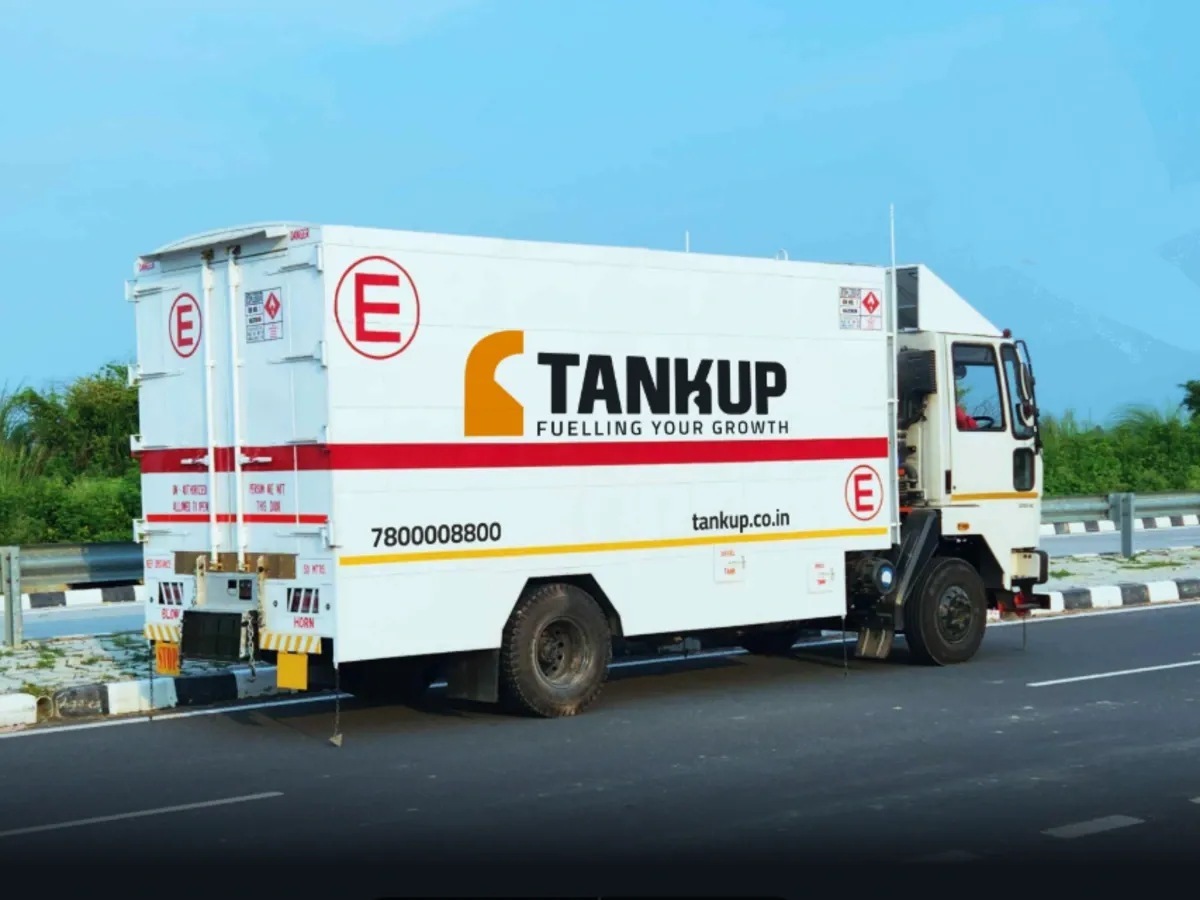
Tankup Engineers manufactures specialised vehicle superstructures—mobile tanks, refuellers, sprinklers, blasting shelters—for construction sites, mining, military, and airports.
The company is seven years old (incorporated 2020) and listed on NSE Emerge in April 2025 after a 10:1 bonus and a ₹11.5 Cr rights issue in FY25. In August 2025, it acquired 100% of Titan Asia, a refueller fabricator with ₹39.4 Cr in orders.
Pankhuri Lath resigned as CFO in February 2026; Lalit Gupta took over the same month. Independent director Rajneesh Gupta left in May 2026, citing tenure completion.
The company has shipped products to 24 states; Uttar Pradesh contributes 36% of revenue. Top 10 customers account for 64% of sales. It aims to grow international (Australia order received).
Capacity is 360 metric tons per annum; FY24 used 195.60 MT (54.33% utilization). By FY26, production capacity was still 360 MT—no expansion announced.
3. Business Model: WTF Do They Even Do?
Tankup builds metal. Specifically: containers, tanks, refuellers, service vans, explosive carriers. The vehicles move fuel, water, explosives, compressed gases to places fixed pipes don’t reach.
The product mix shows Refueller dominates (52.88% of sales in FY24), followed by Stainless Steel Assemblies (16.34%), Service Vans (7.64%), Water Sprinklers (7.42%), Tank Trucks (4.63%), and Explosive Vans (4.61%).
The customer split was B2C 75%, B2B 21%, B2G 4%—meaning mostly private logistics and construction, not government.
By FY26 revenue mix, Infrastructure led at 47.41%, Petroleum 21.93%, Mining 3.31%, Automobile 4.71%, Defence 0.11%, Aviation 0.06%, and Manufacturing (their own parts sales) 22%.
The company has PESO certification (Petroleum & Explosives Safety Organisation), MSME ZED certification (Zero Defect Zero Effect), and is Ministry of Defence approved for supply to Indian Air Force.
It also does stainless-steel fabrication for industrial customers, mobile service vans for mining operations, and repair & reconditioning.
The facility is in Lucknow, Uttar Pradesh, 2,665 sq. mt spread. It is accredited for quality, environmental, and safety standards.
What’s the wedge into growth? Defence and aviation orders are small today but high-margin and sticky. The Titan Asia acquisition adds ₹39.4 Cr of order book and aviation ground support equipment expertise. But the company is betting on these sectors while its bread-and-butter (petroleum, construction) stays lumpy and price-competitive.
4. Financials Overview
Figures are consolidated, in ₹ crore.
Metric
Mar 2024
Mar 2025
Mar 2026
YoY (24→25)
YoY (25→26)
Revenue
19.42
20.30
57.25
4.5%
182.0%
Operating Profit (EBIT)
3.41
2.53
7.22
-25.8%
185.0%
OPM %
17.6%
12.5%
12.6%
—
—
PAT (Net Profit)
2.48
1.52
4.78
-38.7%
214.4%
EPS (₹)
99.20
3.90
9.03
-96.1%
131.5%
FY25 was a disaster year—revenue grew only 4.5%, profit collapsed 39%, EPS fell to ₹3.90. That dip happened post-IPO; the text hints at restructuring (bonus issue, rights issue).
FY26 swung hard the other way: sales up 182%, profit up 214%, but it’s from a trough. Operating margin stayed flat (12.6% vs 12.5%)—volume grew but pricing and cost structure didn’t improve.
EPS rebounded to ₹9.03, but only after a 10:1 bonus (which split existing equity). The pre-bonus EPS was ₹90.30; post-bonus it’s ₹9.03. The denominator changed, not the earnings power.
Debtors rose sharply: from ₹6.12 Cr (Mar 2025) to ₹38.56 Cr (Mar 2026)—up 530% in one year. This is the working capital trap.
5. Market Expectations & Historical Multiples
This section describes how the market is currently pricing the company and how that compares with its own history and peer group. It is descriptive, not predictive.
Metric
Current
Historical Average (3Y)
Peer Median
P/E Ratio
113.99
85.00
25.02
EV/EBITDA
71.90
—
—
P/B (Price-to-Book)
18.35
—
3.34
ROE %
26.30
34.20
13.20
ROCE %
18.95
—
16.22
The market currently pays 114x earnings versus a 3-year average of 85x and a peer median of 25x. Among industrials capital goods peers (HBL Engineering at 25.6x, Inox India at