General information and entertainment, not investment advice. The author is not a SEBI-registered adviser or research analyst. No recommendation, no promised returns. Markets carry risk including loss of capital. Figures may not be current. Consult a registered adviser before acting.
1. At a Glance
FY26 handed FIEM its “strongest performance to date” on paper: ₹2,816 Cr revenue (+16% YoY), ₹256 Cr PAT (+24% YoY). Net profit climbed while EBITDA margin held steady at 14%, not exceptional but solid. Yet the machinery behind it reveals friction. CEO Vineet Sahni quit mid-tenure; leadership reverted to founder JK Jain. Two-wheeler segment—97% of revenue—grew, but the four-wheeler bet remains a rounding error (₹100–150 Cr guidance for FY27, up from negligible today). The 2W market itself expanded 12% to 26.7M units, though Fiem’s market share data stayed opaque. Working capital tightened visibly: receivables spiked ₹48 Cr YoY; inventory rose ₹29 Cr.
The company held ₹298 Cr cash, down from ₹206 Cr (March 2024), yet borrowings stayed low at ₹22 Cr. Dividends jumped to ₹40/share (400% payout) from ₹30 prior, signalling confidence or opportunism.
One eye-catching signal: integrated LED manufacturing claimed 60–63% of automotive lighting revenue, and the order book (₹1,200 Cr, 12-month plus delivery window) is almost entirely LED, suggesting structural mix-shift happening silently.
2. Introduction
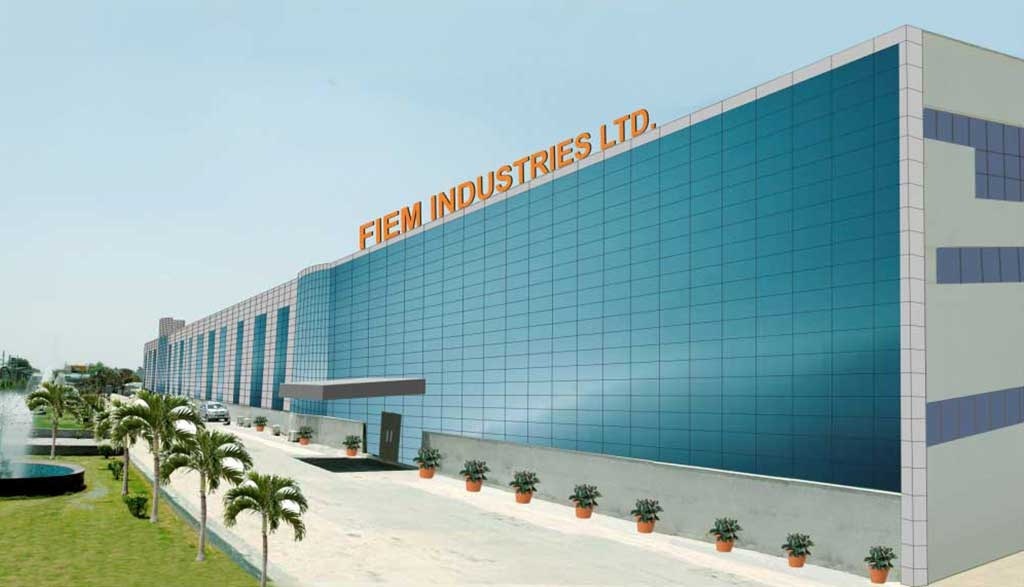
FIEM Industries Ltd has occupied a corner of India’s auto-component lighting space for 37 years. Founded in 1989 as Rahul Auto Private Limited by JK Jain, the company holds 30%+ of the two-wheeler headlamp market and supplies lighting, mirrors, and moulded plastic bits to 50+ OEMs: Honda, TVS, Yamaha, Suzuki, Hero MotoCorp, Royal Enfield, Mahindra, and others.
Capacity utilisation hovered at 75%, per management; the company inched forward on debottlenecking capex (₹108 Cr in FY26, guided at ₹200 Cr over two years). R&D spend ran 2%+ of sales; in-house EMI/EMC validation (rare for lighting) reduces development cycles and claims to compress time-to-market for new models.
The sector backdrop: rural demand improved, EV adoption crept upward. OEM launches clustered on EV platforms (TVS iQube, Honda Activa EV, Royal Enfield EVs under development, Yamaha exports ramping). Fiem positioned itself as “trusted partner” across these launches, though OEM disclosure tends to lag announcement. CEO departure, announced May 31, marked a 3-year tenure cut short. Chairman Jagjeevan Kumar Jain assumed operational control; no external CEO hire planned.
3. Business Model: WTF Do They Even Do?
Fiem’s core: manufacture and supply automotive lighting for two-wheelers and four-wheelers, anchored by 97.7% revenue from 2W. The company also ships rear-view mirrors, plastic moulded parts, sheet metal, and LED luminaires for non-auto applications (indoor/outdoor lighting, integrated passenger information systems for transit).
Product Mix & Lighting Transition
Automotive lighting segment (31% conventional headlamps, 42% LED automotive lighting, 12% rear-view mirrors, 10% plastic moulded, 5% other). Management flagged that new-business pipeline runs “almost 100% LED”—a structural pivot. Pricing for conventional-to-LED is “3 to 4x” depending on content (DRL, sequential, position lamps); yet management claimed margin parity, implying mix-shift is a growth and competitiveness lever, not a margin expansion play.
Geography & Customer Concentration
Revenue: Domestic OEMs 92%, replacement market 7%, exports 1%. Major customers include HMSI (where Fiem holds 100% share on rear-view mirrors, 100% on TVS DRL/license lamps—per disclosures). Nine manufacturing units span Kundli (Haryana), Hosur (Tamil Nadu), Nalagarh (HP), Tapukara (Rajasthan), Ahmedabad (Gujarat).
The 4W Experiment
Four-wheeler remains a strategic “build-out, not a sprint.” Management signalled engagement with Mahindra, Force Motors, Tata Motors, and Maruti (on backlog). They converted 70% of 700-Cr RFQs into “business under development” (not booked orders; management cautioned against treating RFQs as firm). FY27 guidance: ₹100–150 Cr 4W revenue; FY28: ₹200–250 Cr. Profitability to be neutral; consolidated EBITDA guidance held at 14%+ even as 4W ramps.
Order Book & Capacity
Order book valued at ~₹1,200 Cr (1–2 year delivery window), spanning 100+ projects. Capacity utilisation at 75% left headroom for organic growth without capex explosion. Management planned ₹200 Cr capex over two years, largely for debottleneck and 4W support—no greenfield.
4. Financials Overview