BEML Ltd FY26: Order Book Bloat, Profitability Squeeze
General information and entertainment, not investment advice. The author is not a SEBI-registered adviser or research analyst. No recommendation, no promised returns. Markets carry risk including loss of capital. Figures may not be current. Consult a registered adviser before acting.
1. At a Glance
BEML ended FY26 with revenue of ₹4,351 Cr and net profit of ₹141 Cr—a headline beat on sales (+8% YoY), a headline loss on profit (-50% YoY). The operating margin compressed to 7% in the full year from 11% in FY25.
An order book sitting at ₹15,896 Cr is notable in scale. But execution spanned unevenly across quarters: Q4 dispatch spike created a debtors problem (191 days receivable), and management’s own commentary blamed one-time project corrections of ~₹250 Cr for the profit cratering.
The pivot is real: defense and rail/metro climbed from 46% of revenue to 59% of the mix. The business is structurally shifting away from mining’s seasonality toward annuity-like contracts. Whether the margin recovery keeps pace with order execution will define the next chapter.
2. Introduction
BEML is a 60-year-old PSU in heavy earthmoving, defense vehicles, and rail coaches. The Government of India owns 54% of the equity; the rest is held by institutions (19%), public (22%), and foreign investors (6%).
In June 2026, the company announced an analysts’ meet; recent moves include a ₹1,500 Cr greenfield rail facility at Umariya (Bhopal), approval in February, and multiple defense indigenization milestones—a 12×12 high-mobility platform cleared for production, a 21 m³ rope shovel working for over a year, and a 35-ton electric dump truck as the first step in an EV conversion roadmap.
Exports logged ₹107 Cr in FY26—a historic high—anchored by a ₹60 Cr metro rolling stock order from Africa and a West Asia mining equipment repeat contract. This is BEML’s first overseas metro order, a moat long sought. Management framed the moment as execution proof: moving from import-led to indigenous and export-led.
3. Business Model: WTF Do They Even Do?
BEML makes three things, in order of past presence but shifting urgency:
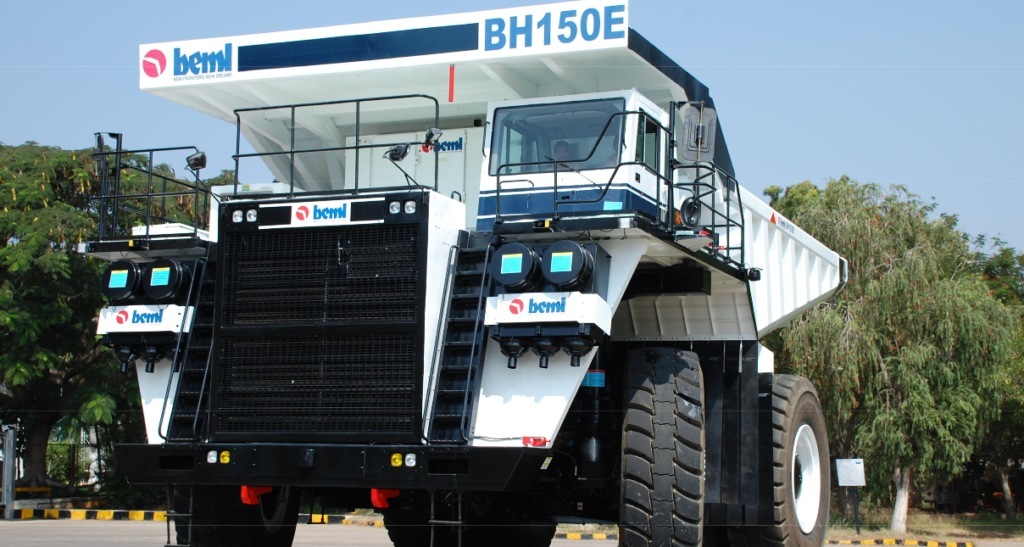
Mining & Construction (~40–41% of FY26 revenue). Hydraulic excavators, motor graders, dump trucks, bulldozers, rope shovels—the equipment that opens earth. Clients: Coal India, state-run mining corporations, private contractors. The business is fast-turn (2–3 month cycle), high-margin on contracts, but cyclical on monsoon and budgets. FY26 saw unusual strength at year-start (₹350 Cr export order with repeat options + ₹600 Cr visibility in L1 positions), bucking last year’s monsoon-driven stall.
Defense & Aerospace (~27% of FY26 revenue). Armored recovery vehicles, bridge layers, engines for critical platforms, and 100% indigenous designs like the LAMB (Light Armored Multi-purpose Vehicle)—STANAG Level 2 belly protection, undergoing trials through March 2026. The 12×12 platform is positioned for LRSAM/PINAKA/radar carriers. Management sees pipeline depth: 230 armored recovery vehicles cleared, self-propelled mine barrier as sole bidder, sub-bridging systems, triple-ME follow-ons. The ticket sizes ($15k Cr for Anka, $600 Cr for trailed orders) and tender cycles (6–24 months) mean revenue lumpiness, but also moat-building R&D.
Rails & Metro (~19% of FY26 revenue, rising to 40–45% target). Coaches for Indian Railways and metro systems. The company has supplied 1,100+ metro cars to date and manufactures high-speed and Vande Bharat rakes. The LHB/LHP order (₹1,600 Cr) cleared design in June 2026; dispatches started. The Aditya facility can produce 12 metro coaches/month or 6–8 high-speed coaches/month; a new Bhopal facility (Brahma) will add 300–350 annual capacity in 2.5–3 years. This segment is annuity-like, with price variation clauses (PVC) covering inflation in most modern contracts—a margin hedge mining can’t claim.
The shift is deliberate: management expects rail/metro and defense to together account for 65–70% of revenue long-term, with mining baseline ~30–35%. This reduces earnings volatility and creates a less seasonality-prone cash flow.
4. Financials Overview
Figures are consolidated, in ₹ crore.
Metric
FY24
YoY Change
FY25
FY26
YoY Change
Sales
4,054
4.1%
4,022
4,351
8.2%
EBITDA
445
13.7%
506
299
-40.9%
PAT
282
3.8%
293
141
-51.9%
EPS
₹33.83
—
₹35.12
₹16.97
-51.7%
Comment: PAT was distorted. Management cited ~₹250 Cr from “one-time correction in two projects” (forex-hedged foreign currency contracts realizing losses on settlement) and a one-time gratuity provision under the new labor code. Strip these out, and underlying operations were positive. The ~₹800 Cr execution spillover in rail/metro (Mumbai Metro storage delays, Vande Bharat engine redesign) also depressed FY26 revenue versus plan. Management expects FY27 to see execution “fire on all cylinders,” with rail/metro orders now at ₹5,500 Cr executable for the year—described as “first time in the history of the company.”
EBITDA margin fell to 7% in FY26 (OPM: 6.87%). Management guided sustainable EBITDA margin “around 16%” once execution normalizes and prior project distortions clear. The break-even revenue point