General information and entertainment, not investment advice. The author is not a SEBI-registered adviser or research analyst. No recommendation, no promised returns. Markets carry risk including loss of capital. Figures may not be current. Consult a registered adviser before acting.
A defence and space explosives maker just delivered a punch-drunk FY26: revenue slipped 7% to ₹388 crore, but profit stayed stubborn at ₹46 crore—the gap a temple to other income (₹37 crore windfall). The order book hit a record ₹1,569 crore, enough to run 4 years if the execution gods co-operate. Two accidents still casting shadows. A P/E of 74x is playing a game of “how much geopolitical goodwill can you stomach?”
The company told the market it expects ₹600–700 crore revenue in FY27 and margins between 15–20%. Management positioned both recovery and caution in the same breath—the order book “provides strong medium-term visibility,” yet the backlog includes unexecuted items worth ₹800 crore in development or awaiting export licenses.
Why does the stock trade at 74x earnings when the sector median is 32x? Because it owns a moat: the only Indian firm qualified to make countermeasures (chaffs, flares), sole exporter of fully assembled rocket motors to global buyers, and direct supplier to ISRO, DRDO, and BDL. The playbook is execution risk married to regulatory risk and sprinkled with geopolitical dependency.
2. Introduction
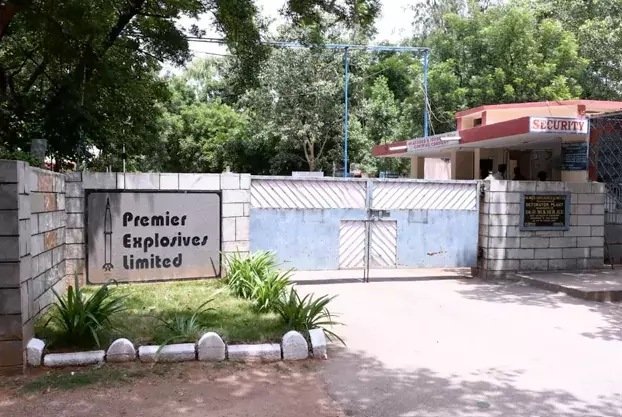
Premier Explosives Ltd (PEL) manufactures industrial explosives and defence-grade propellants, warheads, and pyrotechnics. Registered in 1980, the company occupies a fortress position in India’s domestic defence supply chain—it is the only private manufacturer of solid propellants for missile programs and the only commercial-scale producer of “safer and greener” detonators (NHN type).
Recent moves include a December 2024 joint venture with Global Munition Ltd (defence and aerospace products), an April 2026 export order worth ₹350 crore for defence products (two-year execution), and a November 2025 land grab in Andhra Pradesh (400 acres, under negotiation). In September 2025, an accident at Katepally reversed a temporary production suspension; the plant is now back in action but rebuilding large rocket motor capacity.
The company operates across six manufacturing facilities in Telangana, Madhya Pradesh, Maharashtra, and Tamil Nadu. It also runs operation and maintenance contracts for ISRO and DRDO, generating steady-state revenue (₹18 crore per annum from ISRO, though it lost the Jagdalpur O&M contract to cost inflation).
3. Business Model: WTF Do They Even Do?
Two rivers of revenue: defence/space (83% in 9MFY26) and bulk explosives for mining (17%).
Defence & Space (₹333 crore domestic, ₹17 crore export in FY25): Solid propellants and rocket motors for LRSAM, MRSAM, Astra, and Agni programs. Countermeasures (chaffs and flares) for Indian Air Force. Warheads, mines, drone payloads. A customer list that reads like India’s military-industrial Venn diagram: Bharat Dynamics, ASL, BEL, ISRO, DRDO. Single-customer concentration was 57% in FY25 (the Ministry of Defence, no surprises), top five customers 87%.
The defence segment is a fixed-income annuity wrapped in national interest. Volumes depend on programme milestones, free-issue materials (FIM) from customers, and the moods of government procurement cycles. Margins fluctuate wildly: 21.5% in FY24 (export-heavy, high margin), 13.9% in FY25, expected 13–15% in FY26–27 (heavier domestic mix, lower profitability).
Bulk Explosives (mining, coal, tunnelling): Cast boosters, detonating fuses, packaged explosives. Sold to Coal India, MOIL, NLC, and export to Israel, Greece, Thailand, Turkey. Smaller, lower-margin, but less lumpy than defence.
O&M Services: Steady ₹18 crore per annum from ISRO for running a solid propellant plant at Sriharikota. Lost a DRDO contract (Jagdalpur) due to cost inflation; new contractor got the nod. The company still supplies propellant where it remains the sole source—a humbling mix of being indispensable and expendable.
Why the moat works: Five-year minimum to set up an explosives manufacturing unit (licences, PESO approvals, storage). Entry barriers are structural, not cyclical. Once inside, repeat orders for life—ISRO/DRDO programmes run decades.
4. Financials Overview
Figures are consolidated, in ₹ crore.
Metric
Q4 FY26
YoY Change
vs Q3 FY26
Revenue
89.21
+20.4%
+9.6%
EBITDA
11.47
~level
-45%
PAT
6.58
+78%
+8%
EPS
1.22
—
—
FY26 full-year: Revenue ₹388 crore (-7% vs ₹417 crore FY25), PAT ₹46 crore (+60% vs ₹29 crore FY25). The paradox: revenue down, profit up. The answer: ₹37 crore other income (vendor rebates, delays compensation—non-recurring, per management).
Concall colour: Management attributed the revenue dip to “phasing/execution timing”—a fat order for chaffs and flares executed in FY25, shifted FY26 execution to the backlog. Operating profitability was “impacted by elevated raw material prices amid prevailing global tensions.” Q4 was soggy (OPM: -0.4%, net profit salvaged by other income).
The FY27 pitch: Management targets ₹600–700 crore revenue and 15–20% EBITDA margin. Export orders worth ₹350 crore (April win) plus domestic backlog execution should drive the lift. Raw material sourcing issues (20% sourced from Israel, now partly rerouted) are being solved via