General information and entertainment, not investment advice. The author is not a SEBI-registered adviser or research analyst. No recommendation, no promised returns. Markets carry risk including loss of capital. Figures may not be current. Consult a registered adviser before acting.
1. At a Glance
Prime Focus is a global post-production powerhouse: ₹4,676 crore in revenue across VFX, animation, and media tech.
In FY26, the company returned to full-year profitability for the first time in three years—₹218.76 crore net profit against losses in FY24–25. Operating margins expanded to 30%, a major lift from 22% last year.
But there’s a tension here that never really left. The company carries ₹5,717 crore in debt against ₹2,088 crore in equity. Net debt sits at ₹4,138 crore. The balance sheet has grown—assets jumped to ₹10,649 crore—but so has the leverage embedded in it.
The recent insolvency threat (a ₹353.79 crore dispute over a Reliance deal from 2014) was stayed by the NCLAT in May, but remains sub judice. Money’s now in an interest-bearing escrow. The next hearing is July 9, 2026.
Cash generation was strong: ₹1,024 crore from operations. But a ₹530 crore capex push and working capital lock-up ate into that. The studio is betting hard on scale.
2. Introduction
Prime Focus was founded in 1997 by Namit Malhotra and has grown into one of the world’s largest post-production service providers.
The company operates as a global footprint advantage: 24 locations across Mumbai, Bengaluru, London, Los Angeles, Toronto, Sydney, Barcelona, Budapest, and a dozen more. About 9,900 employees globally; roughly 80% are India-based, which creates a cost shield the rest of the world can’t match.
Two main revenue drivers: DNEG (the VFX and animation arm, ~90% of revenue) and Brahma AI (the tech platform, ~10%). DNEG has won 8 Oscars in visual effects and counts tentpole Hollywood productions as clients—Dune, Oppenheimer, The Last of Us.
Brahma AI is newer and spicier: an AI-native enterprise content platform aimed at broadcasters, OTT platforms, studios, and healthcare. It’s a play on generative AI for content localization, digital avatars, and asset management.
The company divested Prime Focus Technologies (PFT) to DNEG in June 2024 and booked a ₹21,621 crore exceptional gain (net of tax)—a one-time windfall that masked a tougher operating reality for that year.
In July 2024, DNEG (not Prime Focus directly) raised $200 million from a UAE family office to fund content production and tech expansion, including a state-of-the-art hub in Abu Dhabi.
In February 2025, Brahma acquired Metaphysic Inc., a generative AI startup, for USD 130 million (₹1,111 crore). This brought 800+ engineers and a valuation of USD 1.43 billion to the combined entity. It’s a bet that AI-powered content will be the next goldmine.
3. Business Model: WTF Do They Even Do?
Prime Focus is a post-production and tech services hybrid. Most people think “VFX studio” and stop there. Wrong.
Creative Services (90% of FY26 revenue): This is DNEG—high-end visual effects, stereo 3D conversion, animation, editing, color grading, equipment rentals. The company works with the biggest studios: Disney, Marvel, Netflix, Paramount, Warner Bros., Universal, DreamWorks. In FY26, DNEG shipped visual effects for Dune: Part Two (which won an Oscar), Oppenheimer, and a slate of tentpole films and episodic TV.
The business model is project-based and recurring—studios come back because the work is world-class and the India cost base is unmatched. About 90% of revenue comes from repeat customers, which is the closest thing to a moat in this industry.
Tech/Tech-Enabled Services (10% of FY26 revenue): This is Brahma AI and the legacy Prime Focus Technologies—now consolidated under DNEG’s umbrella. It’s a soup of AI-native workflow platforms (CLEAR, BRAHMA CORE, BRAHMA STUDIO), subtitling automation, dubbing, compliance mastering, and digital delivery. FY24 processing: 2.4 million minutes of subtitles, 15,000+ hours of dubbed content.
Brahma AI is a newer skin on an older question: can media tech be sold as a platform, or is it just a service? The company is betting on the former—positioning Brahma as an operating system for AI-driven content creation, with use cases in media, healthcare, sports, retail, and education.
The hidden tension: Creative Services is a people business with gross margins that compress when projects bunch or studios hit pause (see FY24’s Hollywood strikes). Tech Services is early, unproven at scale, and yet priced like a growth bet. DNEG’s global footprint lets it smooth geographic and project cycles. But the model is still hostage to entertainment capex cycles and now also to whether AI can actually generate revenue or just hype.
4. Financials Overview
Figures are consolidated, in ₹ crore.
Metric
FY26
FY25
YoY Change
3-Yr CAGR
Revenue
4,675.81
3,598.88
+30%
+12%
EBITDA
1,423
786
+81%
N/A
PAT (post-exceptional)
301
(377)
Restored
N/A
EPS (post-exceptional)
3.94
(12.57)
Restored
N/A
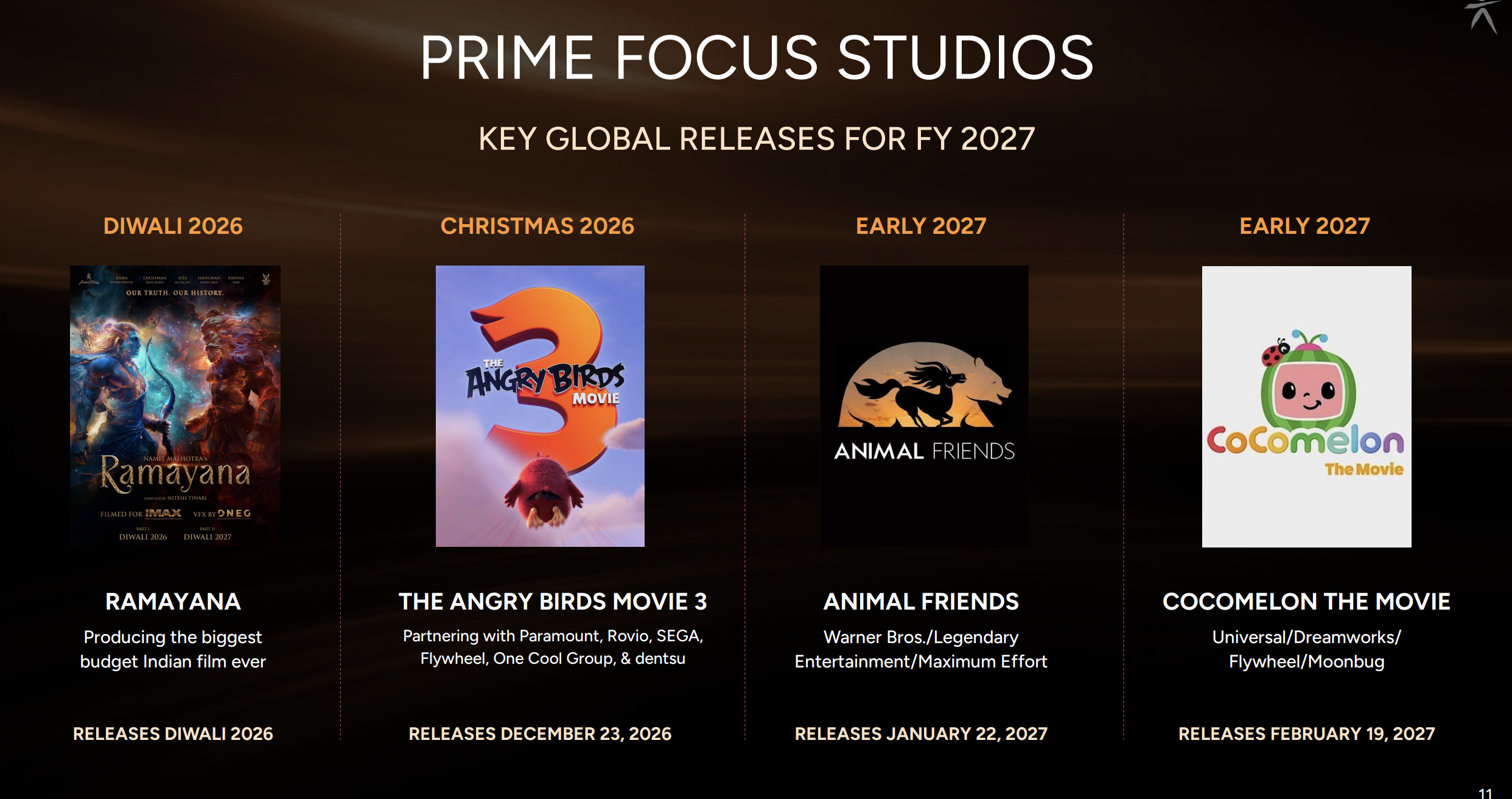
FY26 was a reset year. Revenue grew 30% YoY, driven by tentpole films (Ramayana, Dune: Part Three, Masters of the Universe, Blade Runner 2099). Personnel costs ticked up 19% but fell as a percentage of revenue—from 66% in FY25 to 60% in FY26—signaling operational leverage kicking in.
EBITDA margin expanded from 22% to 30%, a structural jump. This happened because studios had work lined up after the 2023 Hollywood strikes, the company’s pricing held, and India’s wage advantage persisted.
The exceptional items in prior years—₹21,621 crore exceptional gain in FY25 from the PFT sale, ₹38 crore impairment in FY24—have now subsided. FY26 recorded a ₹25 crore exceptional loss (mainly from labour code provisions). Real operating profit matters now.
Operating cash flow surged to ₹1,024 crore, from ₹295 crore in FY25. A ₹684 crore working capital outflow (driven by content investment) and ₹530 crore capex spend tempered the headline number. Still, the cash generation story is credible.
5. Market Expectations & Historical Multiples
This section describes how the market is currently pricing the company and how that compares with its own history and peer group. It is descriptive, not predictive.
Metric
Current
5-Year Average
Peer Median
P/E
58.7x
38.3x
39.4x
EV/EBITDA
15.0x
N/A
N/A
P/B
8.6x
N/A
1.6x
ROE
16.5%
-2.1%
3.6%
ROCE
11.5%
N/A
3.0%
The market currently pays 58.7x earnings here (based on FY26 reported EPS of 3.94), against a 5-year median P/E of 38.3x and a peer set median of 39.4x. The outlier is because FY26 is a restoration year after two years of losses; the denominator is small.
On an EV/EBITDA basis, the stock trades at 15.0x, above the peers’ median of single digits, suggesting the market is pricing in durability of the EBITDA margin recovery and growth in Brahma AI.
Price-to-book sits at 8.6x against a peer set median of 1.6x, a yawning gap. This reflects either the market’s confidence in future profitability or a bet that balance sheet assets (particularly goodwill from the Metaphysic deal) will compound. Goodwill stands at ₹238.95 crore.
ROE recovered to 16.5% in FY26, the first positive number in three years. The 5-year average masked a long dead zone; ROCE at 11.5% remains weak relative to the cost of debt (9–10% implied on gross borrowing costs).
The market appears to be pricing in: (a) sustained tentpole production calendars; (b) margin expansion from operational leverage; (c)