Relaxo Footwear FY26: A Business That Walked Into a Price Hike at 48x
General information and entertainment, not investment advice. The author is not a SEBI-registered adviser or research analyst. No recommendation, no promised returns. Markets carry risk including loss of capital. Figures may not be current. Consult a registered adviser before acting.
1. At a Glance
Relaxo earned ₹179 Cr in FY26 on ₹2,702 Cr revenue—numbers that look steady until you dig into how they got there.
The market prices it at 48x earnings. Peers sit between 16x and 66x, so context matters more than the absolute multiple.
What’s real: footwear volumes contracted (17.5 Cr pairs sold vs 19.5 Cr in FY24), margin pressure came from wages and input costs, and the company just took 15–18% price increases starting May ’26. Management expects “at least 4% to 5%” volume growth in FY27.
What’s uncertain: whether consumers absorb those hikes without flinching, whether raw material inflation keeps biting, and whether the pivot to premium brands (Sparx eyeing ₹2,800 MRP) can offset mass-market softness.
FY26 was a bridge year—volume weak, margins held flat by cost actions and GST tailwinds, profits up 5% only by extraction. FY27 hinges entirely on the pricing stick and demand elasticity. The balance sheet is fortress-like. Everything else is a live debate.
2. Introduction
Relaxo Footwears was incorporated in 1984 and has spent four decades in the footwear business—all of it mass-market, most of it hawai slippers and rubber comfort plays. The company operates 9 plants across Haryana, Rajasthan, and Uttarakhand with capacity to make 10.5 lakh pairs per day.
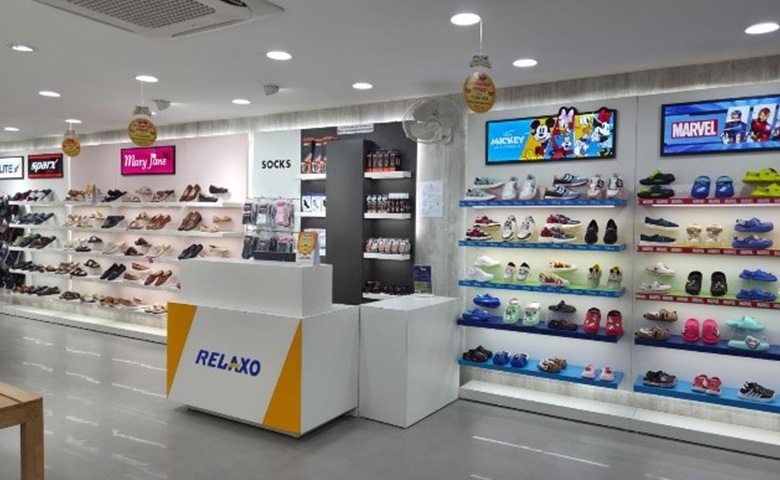
By 2026, it claims to be India’s largest footwear manufacturer, supplies 630 active distributors feeding 70,000 retail touchpoints, runs 420 exclusive brand outlets (EBOs), and exports to 37 countries.
Over the past 10 years, it has diversified from pure slippers into casual shoes, sports shoes (Sparx), and semi-formal sandals. It operates four brand tiers: Hawai (casual, affordable), Relaxo (legacy comfort), Sparx (sports/youth), and Flite (semi-formal).
The cost of doing this? The company has seen its net profitability compress—FY20 saw a 9.4% net margin, FY26 clocked 6.6%. Wage inflation in Haryana (cited by management as hitting 25–30% in some factories) and raw material volatility have been persistent headwinds.
In March 2026, the promoters (the Dua family, holding 71.3%) restructured the executive layer: two brothers, Gaurav Kumaar and Ritesh Dua, both became Co-CEOs.
3. Business Model: WTF Do They Even Do?
Relaxo makes shoes. Not fancy ones—hawai slippers, sandals, casual shoes, sports shoes.
The portfolio is split by brand and price tier. Hawai (the legacy rubber slipper) represents roughly 45% of units sold but only 23% of FY26 revenue—margins thinnest here, volume largest. Sparx (sports/youth positioning, ₹999–1,800 per pair base, now expanding upward to ₹2,500–2,800 MRP) is 16% of units but 41% of revenue. Flite and Bahamas fill the gaps.
Three-quarters of sales flow through General Trade (small retailers, kirana-style stockists). 9% now comes from “new channels” (quick commerce like Blinkit, Zepto, plus e-commerce like Flipkart, Amazon). EBOs (company-owned outlets) represent about 10% of sales today.
Geography: General Trade sales are 52% North-heavy, 24% East, 14% West, 10% South. The company is filling gaps now—West and South expansion explicit in FY27 plans.
Here’s what’s interesting and brutal simultaneously: the model is high-volume, low-margin, distribution-intensive, and stuck inside a fragmented, price-sensitive footwear market with an enormous unorganised sector. Your ability to set price is constrained; your ability to control raw material costs is zero; your ability to absorb wage shocks is binary (pass it on or compress margin). That’s the trade the company has chosen. And it’s been OK at it for 40 years—until the last five, when macro and competition conspired to flatten growth and margins.
Management attributed Q4 strength to three things: back-end plant cost reduction, operating leverage (volumes up, fixed costs flat), a price increase taken in Q4, and reduced discounting. No special “inventory gain” was cited.
The GST rate cut (12% → 5% on footwear in Dec ’25) created a channel destock in Q3, recovery in Q4. Management called this “normalization” and said GT (General Trade) demand recovered post-GST, expecting it to “continue,” but with a qualifier: “we are closely monitoring after the price increase, how the consumer reacts.”
Concall driver (June ’26): Management confirmed price increases of “2 to 3” tranches, roughly 15–18% blended across consumer prices. Cost inflation expected at 15–20% (wages cited as 25–30% in Haryana, 10–15% elsewhere; raw materials “shot up” in April but are “now softening” daily). The Chairman stated flatly: price increases will remain even if RM normalizes.
5. Market Expectations & Historical Multiples
This section describes how the market is currently pricing the company and how that compares with its own history and peer group. It is descriptive, not predictive.
Metric
Current
3-Year Avg
5-Year Avg
Peer Median
P/E
48.0
51.3
103.0
39.6
EV/EBITDA
21.0
22.4
32.1
18.3
ROE
8.33%
8.97%
9.78%
13.74%
ROCE
11.1%
11.3%
15.5%
15.12%
The market currently pays 48x earnings here against a peer median of 40x. The multiple sits above Relaxo’s own 3-year and 5-year averages, reflecting some forward optimism or inertia from older expectations.
EV/EBITDA stands at 21x, vs the peer set at 18x—again, a modest premium, not extreme. ROCE and ROE are the softer metrics: the company’s returns on capital have compressed to 11–8% range from a historical 15–10% span, signaling that incremental capital is being deployed less efficiently than in prior cycles.