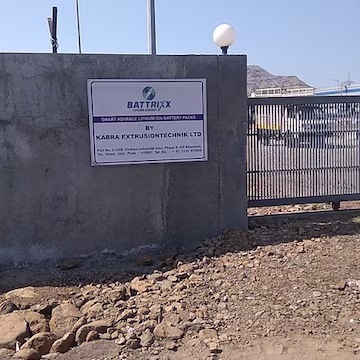
Kabra Extrusion Technik FY26: The Machine That Makes Machines Just Lost ₹5.37 Crore
General information and entertainment, not investment advice. The author is not a SEBI-registered adviser or research analyst. No recommendation, no promised returns. Markets carry risk including loss of capital. Figures may not be current. Consult a registered adviser before acting.
Prices referenced in this article are lagged reference prices, not live market quotes.
1 — At a Glance
Kabra Extrusion Technik (KET) closed FY26 with revenue of ₹451.05 crore — a fifth consecutive year of volume pressure after the FY23 peak of ₹670 crore. Net profit printed at ₹-5.37 crore, the company’s first full-year loss in at least a decade.
The extrusion machinery division — 40% market share, 15,000 installations, four-decade track record — turned in structurally stable margins but ran into a brick wall called Jal Jeevan Mission. PVC pipe manufacturers deferred their capex. The pipes waited. The machinery orders thinned.
The battery division (Geon/Battrixx) is the other moving part: growing revenue, persistent operating losses, and a ₹133 crore BESS order that arrived in Q4 FY26 and has yet to show up in the numbers. The working capital cycle stretched to 353 days (inventory days) — a number that deserves its own uncomfortable stare.
The market cap at the reference price of ₹237.73 stands at ₹830.89 crore. CRISIL downgraded the long-term rating one notch to A-/Stable in May 2026. The CFO resigned in April. The COO resigned in February. The Executive Director stepped down in September 2025.
That is a lot of chairs moving at once.
2 — Introduction
Kabra Extrusiontechnik Limited was incorporated in 1982, making it old enough to have survived Rajiv Gandhi’s economic reforms, the 1991 liberalisation, the 2008 global financial crisis, and three GST filing deadlines. It is a part of the Kolsite Group, headquartered in Daman, and is publicly listed on both BSE (524109) and NSE (KABRAEXTRU).
The core business is straightforward: the company builds plastic extrusion machinery — the industrial equipment that transforms raw plastic pellets into pipes, films, sheets, and profiles. Think of it as the B2B plumbing behind India’s B2B plumbing.
The second chapter in the story started in FY21 when the company entered the lithium-ion battery pack business under the Geon and Battrixx brands, targeting electric vehicles (2W, 3W), battery energy storage systems (BESS), and, as of July 2025, home inverter batteries. The battery manufacturing facility sits in Chakan, Pune. In FY22, the company fully acquired Varos Technology for in-house battery management system (BMS) capability.
The FY26 numbers reflect a company navigating two very different business cycles simultaneously: a mature, cash-generative machinery business whose revenue declined 13-14% as PVC pipe manufacturers froze capex, and a loss-making battery business that is ramping slowly but carries the weight of upfront fixed costs.
Revenue fell from ₹476.85 crore in FY25 to ₹451.05 crore in FY26. The net loss of ₹5.37 crore compares to a profit of ₹32.20 crore in FY25. CRISIL estimated operating margin declined 650-700 basis points in FY26, driven almost entirely by battery division losses while the extrusion division held its margin line.
The company did not declare a dividend for FY26, ending a streak that had been unbroken since FY20.
3 — Business Model: WTF Do They Even Do?
The short version: KET makes the machine that makes the pipe that carries the water that the government keeps promising will reach every village.
Division 1: Extrusion Machinery
The company manufactures plastic extrusion lines — blown film lines, pipe extrusion lines, sheet extrusion, and compounding lines. These are capital goods: large, specialised, custom-configured machinery bought by PVC pipe manufacturers, packaging film producers, and similar industrial customers. Price points run into crores per machine.
The business model is classic capital-goods: lumpy orders, 6-8 month gestation (which is why inventory days look like a semester abroad), and deep customer relationships cemented by installation, commissioning, and after-sales service. Market share is approximately 40% in the organised segment. The company has exported to over 100 countries and clocked 15,000+ installations cumulatively.
Technology comes partly in-house (one of the larger R&D teams in Indian plastics machinery, per the company’s own claims) and partly via a technical tie-up with Battenfeld-Cincinnati, Germany, running since 1983 — a collaboration that has outlasted multiple governments, four IPL title holders, and the entire tenure of the fax machine. The tie-up runs until 2026, which creates its own question mark.
The Achilles heel is demand dependency: the customer base — primarily PVC pipe manufacturers and packaging film companies — is itself dependent on government infrastructure capex (Jal Jeevan Mission being the key current driver). When JJM slows, pipe manufacturers defer their own machinery orders. KET sits two steps removed from the government’s capex resolve.
Division 2: Battery / Geon / Battrixx
The company pivoted into EV batteries in FY21. The pivot logic was coherent: India’s EV wave was building, the company had manufacturing infrastructure in Pune, and the Varos acquisition brought BMS capability in-house.
The execution has been rougher. FAME 2 subsidy changes disrupted volumes. The battery division contributed 26% of FY25 revenue (down from 52% in FY23), which represents a meaningful shrinkage in mix share. More critically, the segment has been generating operating losses — losses large enough to drag the consolidated OPM from ~10% in FY25 down to ~2% in FY26.
The redeeming element is the order pipeline: a ₹133 crore BESS contract was announced in February 2026 for FY26-27, and CRISIL notes substantial orders in BESS that are expected to catalyse growth in FY27. In July 2025, the company entered the B2C space with home inverter batteries — either a smart broadening of the distribution channel or a case of doing seventeen things when one needs fixing, depending on how execution unfolds.
The business model, in summary, is: one legacy cash engine idling because the government’s pipes are waiting, and one growth engine that keeps consuming oxygen before it has learned to breathe on its own.
4 — Financials Overview
Figures are consolidated, in ₹ crore. Result type: Quarterly. Latest period: Q4 FY26 (March 2026).
Quarterly Snapshot — Q4 FY26
Metric
Q4 FY26
YoY (vs Q4 FY25)
QoQ (vs Q3 FY26)
Revenue
120.15
-13.9%
+8.9%
EBITDA
19.77
—
—
PAT
6.90
-36.3%
Positive vs -4.98
EPS (₹)
1.97
—
—
The revenue line shows a -13.9% decline year-on-year, consistent with the weakness in the extrusion division. The sequential improvement from Q3 FY26’s ₹110.34 crore to ₹120.15 crore indicates a mild recovery, though the absolute level remains well below prior-year quarters. Q4 FY25 had delivered ₹139.54 crore in revenue and ₹10.83 crore in PAT.