RIR Power Electronics FY26: Odisha Capex Bet Meets Margin Squeeze
General information and entertainment, not investment advice. The author is not a SEBI-registered adviser or research analyst. No recommendation, no promised returns. Markets carry risk including loss of capital. Figures may not be current. Consult a registered adviser before acting.
1. At a Glance
Revenue climbed to ₹90.87 cr in FY26, a 5.41% year-on-year lift, but the growth came with baggage.
Profit after tax fell 18.81% to ₹6.72 cr — the same size as PAT in FY25, now spread over a slightly fatter top line.
A ₹618 cr capex project (Odisha SiC plant) is consuming cash and focus. Half the capex already incurred; government subsidy expected to cover 50% of future spends.
The current price sits at ₹169 — a lagged reference — against an FY26 EPS of ₹0.84, producing a trailing P/E of 201x.
Operating margin compressed 218 basis points year-over-year in PAT terms. The market waits for Odisha to deliver.
2. Introduction
RIR Power Electronics landed in 1969 under a technical partnership with International Rectifier Corporation, USA, then went public in 1986. The name says semiconductors; the business spans traditional power devices (thyristors, diodes, rectifiers) and custom equipment for railways, defense, and DC substations.
A leadership shift in 2005 brought Harshad Mehta as promoter. In 2009, a merger with Orient Semiconductors strengthened the manufacturing base. By 2014, the company had built custom rectifiers for BARC. In 2019, it supplied a 12V, 10,000A unit to Hindalco’s Hirakud smelter.
The big pivot came in 2021: RIR acquired 100% of Visicon Power Electronics to manufacture Silicon Carbide (SiC) wafers—a bet on the future of high-power, high-voltage semiconductors.
In June 2026, the company announced its first overseas order: 120 units of 125mm, 5kV press-pack Silicon Controlled Rectifiers (SCR) for high-power, high-current applications, execution phased through end-2026.
The Odisha SiC facility, announced in June 2025 with a ₹618 cr capex, is now the center of gravity.
3. Business Model: What Actually Happens Here
The company splits into two revenue buckets.
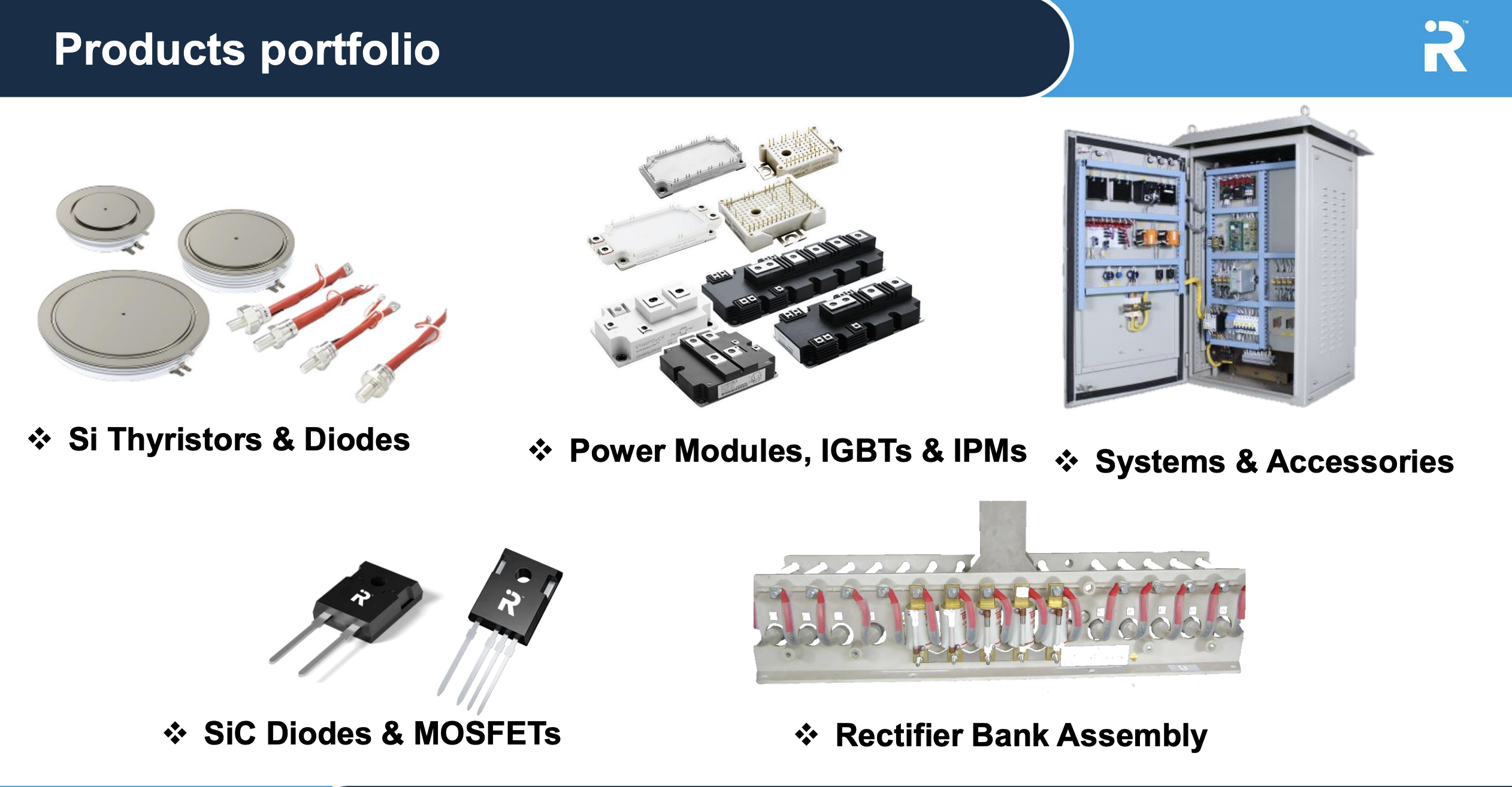
Semiconductor Devices (the smaller, older part): diodes, thyristors, bridges, power modules, IGBTs, IPMs. FY25 saw ₹39.14 cr here (45% of revenue); FY24 was ₹29.24 cr (44%). The stack is low-to-high power, 28mm to 125mm chips.
Power Equipment & Systems (the custom-built, application-heavy part): rectifier assemblies, DC traction substations, high-current stacks, battery chargers. FY25: ₹47.07 cr (55%); FY24: ₹37.52 cr (56%). This is where railways, defense, and grid companies show up.
Geography: 84% domestic (FY24), 16% export. Over 300 customers, including BHEL, NTPC, Suzlon, ABB, Adani Power, SAIL, GAIL. Presence in 10+ countries.
The Halol facility (Gujarat) spans 87,000 sq. ft. and runs single-shift. Capacity headroom exists; capex toward testing infrastructure and shift scaling is planned.
What’s missing is fabric. RIR doesn’t own a fab. It has wafer-level capability (epitaxy via Visicon, now moving to Odisha) but outsources device manufacturing. For SiC, it partners with Taiwan (1200V, 1700V) and is exploring Korean sources for 3.3kV.
Odisha is designed to fix this: two-phase program (Phase 1: epitaxy + packaging; Phase 2: fab). Phase 1 (epitaxy + packaging) targets end-July tool completion, Q2 FY27 operations start. Revenue will come from external sales of epi wafers and outsourced manufacturing validation before the fab itself is live.
4. Financials Overview
Figures are consolidated, in ₹ crore.
Metric
Q4 FY26
Q3 FY26
QoQ %
Q4 FY25
YoY %
Revenue
23.95
20.27
+18.16%
26.46
-9.50%
EBITDA
2.09
0.86
+143.0%
3.44
-39.2%
PAT
1.39
0.44
+215.9%
2.55
-45.5%
EPS
0.17
0.06
+183.3%
0.32
-46.9%
Q4 bounced hard on the quarter: +18% QoQ in revenue, +143% in EBITDA. But the year-on-year numbers tell a harsher story.
Q4 FY25 carried a ₹3.3 cr one-time order (management’s attribution for the YoY dip). Strip that out conceptually, and FY26 Q4 sits closer to a normalized quarter.
FY26 full-year performance:
Metric
FY26
FY25
YoY %
Revenue
90.87
86.21
+5.41%
EBITDA
10.20
11.39
-10.4%
PAT
6.72
8.28
-18.8%
EPS
0.84
1.08
-22.2%
Order intake FY26: ₹90.2 cr. Closing order backlog: ₹17.4 cr. Export mix: 20% of new orders from overseas customers.
Earnings Call Takeaway (June 2026):
Management emphasized capex physics. Total project cost is ₹618 cr; ₹120 cr already spent. Of the ₹500 cr remaining, government subsidy expected to cover 50%. Completion target: Dec 2027–Mar 2028. The gating item is power connectivity (33 kV supply) — not tool readiness or cleanroom quality. Management guided to ₹0.65x asset turnover expectation for Odisha once live (vs. global peer range of 0.5–0.75x).
Management also flagged Halol’s potential: 2–3x revenue growth in 2–3 years through shift scaling and testing infrastructure capex (~₹5 cr from internal cash).
5. Valuation Discussion: Fair Value Range (Educational Only)
What follows is a walkthrough of how three valuation methods work, using this company’s numbers as the example — not a target, not a forecast, not advice.
Method 2 (EV/EBITDA): FY26 EBITDA ₹10.20 cr, EV/EBITDA peer band 21–55x produces ₹214–561 cr enterprise value. At ₹1,341 cr current EV, the ratio is 131x.
Method 3 (Simplified DCF): Assume 8% FCF yield (conservative for semiconductor-adjacent), ₹6.72 cr PAT converts to ~₹3–4 cr normalized FCF (post-capex); 8% of