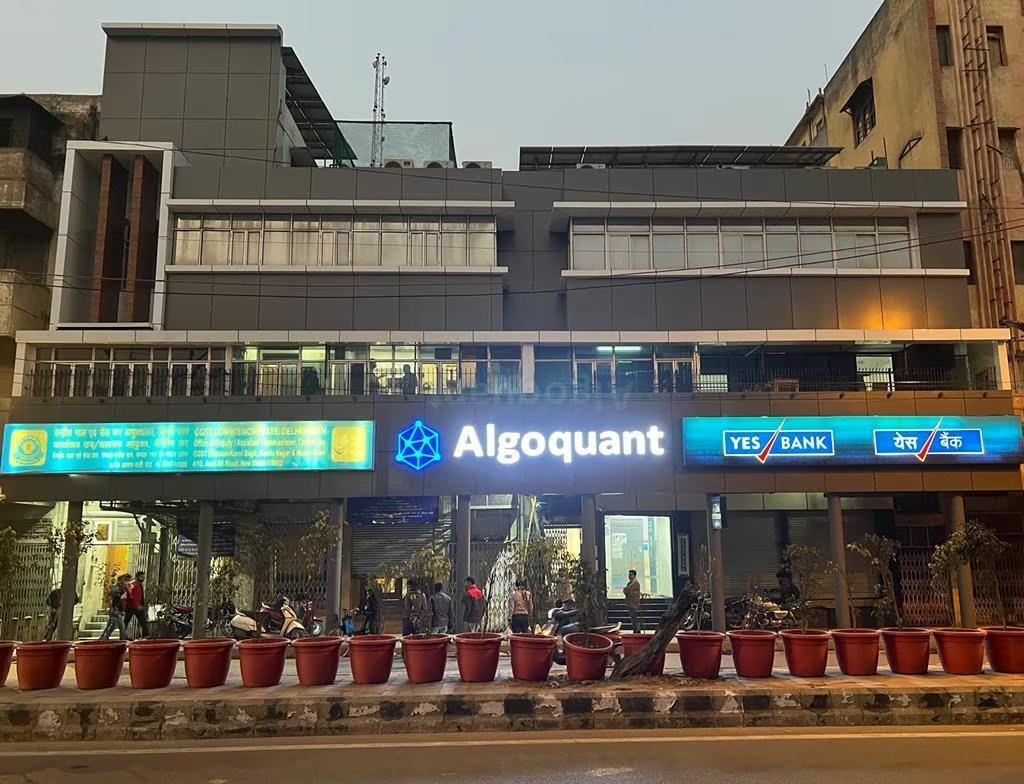
Algoquant Fintech FY2026: The Algorithm Bets Its House
General information and entertainment, not investment advice. The author is not a SEBI-registered adviser or research analyst. No recommendation, no promised returns. Markets carry risk including loss of capital. Figures may not be current. Consult a registered adviser before acting.
1. At a Glance
A trading firm built on algorithms just went public after two years of jaw-dropping profit—but its stock is asking 45x earnings in a market where the peer median sits at 30x.
The numbers are loud: FY26 net profit hit ₹32.74 Cr on ₹235 Cr in revenue, both ballpark with the prior year; margins in the P&L look tidy at 22% operating profit.
But the share split (1:2) and the 8:1 bonus in August 2025 diluted the equity base to ₹281 Cr shares—a capital raise on paper that moved the needle on EPS backward.
The balance sheet holds ₹155 Cr in cash against ₹34.24 Cr in borrowings, a net cash position that covers three months of operations with oxygen to spare.
The tension: can this algorithm-driven arbitrage shop sustain its own valuation while staying hedged?
2. Introduction
Algoquant Fintech Ltd, formerly Hindustan Everest Tools, is now a technology-driven trading firm focused on low-risk arbitrage and high-frequency trading in Indian derivatives.
In March 2024, the company underwent a composite scheme of arrangement—Algoquant Investments Private Limited and Growth Securities Private Limited merged into it—effective April 2023.
The company moved from obscurity (₹16.59 Cr revenue in FY22) to NSE listing in January 2026, a three-year arc that saw FY24 post ₹156 Cr revenue (140% spike).
FY25 and FY26 stabilised revenue near ₹235 Cr, while net profit hovered at ₹33 Cr. In August 2025, a bonus and split expanded the share count from 31.2 Cr to 281 Cr.
The promoter structure consolidated: Algoquant Financials LLP now holds 51.62%, Dhruv Gupta 18.5%, Devansh Gupta 3.56%, with the government (via Enforcement Directorate Raipur) holding 3.4% post-amalgamation.
3. Business Model: WTF Do They Even Do?
Algoquant runs hedged derivatives arbitrage—a trade where you buy and sell the same security across markets (or instruments) simultaneously, pocketing the spread while bearing no directional market risk.
The machinery: sophisticated algorithms execute trades at ultralow latencies, skimming basis between cash and futures, calendar spreads, or cross-listing mispricings—all locked in electronically before a finger can blink.
Revenue breakdown (FY23): trading gains ~92%, margin interest ~2%, fixed-deposit interest ~2%, loan interest ~2%, provisions written back ~2%. A bit lumpy—trading P&L can swing with volatility and order-flow opportunity.
Cost structure: ₹51.88 Cr employee cost (FY26), ₹62.72 Cr other operating expenses (infrastructure, hardware, exchanges)—together they consume 48% of revenue. The firm sits in Gift City (Ahmedabad), an IFSC hub for tax arbitrage and latency gains on offshore flows.
The business scales with market volumes and volatility; thin margins on each trade but high frequency = compounding returns on capital. The trade-off: zero control over spreads, complete dependence on algorithmic edge, and the eternal risk that speed advantage evaporates when machines everywhere become just as quick.
4. Financials Overview
Figures are consolidated, in ₹ crore.
Annual P&L (FY Basis)
Metric
FY24
FY25
FY26
YoY
Revenue
156.28
234.59
235.46
+0%
EBITDA
—
—
44.27
—
Net Profit
24.82
32.58
32.74
+1%
EPS (Reported)
1.14
1.16
1.16
0%
FY26 mirrored FY25 almost exactly: revenue flat at ₹235 Cr, net profit up marginally ₹0.16 Cr. Operating profit margin clocked 22%, unchanged from prior year. The cash generation story stayed intact—₹60