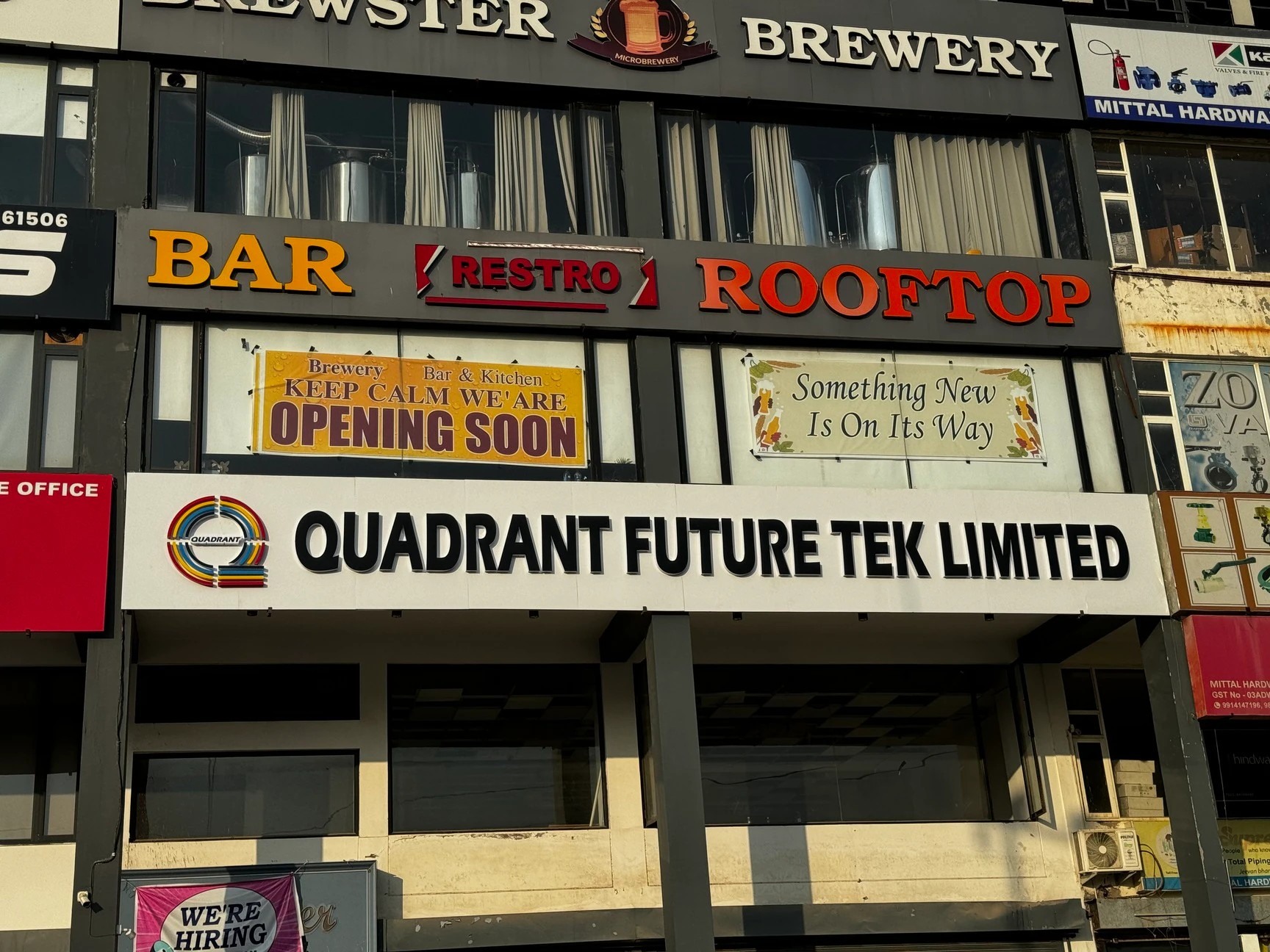
Quadrant Future Tek Ltd FY26: Loss Widens, Order Book Thickens
General information and entertainment, not investment advice. The author is not a SEBI-registered adviser or research analyst. No recommendation, no promised returns. Markets carry risk including loss of capital. Figures may not be current. Consult a registered adviser before acting.
1. At a Glance
Quadrant Future Tek swung to a loss of ₹42.94 Cr in FY26 from a ₹19.68 Cr loss in FY25—not a flip to profitability, but a deeper crater on lower manufacturing utilisation and a KAVACH business that is not yet revenue-generative.
Cable division revenue nudged up 1.8% to ₹153 Cr. The Train Collision Avoidance System (KAVACH) generated negligible revenue but accumulated an order book of ₹8,054 Mn as of May 2026, a bet that final regulatory approval will open the floodgates.
Cash held at ₹32.45 Cr against market cap of ₹1,375 Cr. Inventory bloated to ₹105 Cr from ₹44 Cr—a working capital wart that demands watching.
The company raised ₹290 Cr via IPO in January 2025, yet by March 2026 had burned ₹310 Cr in cash—a warning flag planted and ignored.
2. Introduction
Quadrant Future Tek, incorporated in 2015 and listed January 2026, operates in two chasms: specialty cable manufacturing with roots in defence and railways, and train signalling systems under India’s homegrown KAVACH initiative.
The cable business sells electron-beam irradiated wires to Indian Railways (70% of revenue), naval defence, and is positioning for solar and EV sectors. Backward integration in polymer compounding and irradiation helps margins when commodity prices don’t spiral.
KAVACH is a multi-year, high-stakes bet. The company has in-house designed both hardware and software to Indian Railways’ Automatic Train Protection standard. By May 2026, RDSO (Research Designs and Standards Organisation) approved passenger trials on a dedicated rail route—the final approval gauntlet before commercial deployment.
Management signalled optimism in earnings calls: “final phase of field trials” language, KAVACH Version 4.0 positioned as ready, and a MOU with RailTel to jointly market systems. Reality: not a rupee of revenue yet, only a ₹8,054 Mn order book waiting for a thumbs-up that hasn’t arrived.
The cable division remains the cash cow—barely. FY26 saw it deliver operating profit of ₹49 Cr against ₹123 Cr in FY25. The KAVACH division burned ₹602 Cr in losses in FY26.
3. Business Model: WTF Do They Even Do?
Specialty Cables. Think electron-beam cross-linked polymers. The company irradiates cables under a 2.5 MeV electron accelerator (AERB-licensed) to achieve superior fire-resistance, lighter weight, and thermal durability. Railways save ~4–6 tonnes per rake. Defence loves them for submarines. The company claims installed capacity of 1,900 MT per annum with ~49% utilisation in FY25.
Revenue split: 70% from public-sector railways and defence, 30% private. The company pivoted hard in FY26 to chase solar and EV cables, securing BIS approval for solar PV cables. Margins are margin-thin: OPM swung to -10.25% in Q4 FY26 (vs. 14.38% in Q1 FY25).
Train Collision Avoidance System (KAVACH). This is the hype. Indian Railways’ national safety mandate to retrofit 15,512 km of track with anti-collision systems. The company designed, built, and tested KAVACH Version 4.0 from scratch. RDSO approved laboratory type-testing. In May 2026, RDSO greenlit passenger trials.
Competitive moat: only a handful of approved vendors exist. The MOU with RailTel—a government telecom entity—is meant to lock distribution and co-brand globally. Capacity on paper: 2,264 locomotive units and 4,492 station units per annum, though nothing has shipped commercially yet.
Revenue from KAVACH in FY26: ₹0.03 Mn (rounding error). Capex tied up: ₹239 Mn of IPO proceeds deployed toward Electronic Interlocking System development, a follow-on play. Losses: ₹602 Cr in FY26.
The model is a bet on timing: pass regulatory approval in FY27, ramp production, and KAVACH becomes a multi-year cash contributor. Until then, it’s a cash incinerator dressed as innovation.
4. Financials Overview
Figures are consolidated, in ₹ crore.
Metric
FY25
FY26
Change
Revenue
150.25
152.97
+1.8%
EBITDA
2.6
-34.0
N/A
PAT
-19.68
-42.94
-118%
EPS (annualised)
-4.92
-10.74
N/A
Quarterly Snapshot (Latest Quarter – Q4 FY26):
Revenue jumped 70% QoQ to ₹56.56 Cr—cable division traction from railways and defence. Operating profit turned negative at -₹5.80 Cr as expenses blew through. Net profit on a standalone basis came in at ₹1.14 Cr (aided by deferred tax reversals), masking the full-year carnage.
P&L walkthrough from audited results:
FY26 revenue of ₹152.97 Cr (+2% YoY) generated ₹39.0 Cr operating loss (EBITDA -₹34 Cr; add back depreciation of ₹18.73 Cr). Finance costs fell to ₹3.03 Cr from ₹8.27 Cr (IPO paid down debt). PBT loss of ₹55.74 Cr. Tax benefit of ₹12.79 Cr (deferred tax from loss carryforwards). PAT loss of ₹42.94 Cr.
Separately, the auditors flagged: company burned ₹310.22 Mn in cash in FY26, despite ₹290 Cr IPO raise. Management notes going-concern confidence; we note the burn and the inventory crater.
5. Valuation Discussion: Fair Value Range (Educational Only)
What follows is a walkthrough of how three valuation methods work, using this company’s numbers as the example — not a target, not a forecast, not advice.
Method 1 (P/E): Annualised reported EPS for FY26 is ₹-10.74. The company is unprofitable; P/E multiples are undefined. For educational purposes, we note the Cables peer band trades at P/E 21.85x–53.58x. If the company returned to FY24’s reported EPS of ₹13.90 and applied the cable sector median of 35x, the arithmetic produces ₹487–₹486 as a range under that historical assumption. (This is not a forecast and not a target; it is solely to show the method’s mechanics.)
Method 2 (EV/EBITDA): FY26 EBITDA is -₹34.0 Cr. The company is EV/EBITDA negative. For reference, cable peers trade 16x–35x. Were the company to generate ₹100 Cr EBITDA (not a forecast—purely illustrative), the peer band would imply ₹1,600–₹3,500 Cr of enterprise value. The current enterprise value is ₹1,367 Cr.
Method 3 (Simplified DCF): The company is pre-profitability with unpredictable capex burn tied to KAVACH approval timing. A DCF hinges entirely on assumptions about approval timing, production ramp, and margin trajectory—none of which are contractually certain. Mechanically, if one assumed 10% FCF margins on ₹300 Cr steady-state revenue by FY29, 12% discount rate, and terminal growth of 3%, the calculation produces a range of ₹250–₹350 per share. This is purely mechanical and does not factor regulatory risk, management execution, or macro shocks.
These figures show how the methods work and are not a valuation, a target, or advice.
6. What’s Cooking
KAVACH Passenger Trials (May 2026): RDSO approved commencement of final passenger field trials. A dedicated rail route and train allocated. This is the gatekeeping approval phase; still no commercial units rolling.
KAVACH Order Pipeline (₹8,054 Mn as of May 2026): CLW, ICF, BLW locomotive factories have issued letters of intent/orders for 768 onboard KAVACH units across multiple tranches (Jan-Feb 2026). Execution timelines: 12 months from award. Revenue recognition only upon delivery.
Specialty Cable Order Book (₹558 Mn as of FY26): Active tenders running. Capacity headroom estimated at 51% utilisation. Demand recovery narrative hinges on railway capex cycles and defence procurement.
Electronic Interlocking System (EI) Development: ₹239 Mn from IPO reserved. Prototype approval received from RDSO; site approval pending. This is a follow-on to KAVACH, leveraging same R&D team and safety certifications.
IPO Proceeds Utilisation (₹290 Cr total): As of 31 March 2026, ₹267 Cr deployed: ₹150 Cr for working capital, ₹65 Cr repayment of term loans, ₹17 Cr toward EI capex, ₹2 Cr issue costs. Unused: ₹23 Cr—though company burnt ₹310 Mn cash in FY26 alone, a mismatch not explained by the allocation table.
KMP Resignations: Suresh Bopparaju (Advisor, Train Control Systems) resigned March