General information and entertainment, not investment advice. The author is not a SEBI-registered adviser or research analyst. No recommendation, no promised returns. Markets carry risk including loss of capital. Figures may not be current. Consult a registered adviser before acting.
1. At a Glance
Bata India closed FY26 with ₹827.6 crore in quarterly revenue (+5.0% YoY), but profit collapsed: net profit tumbled to ₹2.2 crore in Q4 versus ₹63.6 crore a year prior—a 96.5% fall.
The company’s FY26 full-year net profit landed at ₹134.2 crore against ₹330.7 crore in FY25: a 59.4% decline year-on-year. Operating margins stayed in the low 20s (20.1% OPM for FY26), but the path to the bottom line deteriorated.
The market prices the stock at ₹664.6 as of early June 2026 (lagged reference), against an annual EPS of ₹10.44 for FY26—yielding a P/E of 63.7x, well above the peer median of 41.2x.
Three things dominate: the inventory correction and “Customer First” program have shown traction in turns and availability; e-commerce and digital channels are posting double-digit growth; and the share of premium brands (Hush Puppies, Power, Floatz) within the portfolio is now material. Yet operating profit momentum has stalled, and the path from operational wins to profit recovery is not obvious.
2. Introduction
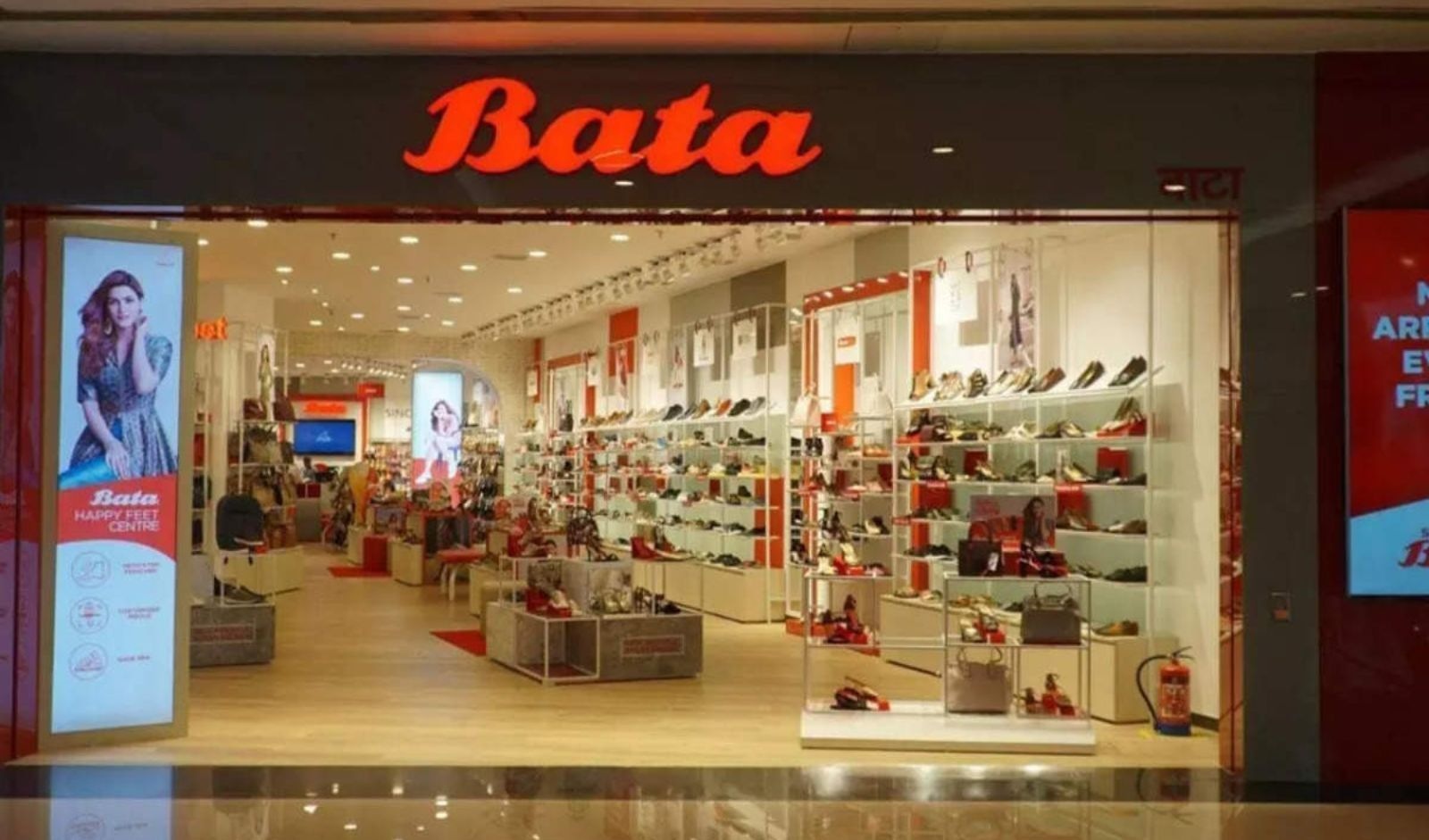
Bata India is the Indian subsidiary (50.16% held by Bata Corporation, Amsterdam) of the 130-year-old Czech footwear empire. The company operates roughly 2,053 retail outlets under the Bata brand, plus networks across franchise, multi-brand outlets (MBOs), key retail outlets (KROs), and e-commerce channels.
FY26 marked a reset. After several years of profitability stress, management articulated a four-pillar strategy: inventory optimization (“Customer First”), zero-based merchandising (ZBM) at scale, franchise and distribution expansion, and product funnel reimagination.
The company monetized a 11.54-acre land parcel in Faridabad for ₹154.44 crore in April 2024—a one-time event that inflated FY25 profitability. Absent that, FY25’s underlying profit was lower than the headline ₹330.7 crore might suggest. FY26, then, is the first full year of operating performance without exceptional land sales.
3. Business Model: WTF Do They Even Do?
Bata India is a footwear manufacturer and retailer. It designs, sources, and sells shoes across price points—canvas, rubber, leather, plastic—under a multi-brand portfolio.
The Bata brand itself is mass-market: school shoes, casual wear, professional footwear, for all age cohorts. Alongside it sit premium brands acquired and built over the past 3–4 years: Hush Puppies (casual-premium), Power (athleisure), Nine West (licensed from ABG), North Star, Floatz (casual slides), Scholl (healthcare), Bubblegummers (kids).
As of FY24, premium brands accounted for 40% of revenue. The company has been building owned-brand equity in the premium bucket; Hush Puppies alone was pegged at ₹700 crore in annual revenue (largely through retail) in recent disclosures, with ~160 exclusive brand outlets (EBOs) and growth plans to ~200 EBOs over the next 12 months.
Distribution happens across four channels: company-owned and company-operated stores (COCO, ~1,150 doors as of FY26), franchises (~720 doors), multi-brand outlets (15,000+ MBOs across 1,660 towns), and e-commerce (bata.in, marketplace, omni/home-delivery).
The company has four manufacturing units (Batanagar, Bataganj, Peenya, Hosur) with a capacity to produce 21 million pairs annually. However, the in-house manufacturing footprint has shrunk from 30–35% of sourcing four years ago to mid-teens now; the company is shifting to contract manufacturing with a consolidating base (120+ partners down to 60, target 15 in the long term). This asset-light pivot is the business model’s big strategic move.
4. Financials Overview
Figures are consolidated, in ₹ crore.
Metric
Q4 FY26
Q4 FY25
YoY Change
Q3 FY26
QoQ Change
Revenue
827.6
788.2
+5.0%
801.3
+3.3%
Operating Profit
150.8
177.8
-15.2%
144.9
+3.8%
PAT
2.2
45.9
-95.2%
13.9
-84.2%
EPS (annualized)
10.44
20.42
-48.9%
—
—
Full Year FY26: Revenue: ₹3,515.5 crore (+0.77% vs FY25 ₹3,488.8 crore). Operating profit: ₹707.0 crore (OPM 20.1%, vs 22.1% in FY25). PAT: ₹134.2 crore (vs ₹330.7 crore in FY25, down 59.4%). Reported EPS: ₹10.44 (vs ₹25.73 in FY25).
The profit cliff in FY26 reflects three headwinds: (1) the absence of exceptional gains (FY25 had ₹185.9 crore in other income, largely from land monetization; FY26 had ₹30.2 crore); (2) a ₹281 million voluntary retirement scheme cost in Q4 (gross impact); (3) EBITDA margin compression from 23% in FY25 to 20.1% in FY26, driven by advertising spend acceleration (1.5x investment vs prior year).
Concall Commentary (Feb 2026, covering 9M FY26): Management called out “turnover-led growth of about 3%” in Q3 as “welcome after some time,” citing “signs of momentum and green shoots.” EBITDA margin expanded ~200 basis points YoY in Q3 despite modest topline growth, powered by “underlying PBT growth… at… 10%.” The margin driver was execution on “merchandising, inventory/working-capital actions, channel mix/discipline, and marketing.”
Management also stated Q3 GST channel disruption had “completely eliminated” by Q4; demand recovery from the GST change is expected to persist “for the foreseeable future.”
5. Valuation Discussion: Fair Value Range (Educational Only)
What follows is a walkthrough of how three valuation methods work, using this company’s numbers as the example — not a target, not a forecast, not advice.
Method 1 (P/E): Annualized EPS for FY26 is ₹10.44. The peer band (from the footwear group) trades at a P/E range of 30.98x (Redtape, lowest) to 67.84x (Metro Brands, highest), with a median of 41.2x. Multiplying ₹10.44 × 30–67x produces a range of ₹313–₹700 per share.
Method 2 (EV/EBITDA): FY26 EBITDA stands at ₹707.0 + 134.61 (interest) + 420.1 (depreciation) = ₹1,261.7 crore. The market cap is ₹8,541.9 crore; total debt is ₹1,386.6 crore; cash is ₹496.5 crore; enterprise value is ₹9,431.9 crore. Current EV/EBITDA is 7.48x. Peers trade EV/EBITDA of 8–24x (peer band); applying 8–24x to Bata’s EBITDA yields ₹101–₹302 per share.
Method 3 (Simplified DCF): FY26 free cash flow (operating cash flow minus capex) was ₹530 crore. Assuming a perpetual growth rate of 2% (conservative given 3-year revenue CAGR of 0.61%) and a 9% cost of equity, a Gordon Growth model produces: ₹530 × 1.02 / (0.09 – 0.02) = ₹7,743 crore, or ₹602 per share at current share count.
These figures show how the methods work and are not a valuation, a target, or advice.
6. What’s Cooking
Zero-Based Merchandising (ZBM) Scale: The company has rolled ZBM across 700+ stores as of May 2026 (vs 400 in Dec 2025, 550 in Mar 2026). Stores on ZBM are running a 4.6% turnover delta versus the rest of the network (higher sales per unit). Management pegged ZBM’s contribution at >70% of retail turnover. The traction suggests the curation/assortment model is working—faster inventory turns, fresher product, easier consumer choice.
Inventory Correction & Availability Trade-off: Inventory was cut 28% YoY (from ₹708 crore to ₹600 crore in Q4 FY26). Freshness jumped from 75.4% to 86.8% (inventory <6 months old). Inventory days fell to 164 (FY26) from 195 (FY25). Yet the company claims availability improved +950 basis points—implying the stock-out risk is not material. This is either truth or an optimistic framing; the numbers suggest stock-turn velocity rose faster than sales, which would require meaningful demand or channel rebalancing.
Franchise Expansion & Tier-3+ Penetration: Franchise doors reached 722 as of Q4 (vs 661 in Q3 FY25), with an aspiration to breach 1,000 in the next couple of years. The strategy is to hit Tier-3 and below towns where cohort sizes are smaller but growing fast. Franchise is described as “extremely profitable” and a high-double-digit growth driver for overall profitability.
E-commerce & D2C Scale-up: Bata.com grew 81% YoY in Q4. The company’s app, launched ~6 months ago, already accounts for ~14% of bata.com sales (240k+ downloads). E-commerce channel contributes mid-double-digit growth and sits at ~10% of total retail turnover (including omni delivery, which is ~3.8% of retail). Gross margins are “broadly at par” with retail but a drag on net profitability due to fulfillment cost; management expects scale to remedy this.
Premium Brand Momentum: Hush Puppies grew disproportionately in FY26 (relative to overall portfolio). Power and Floatz also outpaced the network. Victoria Ballerina campaign (a women’s formal sneaker) drove 2.9x revenue and 3x volume growth in Q4 vs Q3. Media spend was 1.5x higher than prior year, a strategic push to build brand consideration (which rose from 60 to 66 points over 2 years per management disclosure).
Product Funnel Reimagination & Kit Rationalization: Management has redesigned product development. The company reduced styles by ~25%, kit lines by ~30%, and colorways by ~20% across the funnel. The goal: product authority and scale rather than breadth. Floatz is cited as a multi-year brand-build example (almost 3 years to maturity), with low online penetration versus offline, representing growth runway.
Manufacturing Base Consolidation: Contract partner count fell from 120+ (3 years ago) to 60, with a target of 15. The company is moving toward longer-term, deeper partnerships for “technology and innovation” while outsourcing labour-heavy lines. In-house capacity is being reserved for IP/automation-heavy, low-labour products only.
7. Balance Sheet
Item
FY24
FY25
FY26
Total Assets
3,349.8
3,822.8
3,778.5
Equity (Reserves + Capital)
1,526.9
1,574.9
1,595.6
Borrowings
1,357.3
1,446.5
1,386.6
Other Liabilities
465.6
801.4
796.3
Total Liabilities
3,349.8
3,822.8
3,778.5
Assets = Liabilities: ✓ (Commerce Students Rejoice).
Three observations:
The balance sheet has thinned, not swollen. Total assets fell ₹44.3 crore YoY, while equity inched up (thanks to reserves, despite profit decline). Debt reduced by ₹59.9 crore to ₹1,386.6 crore, a modest deleveraging. The D/E ratio stands at 0.87x—mild compared to historical peaks but elevated for a company in the 20% EBITDA margin bucket.
Net cash (cash minus debt) is ₹(890.1) crore negative. The company burned cash in FY26 through capex (₹257.3 crore investing cash outflow) and dividend payout (₹115.7 crore, part of the 86% payout ratio declared for FY26). This is not a fortress balance sheet, nor is it distressed; it is a slow machine consuming its own equity cushion.
The land monetization in FY25 masked this dynamic. Without it, FY25 would have posted lower profit, and capex/debt would have looked sharper. FY26, stripped of that one-off, shows a company in structural transition—cutting inventory, consolidating suppliers, shifting to franchise and asset-light models—while holding the fort on profitability through margin discipline and brand investment.