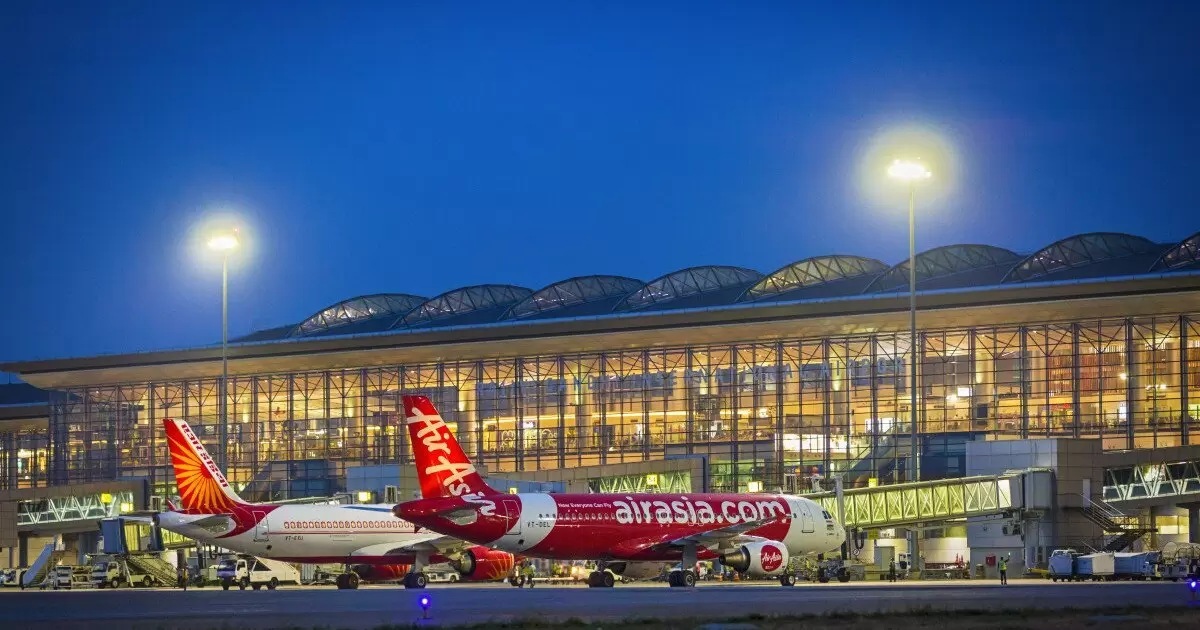
GMR Airports FY26: A Decade of Red Ink, Suddenly Black
General information and entertainment, not investment advice. The author is not a SEBI-registered adviser or research analyst. No recommendation, no promised returns. Markets carry risk including loss of capital. Figures may not be current. Consult a registered adviser before acting.
Prices referenced are not live.
1. At a Glance
After 11 years of losses, GMR Airports reported its first profitable year. Net profit swung from a ₹393 Cr loss in FY25 to a ₹175 Cr profit in FY26 — a turnaround, not a boom.
The tension sits here: a turnaround that arrives not from operational excellence but from a shift in what the company now controls. Duty-free operations at Delhi and Hyderabad airports, which the company acquired concessions for mid-year, appear to have moved the needle. Without them, the numbers would likely still be red.
Revenue rose 42% to ₹14,807 Cr, but interest costs — at ₹3,859 Cr — consume 26% of it. The net debt sits at ₹340 billion, about 5.5x EBITDA. The company says it will drop below 4x in 18–24 months. Cash generation was steady at ₹4,884 Cr from operations.
Does the turnaround hold without the new revenue streams? That remains the question the data leaves open.
2. Introduction
GMR Airports operates four major Indian airports: Delhi (74% stake), Hyderabad (74%), Goa (100%), and Medan, Indonesia (49%). The company also holds development stakes in Bhogapuram (Andhra Pradesh, 98.7% built) and Crete, Greece (69% built), plus a technical services role at Cebu (Philippines) through December 2026.
In July 2025, the company acquired duty-free operations at Delhi and Hyderabad. In September, it took over Hyderabad’s retail concession. By October, it won the cargo concession at Delhi. By November, it added Nagpur airport as a brownfield acquisition. These moves reshaped the business in a single financial year — from pure airport operator to a platform capturing upstream retail, cargo, and ancillary spends.
The portfolio of 2,510 acres of airport land forms the long-term real estate angle. Land-adjacent projects are underway at all major airports.
Management describes itself as a blend of three things: a utility business (tariff-regulated airport operations), a consumer platform (retail and food & beverage adjacencies), and a real estate developer. The claim is not novel, but the execution — moving from a single dependency to a stool with three legs — is the event of the year.
3. Business Model: What’s Really Happening?
GMR operates airports, not planes or airlines. The revenue splits into two: aero (landing fees, parking, handling charges) and non-aero (duty-free, retail, F&B, cargo, car parking, advertising).
For FY26, aero revenue represented roughly one-third of total airport revenue. Non-aero — anchored by the new duty-free concessions — jumped to over half. The shift matters because non-aero margins are typically higher and less exposed to the whims of airline capacity.
Delhi airport (DIAL) alone accounts for 44 Cr of gross income — nearly 29% of consolidated revenue from operations. It functions as a cash machine: 78.7 Mn passengers in FY26, +19% aero yield per pax. Hyderabad Airport (GHIAL), at 30.5 Mn passengers, is smaller but growing faster in non-aero (23% YoY growth). Goa (5.4 Mn passengers) is a loss-making, margin-compressed satellite to keep the traffic share of 27% of India’s airports intact.
The model makes sense on paper. Airports are natural monopolies with captive footfall. But GMR’s version carries a burden: ₹43,283 Cr in borrowings against equity capital of just ₹1,056 Cr. The leverage is structural, not incidental.
4. Financials Overview
Figures are consolidated, in ₹ crore.
Metric
FY26
FY25
Change
Revenue
14,807
10,414
+42%
EBITDA
6,150
4,188
+47%
PBT
586
-635
Swing
Net Profit
175
-393
Swing
EPS (annualized)
0.17
-0.37
—
Q4 FY26 Snapshot:
Q4 sales of ₹3,938 Cr (+37.5% YoY) were driven by carry-forward momentum from Q3. EBITDA of ₹1,444 Cr showed a 38% year-on-year jump, though it dipped 13% from Q3, a sign of seasonal softness. Operating margin held at 37%.
The PAT swing from a ₹253 Cr loss in Q4FY25 to a ₹302 Cr profit in Q4FY26 is the headline. But strip out the deferred tax reversal (₹120 Cr) and foreign exchange effects, and the underlying number is closer to ₹200 Cr — still a swing, but smaller.
The company carried forward EBITDA from two operating concessions added partway through the year. Had these not been acquired, FY26 would likely have missed profitability by a hair.
5. Valuation Discussion: Fair Value Range (Educational Only)
What follows is a walkthrough of how three valuation methods work, using this company’s numbers as the example — not a target, not a forecast, not advice.
Method 1 (P/E): Annualised EPS ₹0.17 × peer band 22–30x produces ₹3.7–₹5.1 per share. Against a current price of ₹102, the multiple the market pays is 600x reported EPS — a figure that sits in the realm of loss-making companies or data distortions.
Method 2 (EV/EBITDA): EV of ₹150,000 Cr ÷ EBITDA of ₹61.5 Bn produces 24.4x. Peers in airport operations and infrastructure trade at 18–28x. GMR sits squarely in the band.
Method 3 (Simplified DCF): Assume 5% perpetual EBITDA growth, 9% cost of capital, 40% tax rate. Net debt is