Marine Electricals (India) Ltd Mar 2026: Order Book Scaling Amid Negative Operating Cash Flows
General information and entertainment, not investment advice. The author is not a SEBI-registered adviser or research analyst. No recommendation, no promised returns. Markets carry risk including loss of capital. Figures may not be current. Consult a registered adviser before acting.
1 — At a Glance
The financial narrative of Marine Electricals (India) Ltd showcases a clear divergence between top-line expansion and liquidity generation. Revenue expanded to ₹877 crore in FY26, supported by an aggressive accumulation of commercial and defense orders.
Operating cash flows, however, shifted into negative territory at -₹16 crore for the full year, dropping from ₹55 crore in FY25. This cash depletion highlights structural friction in capital efficiency.
Working capital cycles show distinct strain as debtor days lengthened to 178 days. The balance sheet reflects a significant accumulation of other assets, which have climbed to ₹775 crore, locking up liquidity within project lifecycles.
The market continues to apply an elevated multiple to these earnings, coordinating a price-to-earnings ratio of 59.7x based on a lagged reference price of ₹249.
Scale provides structural visibility, but balance sheets absorb the real cost of execution.
The incoming order flow delivers strong revenue visibility for subsequent quarters, yet the underlying operational mechanics present a persistent cash conversion challenge.
2 — Introduction
Marine Electricals (India) Limited operates as an integrated technical services provider in electrical automation and information communication technology solutions. Established in 1978, the operational model focuses on the marine and industrial sectors, providing power generation, distribution, and automation packages.
The manufacturing footprint consists of multiple facilities across India, the UAE, and Italy. Recent structural expansions include the inauguration of a 51,000 sq ft assembly facility in Vadodara in April 2026. This operational footprint addition expanded total assembly shopfloor space by 25% to accommodate growing industrial switchgear demand.
Capital restructuring has been a core feature of recent management choices. A historical preferential share and warrant issuance conducted in late 2025 at ₹205 per share brought in fresh equity capital. The company utilized these funds to temper dependence on high-cost external borrowings.
The current price posture of the equity rests at a lagged reference price of ₹249, meaning referenced metrics are calculated against non-live historical values. The primary operational objective remains navigating long defense execution cycles while capturing higher-margin industrial data center projects.
3 — Business Model: WTF Do They Even Do?
The company splits its identity between two demanding taskmasters: heavy marine vessels and industrial infrastructure. The business model constructs high-voltage and low-voltage boxes that prevent electrical current from meeting salt water or short-circuiting critical server infrastructure.
The Industry segment accounts for 56% of operations. This unit operates primarily as a critical supplier for data centers, pharmaceuticals, and manufacturing facilities. The structural anchor here is a licensing agreement with Schneider Electric, where the company maintains a 50% domestic market share in manufacturing specialized Blokset panels.
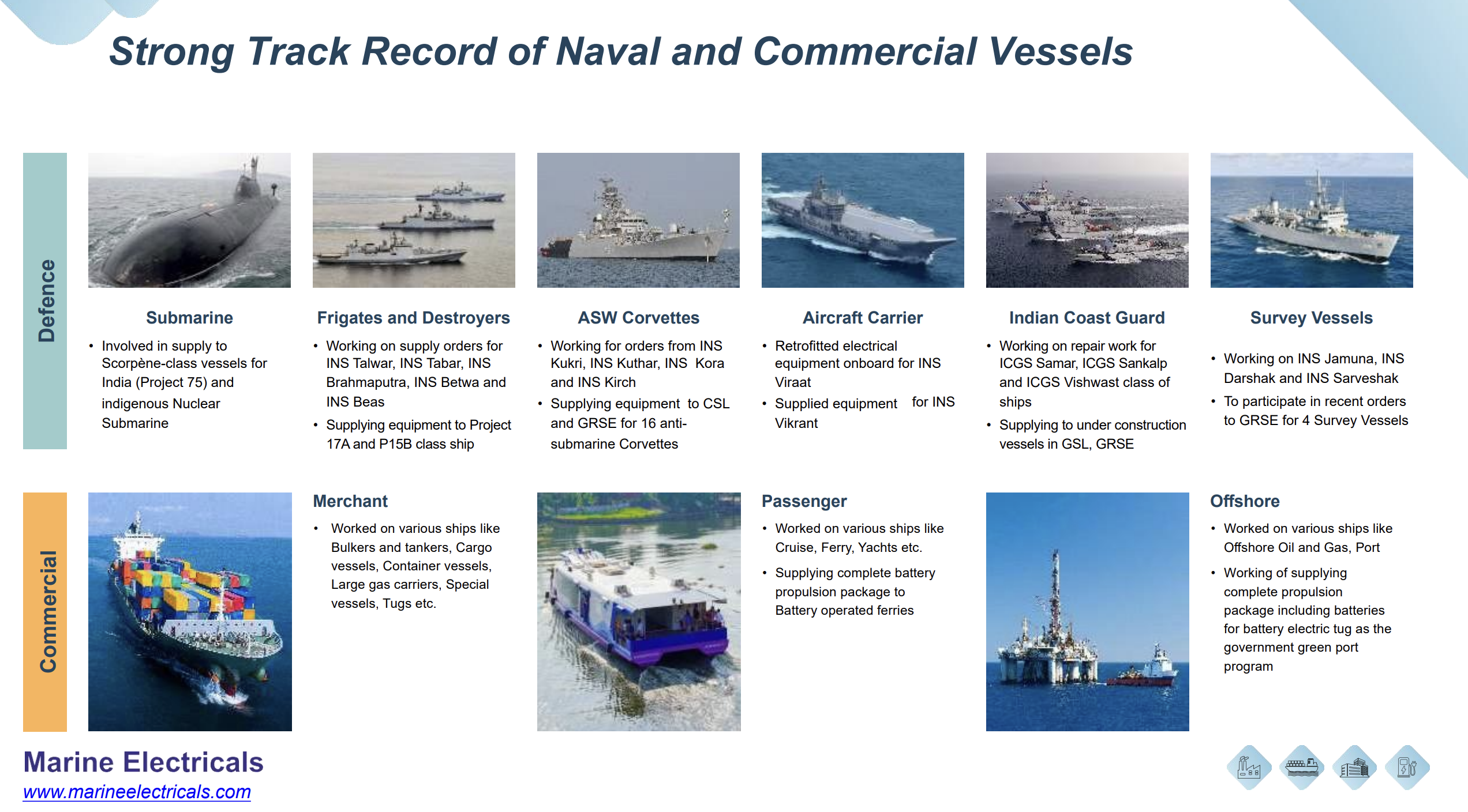
The Marine segment delivers the remaining 44% of revenue. This vertical is an authorized engineering vendor for the Indian Navy, Coast Guard, and major shipyards. The company configures entire electrical architectures for warships, frigates, and submarines, managing power generation alongside integrated platform management systems.
[Industry Segment: 56%] —> Data Centers, Pharma, Blokset Panels [Marine Segment: 44%] —> Naval Ships, Submarines, Navigation Systems
Subsidiary structures add specialized operational lines. A 75% stake in Xanatos Marine provides vessel traffic management systems for ports, while a small electric vehicle segment manufactures chargers paired with an proprietary monitoring application named Bijlify.
The operational model presents an inherent trade-off: the defense contracts carry multi-year execution security but long payment delays, while the industrial segment offers faster cash conversion paired with sharper pricing competition.
Does a 50% market share in naval switchgears insulate operations from the prolonged payment cycles of state-owned shipyards?