Subam Papers Ltd Mar 2026: The 1,000 MTPD Expansion Plan Meets a ₹2.43 Crore Quarterly Reality Check
Date of Publishing -
Spotted a factual error — a wrong number, date, or fact? Tell us and we will check the source.
Section 1 — At a Glance
Subam Papers Ltd has arrived at a critical operational crossroad, where massive capital allocation programs are directly colliding with severe near-term margin degradation. The company completed its financial year ending March 31, 2026, on a note of deep corporate contrast. On one side, full-year consolidated revenue scaled to an all-time high of ₹584.09 Cr. On the other side, net profit collapsed to ₹10.78 Cr, down from ₹26.72 Cr in the preceding fiscal year. The most alarming signal for market participants emerged in the final quarter of the year, where the company slipped into an absolute net loss of ₹2.43 Cr.
This severe deceleration highlights a common small-cap trap: the execution risk of major industrial scale-ups. When a company aggressively expands its structural footprint, fixed overheads, depreciation, and interest expenses move up immediately, whereas commercial volume utilization takes time to catch up.
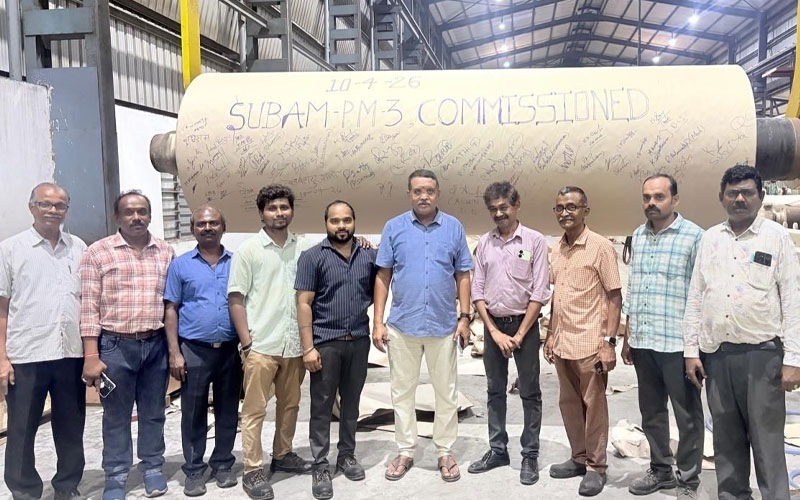
Subam has successfully pushed its consolidated production capacity to 1,000 metric tons per day (MTPD) through its wholly-owned subsidiary. Yet, its raw operational engine is currently burning cash faster than it generates bottom-line returns. Investors are now left balancing the promise of a massive volume surge against the stark reality of a quarterly operational loss.
Section 2 — Introduction
Subam Papers Ltd, established in October 2006, specializes in the production of Kraft paper and paper packaging products from its core base in Tirunelveli, Tamil Nadu. Over its two-decade journey, the firm has positioned itself as an integrated manufacturing outfit, utilizing a blend of solar (14 MW) and wind (1.7 MW) assets to run low-cost captive power operations. The company successfully accessed the public equity markets via an IPO in October 2024, raising ₹93.7 Cr to fund the capital expenditure demands of its primary subsidiary.
However, life in the public eye requires delivering consistent earnings, a feat Subam is currently finding difficult to achieve. While its physical infrastructure is expanding across 400 acres of land, its quarterly profitability metrics are showing signs of exhaustion.
Section 3 — Business Model: WTF Do They Even Do?
At its core, Subam operates a business model built on recycling industrial trash into packaging treasures. The company takes waste paper and turns it into Kraft paper (55.49% of revenue) and Duplex boards (28.12%), alongside lower-margin sub-products like paper cones, cores, tubes, and corrugated boxes.
The structural issue isn’t client concentration, as the top five customers account for a healthy, well-distributed 20.5% of total sales. Instead, the issue is extreme geographic concentration. A staggering 88.65% of Subam’s revenue is generated entirely inside the state of Tamil Nadu. If the local manufacturing belt in Tamil Nadu faces an industrial slowdown, Subam’s entire business model faces a structural hurdle. The company operates as a hyper-local packaging vendor dressed up as an exchange-listed entity.
Section 4 — Financials Overview
Figures are consolidated, in ₹ crore.
Quarterly Performance Trend
Metric
Latest Quarter (Mar 2026)
YoY Quarter (Mar 2025)
Previous Quarter (Dec 2025)
Revenue
141.12
134.65
145.56
Operating Profit
8.72
13.37
8.40
Net Profit
-2.43
4.60
0.13
EPS (₹)
-0.88
1.98
0.06
The quarterly trend is a masterclass in operational pressure. Revenue for the latest quarter grew a mild 4.81% YoY to ₹141.12 Cr, but declined sequentially. Operating profit dropped significantly from ₹13.37 Cr in March 2025 to ₹8.72 Cr in March 2026. The ultimate damage occurred at the net profit line, which collapsed into a negative ₹2.43 Cr due to rising depreciation and a sharp negative swing in other income.
Evaluating sequential changes in operating metrics often reveals structural turning points long before they show up in annual numbers. Management noted that commercial production at its new subsidiary commenced on April 17, 2026, bringing the total capacity up to 3,07,750 MTPA. The overheads are here,