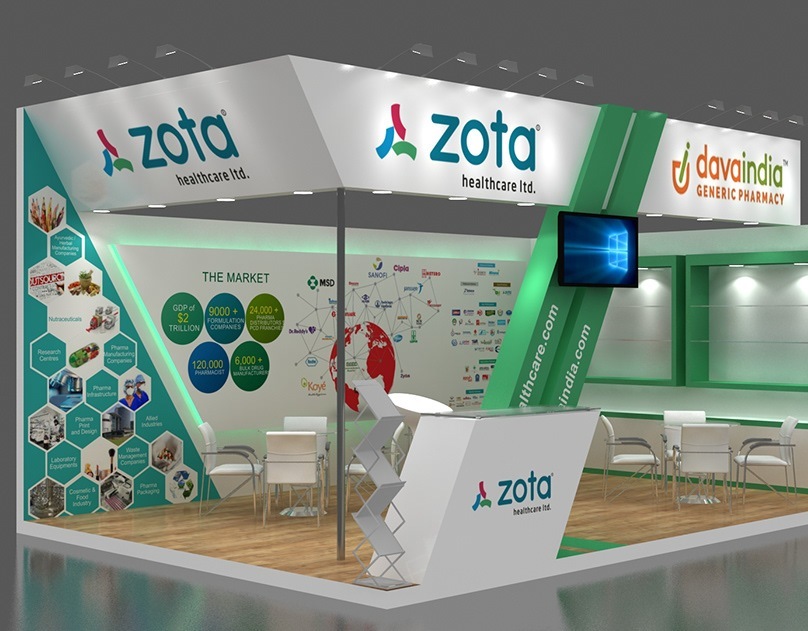
Zota Health Care FY26: The ₹350 Crore Retail Gamble That Ate the Margins
1. At a Glance
An aggressive, capital-fueled retail expansion transformed the financial profile of Zota Health Care Limited in FY26. Total consolidated revenue from operations surged 83.86% year-on-year to reach ₹538.65 crore, up from ₹292.42 crore in FY25. This top-line acceleration was driven by the unprecedented addition of 997 stores to its Davaindia pharmacy network, tilting the company’s business mix decisively toward low-margin, high-volume generic retail.
While the top line expanded rapidly, structural profitability remained under severe pressure. The company reported a full-year consolidated net loss of ₹73.74 crore, deepening from a loss of ₹56.51 crore in the prior fiscal year. Operating profit (EBITDA) staged a structural turn, finishing positive at ₹19.46 crore against an operating loss of ₹5.59 crore in FY25, yet this operational inflection was entirely consumed down the income statement by surging capital costs. Depreciation expenses escalated to ₹82.37 crore as the company built out corporate-owned infrastructure, while finance costs rose to ₹17.38 crore.
The disconnect between positive operational cash generation before working capital and a steep bottom-line deficit highlights a critical transition phase. Corporate infrastructure investments frequently precede retail density, demanding significant upfront capital long before local store clusters achieve self-sustaining volumes. Investor attention remains divided between a massive ₹350 crore Qualified Institutional Placement (QIP) that shored up the balance sheet and the operational reality of negative return ratios, with Return on Equity (ROE) sitting at -15.00%.
2. Introduction
Zota Health Care Limited, historically a domestic formulation marketer and export player operating out of Surat, Gujarat, is currently engineering a high-stakes corporate mutation. The company manufactures, markets, and exports pharmaceutical, ayurvedic, nutraceutical, and over-the-counter (OTC) products across semi-regulated and regulated markets. However, its historical core has been completely overshadowed by its corporate generic retail pharmacy experiment, Davaindia, launched in 2017.
Management spent FY26 treating the corporate structure like an unconstrained retail laboratory. Between subscribing to massive equity tranches in its subsidiary Davaindia Health Mart Ltd.—including a ₹25.30 crore subscription in February 2026 alone—and buying out early-stage vehicles like Curexis Ventures Pvt. Ltd. for nominal sums, the organizational chart is expanding nearly as fast as the store count. To fund this nationwide retail land grab, management diluted equity significantly, concluding a ₹350 crore QIP in December 2025 and clearing out all outstanding warrants by February 2026 to bring in an additional ₹21.83 crore.
3. Business Model: WTF Do They Even Do?
Zota is trying to be three different things at the same time, which explains why its financial statements look so chaotic.
The domestic marketing arm uses a traditional network of over 1,050 distributors to push 4,000 portfolio products, while the export division ships formulations from its 30,000 square foot facility in the Sachin SEZ to over 30 countries. Then there is Everyday Herbal Group, an 87.78%-owned subsidiary that makes herbal cosmetics and wellness products.
The real driver, however, is Davaindia. This network has grown into a massive 2,579-store generic discount machine that accounts for 77% of total revenue. The business model relies on a significant pricing differential: selling unbranded private-label generics directly to consumers at deep discounts compared to standard branded equivalents.
To make this work, Zota uses two distinct retail formats:
COCO (Company Owned Company Operated): 1,656 stores where Zota pays the rent, stocks the shelves, and absorbs the overhead. These stores attract a quarterly footfall of 34.3 lakhs, yielding a gross market value (GMV) of ₹73.23 crore with a modest average wallet spend of ₹231.
FOFO (Franchise Owned Franchise Operated): 923 stores where a franchise partner takes the local operational risk. These register 14.2 lakh quarterly visits but achieve a higher average wallet spend of ₹299, generating a quarterly GMV of ₹42.49 crore.
The operational focus has shifted heavily toward the COCO model. While this preserves a larger share of the retail margin, it also locks the company into substantial fixed overhead costs and long-term lease obligations.
Would you back a corporate strategy that builds 800 company-owned stores in twelve months while operating margins hover at 3.61%?
4. Financials Overview
Figures are consolidated, in ₹ crore.
Quarterly Performance Trend
Metric
Latest Quarter (Mar ’26)
YoY (%)
QoQ (%)
Revenue
163.18
67.76%
14.15%
EBITDA / Operating Profit
8.88
N/A
N/A
PAT
-14.46
N/A
N/A
EPS (₹)
-4.09
N/A
N/A
Note: YoY and QoQ percentage changes for EBITDA, PAT, and EPS are omitted as the trailing periods contained negative values, making direct percentage variations mathematically distorted.
The final quarter of FY26 shows signs of early operating leverage. Revenue reached ₹163.18 crore, a 67.76% jump over the corresponding period last year, supported by sustained volume growth across the mature store base. Operating profit for the quarter came in positive at ₹8.88 crore, lifting quarterly operating margins to 5.44%. This improvement reflects the high gross margins embedded in older retail cohorts.