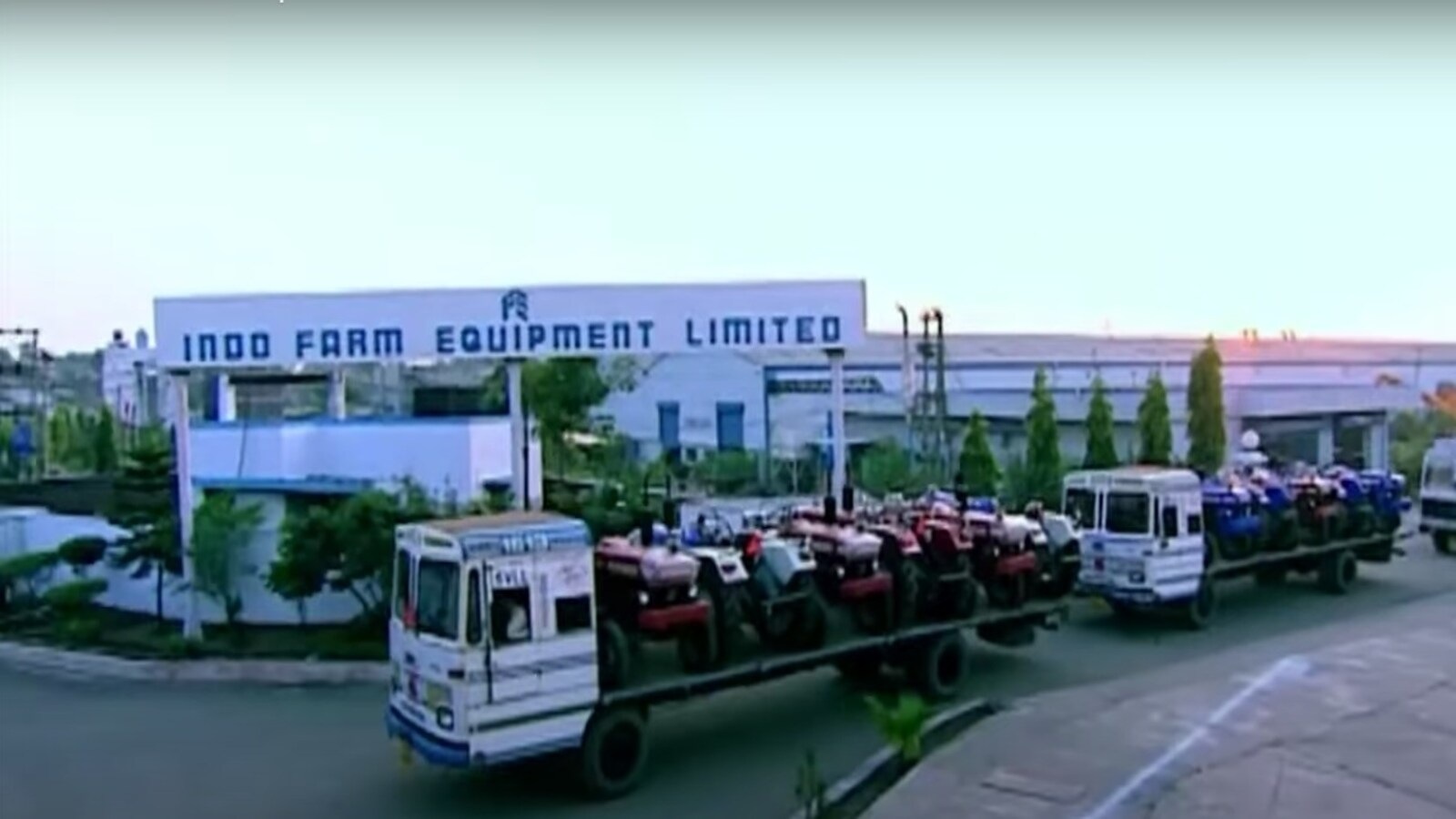
Indo Farm Equipment FY26: The IPO Glow Meets the Emissions Transition Gravity
Section 1 — At a Glance
The narrative of Indo Farm Equipment Limited in FY26 is a study in structural transformation colliding with regulatory headwinds. Fresh off its ₹260 crore public listing in January 2025, the company entered the financial year with an altered balance sheet and an ambitious blueprint to rapidly scale its footprint beyond its traditional strongholds. The capital infusion effectively rationalized its debt structure, lowering total borrowings and building a formidable cash and bank cushion that has radically altered its credit profile.
However, this newly acquired balance sheet strength had to absorb significant friction in the operational engine. The core pick-and-carry crane segment experienced severe domestic volume disruptions, caught in the industry-wide transition from older engine emission norms to advanced standards. This transition induced a sharp pre-buy peak in the preceding periods followed by a notable structural digestion phase, which temporarily stalled the company’s capital goods momentum and caused a contraction in overall operating profit margins.
Concurrently, the tractor segment was deployed as a high-velocity growth engine, heavily leaning on distribution-led expansion into new geographic zones and consuming substantial working capital. While headline revenues expanded by 13.64% to hit ₹440.02 crore, the underlying quality of capital efficiency signals that this aggressive growth phase is demanding heavier assets and structural under-pricing to capture market share.
Structural capital expansions funded via equity eliminate solvency risks, but they temporarily compress return ratios until incremental asset utilisation catches up with installed capacities.
The primary puzzle for investors now shifts from balance sheet survival to execution velocity: can the impending capacity step-up in cranes smoothly clear the market, or will the extended working capital cycles continue to trap the cash generated by the business?
Section 2 — Introduction
Indo Farm Equipment Limited, established in 1994, operates from its integrated engineering cluster in Baddi, Himachal Pradesh. Historically anchored as a prominent manufacturer of agricultural tractors and heavy-duty industrial pick-and-carry cranes, the company has positioned itself as an integrated player that sits precisely at the intersection of rural mechanisation and urban infrastructure creation.
The corporate architecture shifted dramatically in early 2025 following its initial public offering, which brought in ₹185 crore of fresh equity capital. Management has immediately put this cash to work, simultaneously deleveraging the parent company and injecting fresh capital into its wholly-owned financing subsidiary to orchestrate a closed-loop ecosystem where product sales are lubricated by in-house credit lines. As it attempts to transform from a regional Northern India player into a nationally distributed and export-capable industrial enterprise, its operating model is being tested across multiple fronts.
Section 3 — Business Model: WTF Do They Even Do?
To understand Indo Farm, you have to ignore the sleek corporate brochures and look at the heavy metal. The business split is nearly an even coin toss between fields and construction sites: as of the latest nine-month cycle, agricultural tractors pull in 49% of top-line revenue, while pick-and-carry cranes haul in 46%, with the remaining sliver managed by their captive financing arm.
They aren’t just assemblers slapping stickers on imported blocks. Operating out of a massive 65-acre site in Himachal Pradesh, Indo Farm runs a highly backward-integrated operation featuring a captive foundry and advanced CNC machine shops. This heavy infrastructure allows them to build their own engines and transmissions in-house, controlling 40% of a tractor’s value and over 65% of a crane’s cost structure.
The core strategy relies on a closed-loop capital goods loop: they manufacture the industrial asset, distribute it through an expanding dealer network, and then use their wholly-owned subsidiary, Barota Finance Limited, to extend credit to the end customer. It’s a beautifully designed system on paper—until a macro hiccup hits or inventory starts piling up in the backyard because the sales cycle stretches out over half a year.
Section 4 — Financials Overview
Figures are consolidated, in ₹ crore.
Metric
Latest Quarter (Mar 2026)
YoY
QoQ
Revenue
₹133.99 cr
+3.09%
+26.56%
EBITDA / Operating Profit
₹18.62 cr
+1.03%
+37.72%
PAT
₹8.72 cr
-35.46%
+56.91%
EPS
₹1.81
-35.59%
+56.03%
Note: Quarter-on-quarter and Year-on-year variations are derived directly from locked consolidated statements.
Did Management Walk the Talk?
In the preceding conference interactions, management leaned heavily into their distribution narrative, promising that an aggressive post-IPO dealer addition spree would insulate the top line from temporary industrial friction. They successfully delivered on the volume scaling of the tractor division, which surged by roughly 55% over the nine-month period to reach ~2,000 units.
However, they hit a hard wall on operating profitability. Management previously estimated full-year EBITDA margins would comfortably hold between 12.5% and 13%, but the final full-year consolidated operational performance printed a lower margin profile, squeezed by high introductory dealer incentives and a front-loaded opex expansion program.
The crane segment also faced structural bottlenecks, with volumes softening to 705 units as the market absorbed the severe pricing hikes stemming from the transition to newer engine standards. While the company did not experience a total structural breakdown, the earnings quality reveals that buying growth via distribution expansion yields a far thinner bottom line than initially projected.
Would you back a management team that scales tractor volumes by 55% while letting their consolidated quarterly net profit drop by over 35%?
Section 5 — Valuation Discussion: Fair Value Range Only
To determine where Indo Farm Equipment stands relative to its listed peers, we evaluate the business across its primary components using current market metrics. The company has 4.81 crore adjusted equity shares outstanding, which, against a current market price of ₹131.42, establishes a market capitalisation of ₹631.49 crore. For FY26, the reported net profit stands at ₹24.69 crore, yielding an unadjusted full-year EPS of ₹5.14.
Valuation Methods
P/E Multiple Method: The listed peer band for agricultural and commercial vehicle players exhibits a wide variance, anchored from lower-tier manufacturers at 10.2x to premium agri-machinery players like Escorts Kubota trading at 23.9x.