Global Pet Industries Mar 2026: The ₹17 Crore Plastic Expansion Waiting for a Spark
The micro-cap arena is usually divided into two distinct acts: companies that are starved of capital, and companies that are drowning in it while trying to figure out where to put the machinery. Global Pet Industries Ltd is firmly in the second camp. After fetching ₹13.23 crore via an IPO in July 2023 and stacking another ₹21.80 crore through a preferential allotment in late 2024, this small-scale manufacturer of plastic bottle-blowing machinery has successfully inflated its balance sheet. Yet, its operational output remains stubbornly modest relative to its financial size. With a current market capitalization of ₹185 crore and an annual revenue of just ₹55.57 crore for FY26, the company is valued like a high-growth industrial specialist while operating with the financial returns of a localized workshop.
The core tension at Global Pet centers on deployment speed. Out of the ₹21.80 crore raised via preferential shares to fund its expansion, ₹18.92 crore is still sitting unutilized in banking instruments or running through slow capital work-in-progress. Meanwhile, the company’s return profile has drifted sideways, with Return on Equity sitting at a muted 10.0% for FY26. Investors are currently paying a premium for a massive capacity expansion that has been structurally completed—exemplified by the receipt of its full occupancy certificate for a new 5,023.85 square meter manufacturing facility—but has yet to generate a single rupee of high-margin commercial topline. The financial machinery is fully built; the question is whether management can find enough buyers to keep it spinning.
Section 2 — Introduction
Global Pet Industries operates in the unglamorous but essential plumbing of the consumer goods world: making the machines that blow plastic preforms into the everyday PET bottles holding your mineral water, carbonated drinks, and liquid detergents. Incorporated in 2013 and listed on the NSE SME platform in mid-2023, the company has spent the last decade scaling up from basic pneumatic machines to high-speed fully electrical servo systems.
Operating primarily from its manufacturing hubs in Vasai and Palghar, Maharashtra, the business relies on a simple premise: as regional beverage and consumer care brands sprout across India, they prefer buying local, serviceable machinery over expensive European or Chinese imports. The company has carved out a stable domestic footprint across 19 states while maintaining an export pipeline to 19 countries. However, transitioning from a family-led regional engineering outfit into a highly scalable, public-market-ready corporate enterprise is proving to be a jagged journey filled with capital calls and operational friction.
Section 3 — Business Model: WTF Do They Even Do?
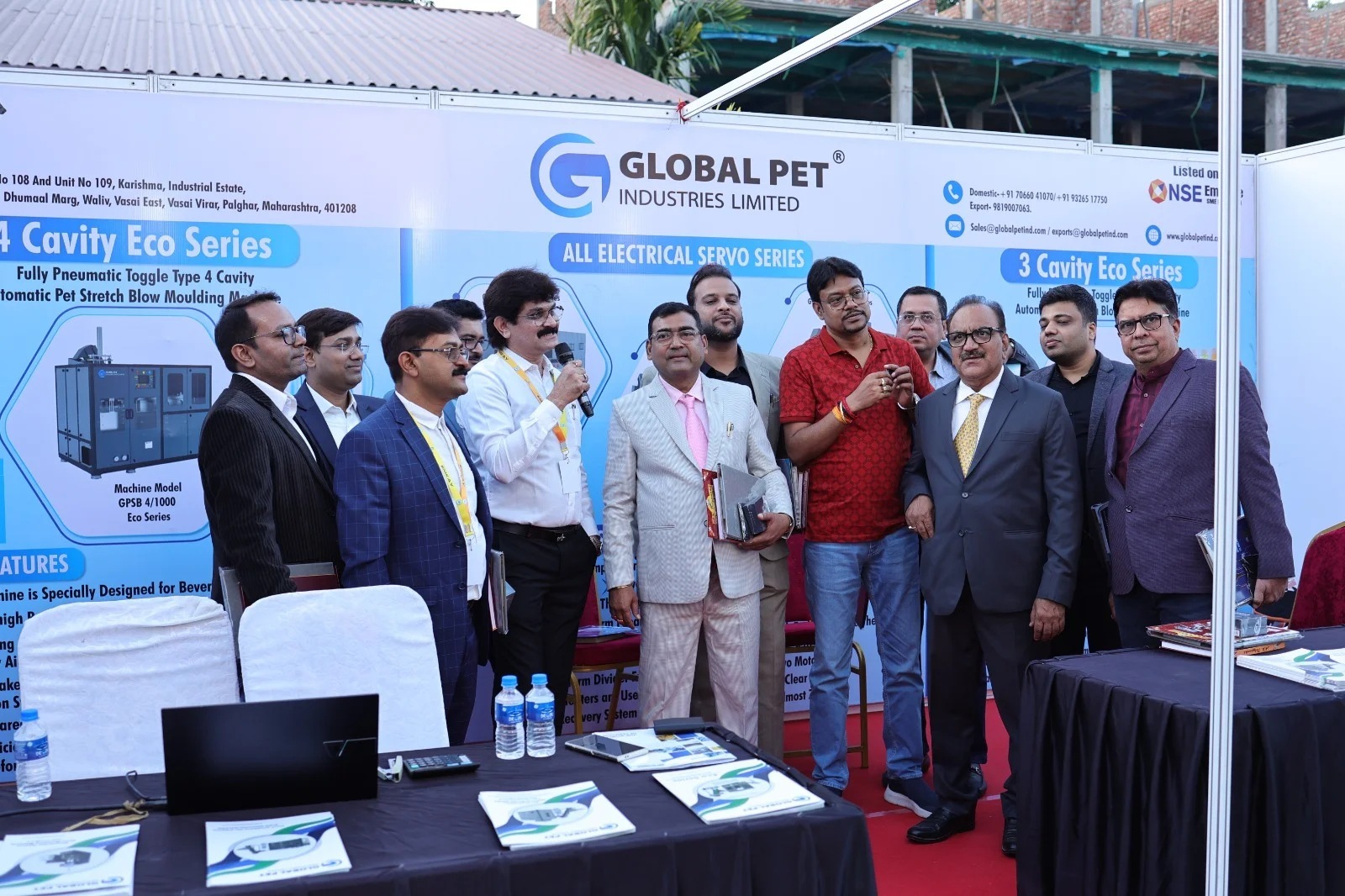
To understand Global Pet, you have to look past the financial line items and peer directly into the factory floor, where steel frames are mashed together with electrical servo motors to build “Stretch Blow Moulding Machines.” The product catalog reads like an escalating menu of industrial speed options. At the bottom sits the “Eco Series”—fully pneumatic, toggle-type contraptions that crank out a modest 2,400 to 3,600 bottles per hour. These are the entry-level tools sold to local regional packers who need basic functionality without complex electronics.
At the premium end, the company builds its “All Electrical Servo Series.” These machines are the real product flex, utilizing single servo motors to synchronize everything from preform transfer to rinsing, filling, and labelling at an aggressive clip of 7,200 to 10,500 bottles per hour.
The revenue model is strictly transactional: they build a machine, ship it, collect the cash, and occasionally sell spare parts. Geographically, domestic buyers anchor the business, accounting for 73% of FY24 revenue, while a scattering of exports across developing markets in Africa and the Middle East makes up the remaining 27%. It is a classic capital goods model: when the consumer market is booming, beverage brands order more machines; when the economy cools down, Global Pet’s order pipeline turns into a dry desert.
Section 4 — Financials Overview
Figures are standalone, in ₹ crore.
Metric
Latest Half (Mar 2026)
YoY (Same Half)
Previous Half (Sep 2025)
Revenue
33.29
22.95%
22.29
EBITDA / Operating Profit
6.16
54.77%
-0.81
PAT
5.35
42.67%
-0.05
EPS (in ₹)
4.54
18.54%
-0.04
The sequential jump from the September 2025 half-year to the March 2026 half-year looks spectacular on paper, swinging from a net loss of ₹0.05 crore to a net profit of ₹5.35 crore. But don’t break out the celebratory champagne just yet. In the capital goods universe, the second half of the fiscal year is traditionally loaded with client dispatches and final billing handovers, making sequential half-year comparisons look wildly dramatic by design.
A cleaner perspective comes from the year-on-year expansion, where a 22.95% topline acceleration in the latest half was met with an impressive operational recovery, pushing operating margins to 18.50% for the six-month period.
Because Global Pet is a small-cap engineering business that does not host elaborate investor conference calls, there is no formal concall transcript or management forward-guidance script to dissect. Instead, management communicates through direct regulatory disclosures. In their latest operational review, they noted that machine production volume for the full year climbed to 182 finished units, up 23.6% from 163 units in the prior fiscal year. The physical factory is working harder, even if the corporate cash registers are still waiting on the final bill clearings.
Section 5 — Valuation Discussion: Fair Value Range Only
To evaluate Global Pet’s valuation framework, we first establish its baseline performance metrics for the full financial year ended March 31, 2026. With an audited full-year Net Profit of ₹5.30 crore and a weighted average share capital base represented by 1.18 crore adjusted equity shares, the full-year Reported EPS lands at ₹4.50. The company’s Current Market Price (CMP) stands at ₹156.95.
To project a reasonable P/E-based fair value band, we look at the broader industrial engineering peer landscape. While elite tier-1 automation giants trade at astronomical multiples above 60x, regional capital equipment manufacturers typically settle into a mature peer P/E band of 22x to 30x. Multiplying our baseline FY26 EPS of